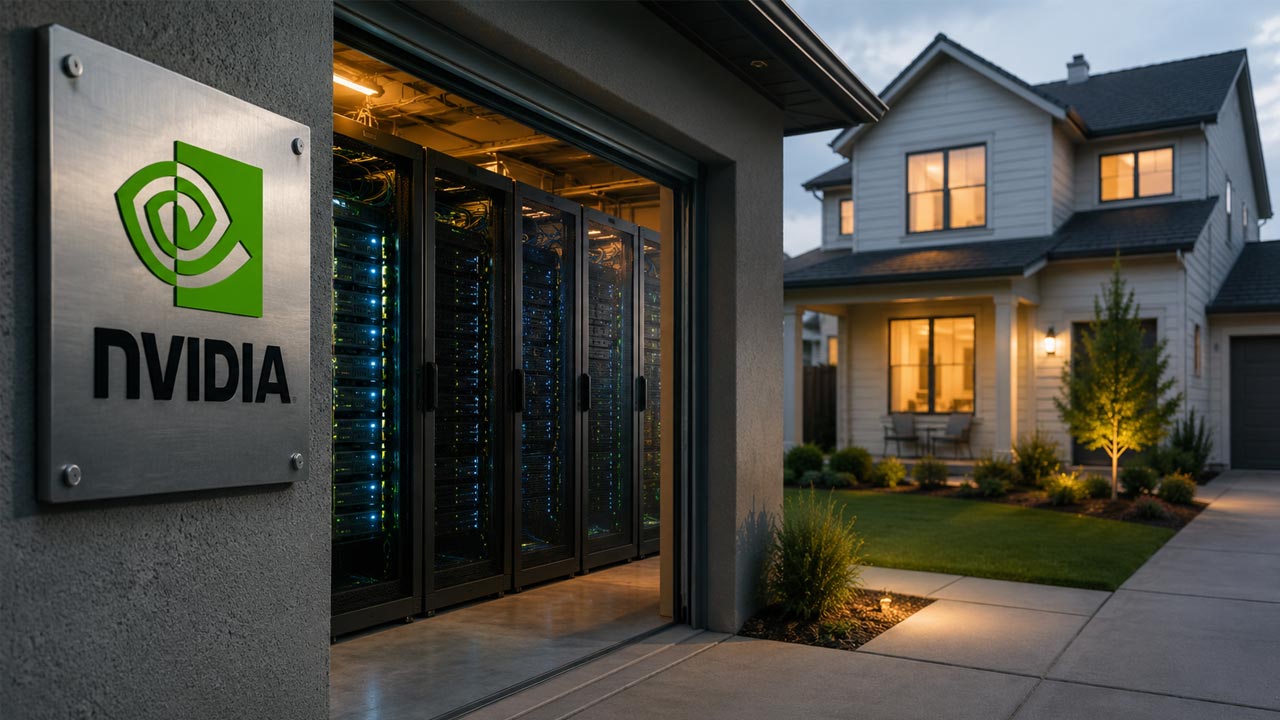
As demand for Artificial Intelligence (AI) infrastructure continues to surge, a NVIDIA-backed startup is testing an unconventional approach to expand computing capacity.
The proposal is to place small-scale AI data centres at residential properties and pay homeowners for the space.
The company, called Parasail, is reportedly offering eligible homeowners and businesses up to $22,000 annually to host compact AI server units. The move comes as technology firms face growing pressure to secure computing power while dealing with rising land, energy and construction costs associated with traditional data centres.
Also Read: Fire at Data Centre Disrupts Google Cloud Services in Delhi, Mumbai and Chennai
Turning Homes Into a Part of an AI Infrastructure Network
Rather than building large facilities, Parasail’s model distributes AI computing equipment across multiple locations.
Participants are supposed to provide space and power access, while the company installs and manages the hardware remotely.
According to reports, the systems are housed in secure outdoor units and designed to operate independently, with homeowners not having to manage the equipment.
In return, the hosts will receive recurring payments in accordance with the agreement and site requirements.
The concept stands out as an innovation trend within the AI industry. Companies are exploring alternative ways to expand infrastructure quickly as demand for graphics processing units (GPUs) and AI training capacity continues to grow.
Also Read: China Plans $295 Billion AI Data Centre Expansion to Challenge US Tech Dominance
AI Companies Are Looking Beyond Traditional Data Centres, But Why?
The rapid rise of generative AI tools has triggered an unprecedented race for computing resources. Large data centre projects often take years to build and require significant investments in land, cooling systems and power infrastructure.
Distributed computing models offer a shortcut. By placing smaller clusters of AI servers closer to available power sources and unused spaces, companies plan to use capacity more quickly and reduce development costs.
Some experts argue that the approach can help address growing infrastructure bottlenecks.
However, questions remain around power consumption, local regulations, noise management and the long-term viability of residential hosting arrangements.
Also Read: China Launches Offshore Underwater AI Data Centre Near Shanghai in Push for Green Computing
Data Centre Gaining New Direction
The breakthrough highlights how the AI boom is reshaping infrastructure strategies across the technology sector.
The demand for computing power continues to outpace supply. Companies are increasingly experimenting with decentralised models that move beyond conventional data centre campuses.
Whether residential AI hosting will become a mainstream solution remains uncertain, but the programme signals how aggressively the industry is seeking new ways to support the next phase of AI growth.
The development underscores a growing reality for the technology sector: future AI expansion may depend as much on access to power and physical space as it does on advances in software and chips.

Samarjit Kaur is a journalist and communications professional covering technology & emerging digital trends. With a focus on clarity and context, she reports on developments shaping industries and governance. When not reporting, she chooses to plug-in and relax on her playlists and plan her next bucket-list trips!