Singapore has unveiled a biological data centre prototype that houses living human neurons in a server rack environment. The move could open a new route for artificial intelligence (AI) computing beyond conventional silicon.
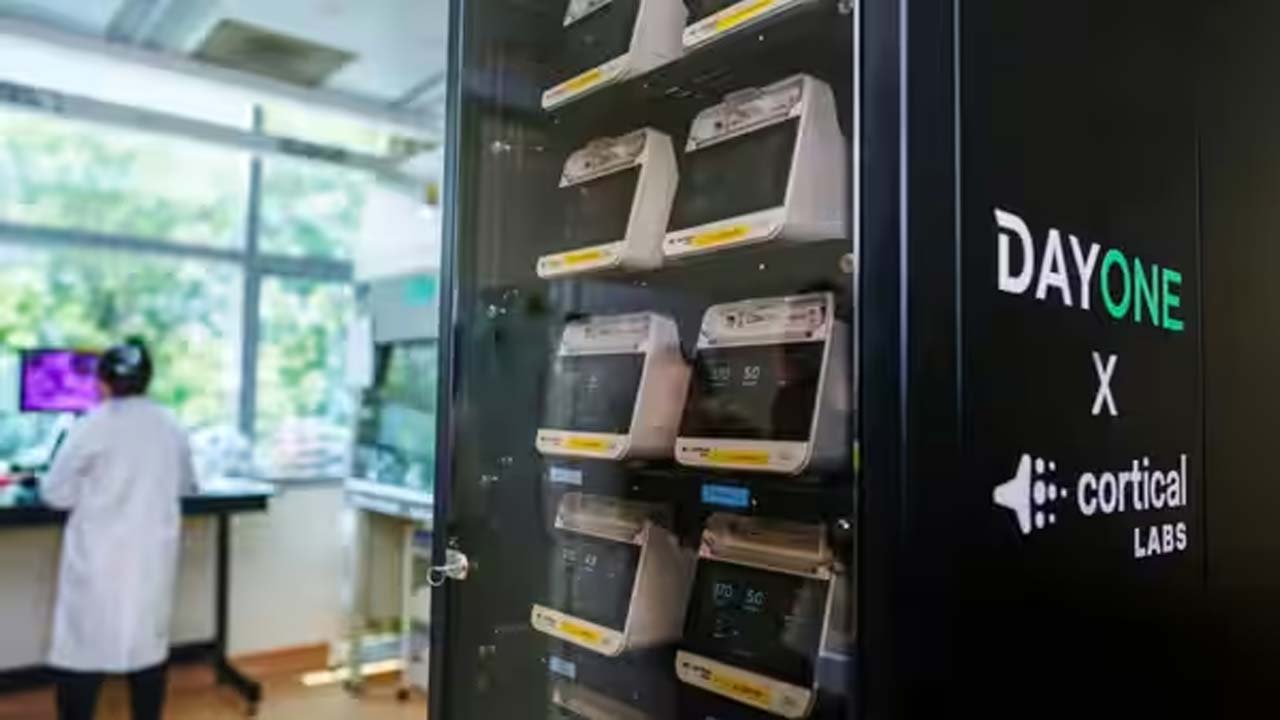
Developed by the Yong Loo Lin School of Medicine at the National University of Singapore (NUS Medicine), data-centre operator DayOne and Melbourne-based Cortical Labs, the prototype uses 20 CL1 biological computing units, with an estimated 16 million lab-grown human neurons across the rack.
Also Read: Great Nicobar May Host Green AI Data Centre Amid ₹92,000 Cr Infra Push
20 Computers, Millions of Living Neurons
The prototype is housed at the NUS Life Sciences Institute. Each CL1 combines lab-grown human neurons with silicon hardware. The widely cited 16 million figure is calculated by multiplying about 800,000 neurons per CL1 across 20 units. NUS has further confirmed the 20-unit deployment but has not independently published a total neuron count for the rack.
NUS provides the neuroscience expertise and oversees the cultivation and maintenance of the cells. DayOne brings data-centre infrastructure expertise, while Cortical Labs supplies the biological computing technology.
The system was demonstrated on August 6, with more than 80 guests from the academia, technology, and digital infrastructure sectors attending demonstrations of the CL1, Cortical Cloud system, and real-time neural activity. NUS describes it as the world’s first independently operated biologically integrated server rack.
Also Read: Samsung Plans Floating AI Data Centres on Ships as Demand for Computing Power Surges
How Human Neurons are Being Used for AI
The neurons are grown from stem cells and placed on silicon platforms fitted with tiny electrodes. These electrodes send electrical signals to the cells and record their responses. Cortical Labs’ software allows researchers to interact with the neural networks in real time.
The approach builds on the company’s earlier DishBrain experiment, in which about 800,000 human and mouse neurons were connected to a chip and trained to play Pong.
The attraction is energy efficiency. Biological neural networks can potentially perform certain tasks using far less power than conventional digital systems. Researchers are exploring applications including AI, drug discovery, biomedical research, robotics, cybersecurity and fraud detection.
Also Read: Google Pledges to Replenish More Water Than It Uses for AI Data Centres
What this Means for Data Centres?
The Singapore installation remains a proof of concept, not a replacement for GPU-based AI infrastructure. Its energy and performance advantages at commercial scale have yet to be independently demonstrated. The biological systems also require controlled conditions and ongoing maintenance.
NUS and its partners plan to move from the validation stage towards a larger Biological Data Centre in Singapore. For the data-centre industry, the immediate question is no longer whether biology can compute, but whether it can do so reliably, economically and at scale.
The next test will be practical: whether living neurons can move from an intriguing laboratory platform to dependable infrastructure alongside silicon-based AI systems.

Samarjit Kaur is a journalist and communications professional covering technology & emerging digital trends. With a focus on clarity and context, she reports on developments shaping industries and governance. When not reporting, she chooses to plug-in and relax on her playlists and plan her next bucket-list trips!