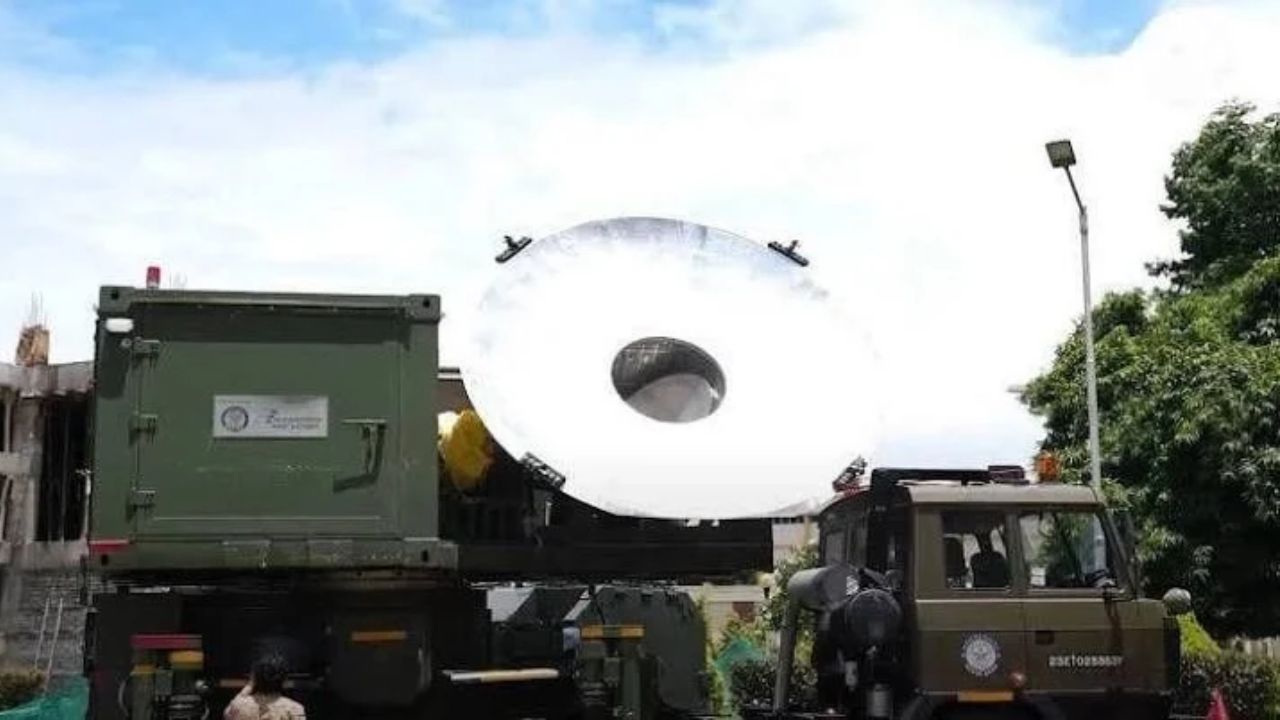
The Defence Research and Development Organisation (DRDO) has issued a Request for Proposal (RFP) for SHIELD, an S-band High-Power Microwave Integrated Evaluation System designed to assess how high-power microwave radiation affects electronic systems.
The project is being developed under the Technology Development Fund (TDF), which supports indigenous defence technologies and industry-led development. DRDO has increasingly used the TDF route for projects involving advanced electronic warfare, RF and microwave technologies.
What is DRDO’s SHIELD system?
SHIELD is planned as a dedicated test and evaluation platform for studying the effects of S-band high-power microwave radiation on electronic equipment.
Rather than being an operational weapon system, the proposed platform is intended to help researchers understand how different electronic systems behave when exposed to intense electromagnetic energy. The results could help identify vulnerabilities, establish survivability benchmarks and support the development of protective measures.
According to the project details, SHIELD will have a modular and scalable architecture, allowing it to be adapted for different testing requirements. The proposed system is expected to generate a far-field electric field strength of at least 3 kV/m. It will also support pulsed operation with flexible duty cycles, allowing researchers to test electronic equipment under different exposure conditions.
How will SHIELD use high-power microwave technology?
A key part of SHIELD will be its use of Gallium Nitride-based Solid State Power Amplifiers, or GaN SSPAs. GaN is increasingly used in high-frequency and high-power electronics because it combines high efficiency, power density and thermal performance. These characteristics are particularly useful when a system needs to deliver significant RF power without becoming excessively large or difficult to cool.
Read More | DRDO completes Quantum Key Distribution trials, strengthens India’s quantum cybersecurity ambitions
DRDO has already been developing indigenous GaN-based technologies for microwave applications. Its work includes GaN HEMT devices and S-band power-amplifier technologies, including devices developed for frequencies around 3.1–3.5 GHz. For SHIELD, GaN-based amplification is expected to help generate the high-power microwave signals required for controlled testing.
Why is SHIELD important for electronic warfare?
Modern military platforms depend heavily on electronics. Communication systems, sensors, navigation equipment and command-and-control systems can all influence how effectively a military unit operates. High-power microwave systems can affect electronics through intense electromagnetic energy. Understanding exactly how equipment responds to such exposure is therefore important for both offensive and defensive applications.
SHIELD could give defence researchers a controlled environment to measure these effects. Such testing could help determine which systems are more vulnerable, what level of exposure causes degradation and how electronic equipment can be made more resilient. The information could eventually contribute to the development of electromagnetic protection and countermeasure technologies.
SHIELD could be mounted on drones
One of the more notable features of the proposed system is its drone-mountable configuration. A compact high-power microwave evaluation system that can be carried by an unmanned platform could give researchers greater flexibility during airborne testing and demonstrations. It also reflects the growing overlap between unmanned systems, electronic warfare and directed-energy technologies.
Read More | DRDO Transfers Critical Cooling Technologies to BHEL, Advancing AMCA Fighter Jet Production
However, the current SHIELD proposal should not be confused with a fully operational drone-based directed-energy weapon. The RFP concerns an evaluation system intended for research, testing and assessment.
Why is thermal management important?
Generating high levels of microwave power produces substantial heat. Managing that heat is therefore a major engineering challenge for systems such as SHIELD. The proposed platform includes thermal-management measures aimed at maintaining reliable operation. This becomes particularly important when the system is expected to operate for extended periods or from a relatively compact platform.
Read More | DRDO Hands Over AI-Powered ‘Prajna’ System, Boosting Internal Security of India
The combination of GaN power amplifiers, pulsed operation and thermal management is intended to provide the performance and flexibility needed for high-power microwave testing.
SHIELD and India’s indigenous defence technology push
The project also has an industrial dimension. Since SHIELD is being pursued through the Technology Development Fund, Indian companies and start-ups could participate in developing the required technologies and integrating them into a working system.
Read More | India’s Smart Border: How Will the New High-Tech Security Grid Work?
The TDF scheme is designed to support the development of indigenous defence technologies and encourage participation from India’s domestic industrial ecosystem. DRDO has previously used the programme for projects spanning electronic warfare, communications and other specialised defence technologies.
For SHIELD, building domestic expertise in high-power microwave generation, GaN electronics, thermal management and electromagnetic testing could help strengthen India’s capabilities in a specialised area of defence technology.

Indrani Priyadarshini is a journalist and editorial professional specialising in technology, artificial intelligence, smart cities, green energy, and digital transformation. With over four years of experience in tech journalism and digital media, she is known for turning complex industry developments into clear, engaging, and insightful stories. Her expertise spans reporting, editorial strategy, digital publishing workflows, and in-depth coverage of emerging technologies shaping the future.