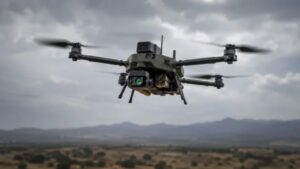
Apollyon Dynamics, a Hyderabad based defence technology startup, has tested its flagship unmanned aerial vehicle (UAV), Nightshade ADX-1, from a moving vehicle, with the aircraft reaching 350 km/h at 50% throttle.
The company said the initial vehicle-mounted launches were carried out under controlled conditions and with the required safety measures in place. The test is an important step in the development of the ADX-1, which Apollyon is working on as a high-speed UAV for operations in contested airspace.
Nightshade ADX-1 undergoes vehicle launch test
The latest test involved launching the Nightshade ADX-1 from a vehicle-mounted platform while the vehicle was in motion. According to Apollyon Dynamics, the UAV reached a speed of 350 km/h while operating at 50% throttle.
Read More | DRDO Develops SHIELD to Test Impact of S-Band High-Power Microwaves on Electronics
The company has described the tests as part of the early development and validation of the platform. The launches were conducted under controlled conditions, with safety protocols followed during the trials. The 350 km/h figure is significant for a UAV at this stage of testing, although it is not the final speed the company is targeting for the platform.
What is the Nightshade ADX-1?
The Nightshade ADX-1 is being developed as a high-speed UAV rather than a conventional drone designed mainly for surveillance or logistics. Apollyon has positioned the aircraft for use in contested airspace. Reports about the platform have also highlighted capabilities such as detecting radar emissions and tracking maritime activity.
The company is working towards a faster configuration of the aircraft. Earlier reports have indicated that its eventual target speed could be considerably higher than the 350 km/h recorded during the latest test. The platform is expected to use a jet-powered configuration as development progresses.
Read More | ISRO’s ‘Bahubali’ Rocket Draws L&T, Adani, JSW Interest: Who Is Eyeing the LVM3 Technology?
From a hostel room to defence technology
Apollyon Dynamics was founded in May 2025 by Jayant Khatri and Sourya Choudhury, who were BTech students associated with the BITS Pilani Hyderabad Campus at the time. The company’s early work reportedly began in a hostel room, where the founders developed and tested their first drones. It then moved towards field testing and demonstrations within a relatively short period.
The startup has since worked on drone systems for defence applications and has also developed a Mobile Drone Lab. The facility is intended to take drone manufacturing, repair and customisation capabilities closer to operational locations. The Nightshade ADX-1 is the company’s move into a more demanding segment of the UAV market, where speed and operational capability are central to the design.
Read More | AssamSAT: Assam moves closer to India’s first state-owned Earth observation system
Apollyon raises Rs 4 crore in pre-seed funding
The company’s development has also received backing from investors and executives from India’s growing space technology sector. In May 2026, Apollyon Dynamics announced a Rs 4 crore pre-seed funding round. The round included participation from founders and executives associated with companies such as Skyroot Aerospace, Dhruva Space and Agnikul Cosmos.
The funding is expected to support the startup’s continued work across its defence and aerospace technology programmes. For Apollyon, the Nightshade ADX-1 is now moving from early development towards more advanced testing. The latest 350 km/h trial provides an early indication of the platform’s performance, while the company continues to work towards its higher-speed target.

Indrani Priyadarshini is a journalist and editorial professional specialising in technology, artificial intelligence, smart cities, green energy, and digital transformation. With over four years of experience in tech journalism and digital media, she is known for turning complex industry developments into clear, engaging, and insightful stories. Her expertise spans reporting, editorial strategy, digital publishing workflows, and in-depth coverage of emerging technologies shaping the future.