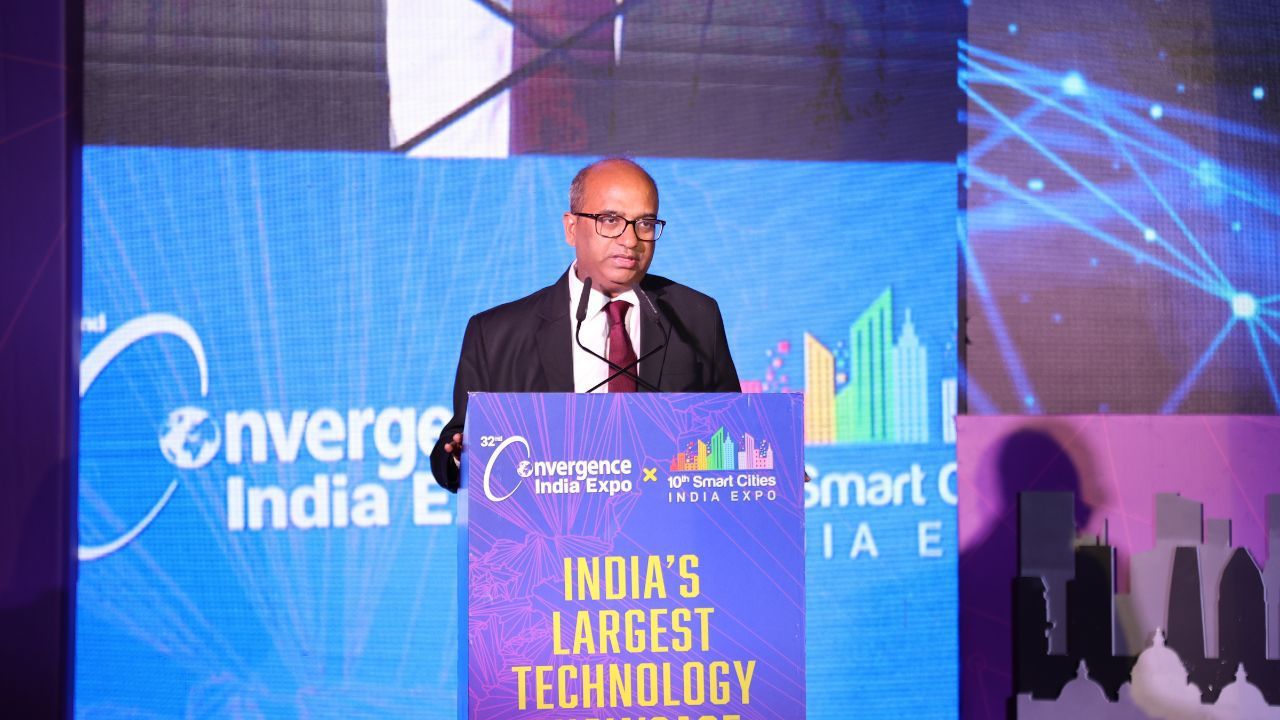
India will need to significantly expand its graphics processing unit (GPU) capacity as artificial intelligence adoption grows to millions of users, according to Abhishek Singh, Additional Secretary at the Ministry of Electronics and Information Technology (MeitY). Speaking at the Rising Bharat Summit, Singh outlined the country’s plans to strengthen its computing infrastructure through a mix of public funding and private sector participation.
During the discussion, Singh noted that India currently has around 62,000 GPUs, which were sufficient for training the first set of AI models developed in the country. However, he emphasised that this capacity will need to grow rapidly as AI-powered services become widely used.
Read More | Convergence India 2026: Where India’s Next Techade Takes Shape
“Sixty-two thousand GPUs were adequate for training the initial models,” Singh said. “But considering the size of the country, if 10–20 crore people begin using these services for different purposes, we will need to significantly upgrade the backend infrastructure. A minimum of 100,000 to 200,000 GPUs will be required to meet India’s demand.”
To support this expansion, the government is working on a policy framework aimed at encouraging private investment in large-scale computing infrastructure. Singh explained that the initiative will rely on a collaborative model where private players contribute GPU capacity, supported by government incentives designed to strengthen the broader AI ecosystem.
Read More | How Close Are We Really to Living With Humanoid Robots?
“We are preparing a policy that will incentivise the private sector to invest in computing infrastructure,” he said. “A portion of the GPU capacity will come from private companies, supported by government incentives to build the larger AI ecosystem.”
The proposed approach reflects a hybrid model in which government-backed incentives are expected to attract private capital for building the hardware backbone required for large-scale AI deployment.
Read More | Behind Every AI Prompt Lies a Water Bill—Who’s Paying It?
Singh also highlighted that the government plans to directly support AI inferencing across several key public sectors. Applications powered by AI are expected to be deployed in areas such as agriculture, education, and healthcare, with the government funding many of these initiatives.
“Inferencing in applications across key public sectors—such as agriculture, education, and healthcare—will be supported by government funding in multiple ways,” Singh said. As India accelerates its AI ambitions, expanding compute infrastructure is emerging as a critical priority, with both public investment and private participation expected to play a central role in scaling the country’s AI capabilities.

Indrani Priyadarshini is a journalist and editorial professional specialising in technology, artificial intelligence, smart cities, green energy, and digital transformation. With over four years of experience in tech journalism and digital media, she is known for turning complex industry developments into clear, engaging, and insightful stories. Her expertise spans reporting, editorial strategy, digital publishing workflows, and in-depth coverage of emerging technologies shaping the future.