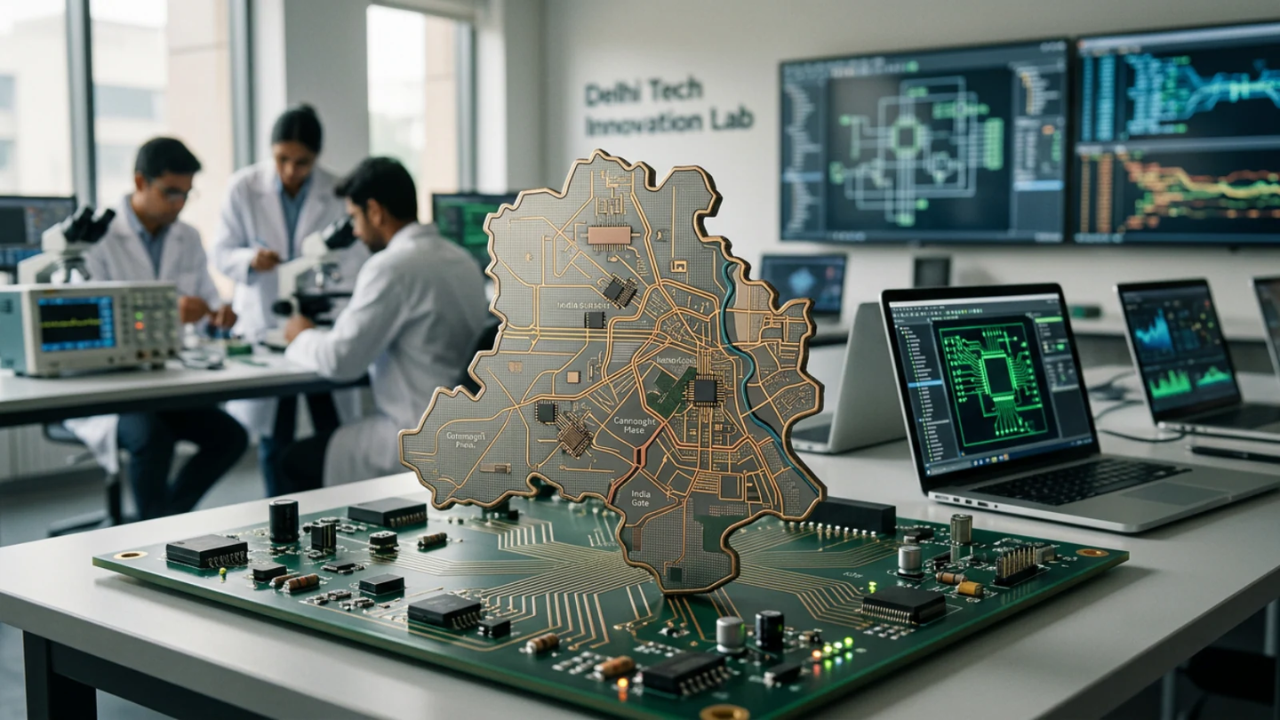
Delhi has initiated work on a dedicated semiconductor policy, with early discussions indicating a focus on chip design, research and innovation rather than fabrication.
The move is part of India’s plan to scale up semiconductor ambitions under central programmes and seeks to build a full-stack ecosystem. For Delhi, the policy is less about competing with manufacturing-heavy states and more about positioning itself as a high-value design and R&D hub.
Why Delhi Is Taking the Design Route?
Do you wonder why the semiconductor policy aims to position Delhi as a hub for chip design, research and advanced packaging? Here’s our breakdown:
Physical and economic constraints
Semiconductor fabrication requires large, contiguous land parcels, a stable electricity supply and ample water.
Delhi’s urban density and resource constraints make such investments unviable at scale. Industry estimates suggest a single fabrication unit can require billions of dollars in capital and extensive utility support.
Given these realities, Delhi’s policy direction is expected to prioritise fabless semiconductor design, embedded systems and advanced electronics R&D. These segments are less capital-intensive and rely more on skilled human resources.
NCR’s existing ecosystem advantage
Delhi-NCR already hosts a base of telecom companies, electronics design firms and engineering talent.
Institutions such as IIT Delhi and other technical universities provide a steady pipeline of talent. The region is also close to Noida’s electronics manufacturing clusters, creating a natural link between design and downstream production.
Also Read: Delhi Bets on Chip Design Over Fab Plants in New Semiconductor Push
What the Draft Policy Is Expected to Cover
Incentives for semiconductor design and startups
Officials involved in early consultations have indicated that the policy may include targeted incentives for fabless semiconductor firms. These are likely to include:
- Partial reimbursement for Electronic Design Automation (EDA) tools, which are critical but expensive
- Financial support for chip prototyping and testing
- Capital subsidies or seed funding support for early-stage startups
- Access to shared infrastructure, such as design labs
These measures are intended to reduce entry barriers in a sector where upfront costs can deter new firms.
Building a design talent pipeline
An important pillar of the policy is expected to be workforce development. India faces a gap in semiconductor-specific skills despite producing a large number of engineers annually. The Delhi policy is likely to propose:
- Curriculum upgrades in universities to include chip design and Very Large Scale Integration (VLSI) training
- Industry-led certification programmes
- Internship pipelines with semiconductor firms
This aligns with the broader national focus on skilling under the semiconductor mission.
Creation of R&D and innovation clusters
The government is exploring the possibility of dedicated semiconductor research clusters. These would aim to bring together:
- Academic institutions
- Startups
- Established industry players
Such clusters can serve as shared ecosystems where smaller firms gain access to tools, mentorship and collaboration opportunities without incurring significant capital investment.
Also Read: ₹1.2 lakh crore: India Braces for Massive Boost in Semiconductor & Chip Manufacturing Ecosystem
Alignment With Central Semiconductor Programmes
Delhi’s policy is not being designed in isolation. It is expected to integrate with central schemes already in place.
India Semiconductor Mission (ISM) 2.0
ISM 2.0 will focus on producing semiconductor equipment and materials in India, designing full-stack Indian semiconductor intellectual property, and fortifying both domestic and global supply chains. A provision of Rs. 1,000 crore has been made for ISM 2.0 for FY 2026–27, with a strong emphasis on industry-led research and training centres to drive technology development and create a future-ready skilled workforce. It acts as the umbrella framework for India’s semiconductor push.
Design Linked Incentive (DLI) Scheme
The Design Linked Incentive scheme focuses specifically on semiconductor design. It offers financial incentives and infrastructure support to domestic chip design companies. Delhi’s policy is expected to build on this by offering state-level top-ups and easier access to infrastructure.
Production Linked Incentive (PLI) for Electronics
While not directly targeted at semiconductors, the Production Linked Incentive (PLI) Scheme, with an incentive outlay of ₹1.91 lakh crore, represents a strategic reform initiative aimed at strengthening India’s manufacturing base. It increases chip demand by boosting domestic production of devices such as mobile phones and IT hardware.
Delhi’s role in this framework is likely to be upstream, anchoring design capabilities while other states handle fabrication and assembly.
Also Read: Breaking | Union Budget 2026 Live: ₹40,000 Crore Semiconductor Mission 2.0 Announced
What It Means for Delhi’s Economy?
“The policy will generate high-quality job opportunities in areas like chip design, semiconductor research and advanced packaging. It aims to promote skill development through targeted training programmes, internships and industry-academia partnerships.”
-Rekha Gupta, Chief Minister of Delhi
With the massive move, here is what Delhi earns:
Moving up the value chain
Services and platform-based businesses have largely dominated Delhi’s startup ecosystem. A semiconductor design focus can shift the ecosystem toward deep-tech innovation, where value addition and intellectual property creation are higher.
High-skill job creation
The semiconductor design ecosystem generates specialised roles, including:
- Integrated circuit (IC) designers
- Verification engineers
- Firmware and embedded systems developers
These roles typically command higher salaries and contribute to a more knowledge-driven economy.
Attracting global design centres
Global semiconductor companies often establish design centres before committing to manufacturing investments. A clear and stable policy framework can make Delhi-NCR an attractive destination for such centres.
Key Challenges That Will Shape Outcomes
Here are some challenges that Delhi might face on its new journey:
- Talent availability and quality: While Delhi has access to engineering talent, semiconductor design requires niche expertise. Without targeted training and industry exposure, the talent gap could slow progress.
- Competition from established hubs: Cities like Bengaluru and Hyderabad already host mature semiconductor design ecosystems with global firms and established supply chains. Delhi will need to differentiate through policy incentives and ease of doing business.
- Execution and policy clarity: The effectiveness of the policy will depend on how quickly it is implemented and how clearly guidelines are defined. Delays in disbursement or lack of coordination between agencies could limit impact.
Also Read: ISM 2.0: India Advances Semiconductor Ambitions with Qualcomm 2nm Chip Unveil
How the Centre Can Support Delhi’s Strategy?
With Delhi signing up for a new semiconductor plan, here’s how the central government can back the state on its plans.
Scaling design-focused incentives
The central government can expand the scope and accessibility of the Design Linked Incentive scheme. Faster approvals and broader eligibility criteria can help more startups participate.
Investing in shared infrastructure
EDA tools, access to fabrication facilities for prototypes, and testing facilities are expensive. Central support for shared infrastructure can significantly reduce costs for startups and academic institutions.
Strengthening academia-industry collaboration
National-level initiatives can encourage partnerships between universities and semiconductor firms. This can include joint research programmes, faculty exchange, and co-funded labs.
Ensuring policy coordination across states
A fragmented approach can slow ecosystem development. Coordination between the states and the Centre can ensure that the design, fabrication, and assembly segments develop in a complementary manner.
Also Read: India Reshapes Semiconductor Mission 2.0, Shifts Focus to Memory Chip Manufacturing
The Road Ahead
Delhi’s semiconductor policy is still under discussion, but its direction reflects a pragmatic assessment of the city’s strengths and limitations. By focusing on chip design and R&D, Delhi can play a defined role in India’s semiconductor value chain.
The success of this approach will depend on execution, talent development, and alignment with central initiatives. Semiconductor ecosystems evolve over long timelines. If backed by consistent policy support, Delhi’s design-led strategy can become a critical layer in India’s broader semiconductor ambitions.

Samarjit Kaur is a journalist and communications professional covering technology & emerging digital trends. With a focus on clarity and context, she reports on developments shaping industries and governance. When not reporting, she chooses to plug-in and relax on her playlists and plan her next bucket-list trips!