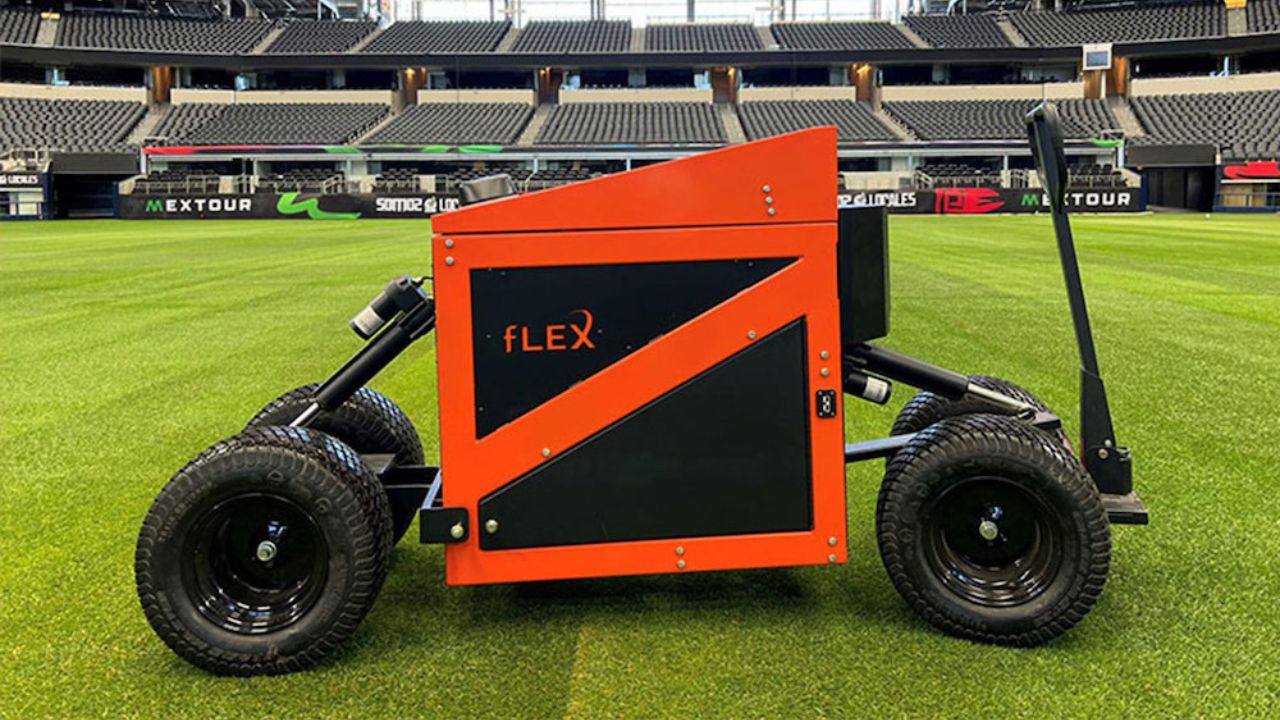
A football pitch can influence everything from the speed of play to a player’s ability to change direction safely. For the FIFA World Cup 2026, ensuring consistent playing conditions across 16 stadiums became a major priority. Instead of relying only on manual inspections, turf experts turned to an unusual assistant—a specialised robot equipped with a 3D-printed foot.
Read More | FIFA World Cup 2026 Semi-Final: What AI Models and Opta Supercomputer Predict About England vs Argentina
Known as fLEX, the robot was developed by researchers at the University of Tennessee to evaluate football pitches with a level of consistency that would be difficult to achieve through human testing alone. Recreating the movements of an athlete, it provides detailed insights into how the surface performs under real match conditions. The robot uses a 3D-printed foot fitted with an actual football boot and is designed to simulate the movements of a player weighing around 165 pounds (75 kilograms). As it strikes and pushes against the turf, high-precision sensors inside the boot measure the forces generated between the studs and the grass. These readings help determine whether the surface offers the right balance of grip, stability, and consistency for professional football.
During testing, the fLEX robot examined 77 different locations across each pitch in approximately 40 minutes. The system collected detailed data from high-traffic areas that typically experience the most wear during matches. Because every movement is repeated with the same force and angle, the results remain consistent across all stadiums, making it easier to compare playing surfaces and identify areas requiring maintenance.
Read More | Inside FIFA World Cup 2026: The Technology, Data and Digital Records Powering Football’s Biggest Event
The robot was used to evaluate pitches at all 16 FIFA World Cup 2026 venues before the tournament. The information gathered allowed turf managers to detect uneven sections, monitor grass quality, and make improvements before teams took to the field. The approach also eliminated the need for players to participate in repeated field testing while providing more reliable performance data.
One of the biggest advantages of the fLEX robot is its ability to measure factors that directly affect player safety. Grip levels that are too low can increase the risk of slipping, while surfaces that are too firm or inconsistent can contribute to injuries during sudden turns or acceleration. By analysing these conditions before matches, stadium grounds teams can make adjustments that help create safer and more predictable playing surfaces.
As football tournaments continue to embrace technology beyond video refereeing and performance analytics, innovations like the fLEX robot show how engineering is also improving the game behind the scenes. While fans may never notice its work, the robot played an important role in preparing the pitches that hosted some of the world’s biggest football matches, ensuring players competed on surfaces designed to deliver consistency, fairness, and safety.

Indrani Priyadarshini is a journalist and editorial professional specialising in technology, artificial intelligence, smart cities, green energy, and digital transformation. With over four years of experience in tech journalism and digital media, she is known for turning complex industry developments into clear, engaging, and insightful stories. Her expertise spans reporting, editorial strategy, digital publishing workflows, and in-depth coverage of emerging technologies shaping the future.