
OpenAI’s GPT-X marks the latest leap in generative artificial intelligence (AI), offering stronger reasoning, faster responses and better multimodal capabilities.
For Indian startups, the technology could lower development costs, speed up product launches and create entirely new business models. Here’s what founders, developers and investors need to know.
OpenAI unveiled GPT-X as its newest flagship AI model, introducing significant improvements in reasoning, coding, multimodal understanding and autonomous task execution. Released in 2026 and made available through ChatGPT and developer APIs, GPT-X is expected to influence software development, customer service, healthcare, education and enterprise automation worldwide.
For India’s startup ecosystem, it represents an opportunity to innovate with fewer resources while competing on a global scale.
Also Read: Top LLM Models for B2B Use in 2026: GPT-5, Claude, Gemini, Llama & More Compared
What is GPT-X?
GPT-X is OpenAI’s latest generation of large language models (LLMs), designed to understand and generate text, images, code and structured data more accurately than previous versions.
Unlike earlier AI chatbots that mainly responded to prompts, GPT-X is built to handle complex workflows. It can analyse documents, write software, process spreadsheets, interpret images, generate reports and assist users with multiple tasks within a single conversation.
For businesses, that means AI is moving beyond being a writing assistant into becoming a digital co-worker capable of completing meaningful parts of day-to-day operations.
For Indian startups operating with lean teams and limited budgets, this could significantly reduce operational costs while accelerating product development.
Also Read: A Complete Guide: How to Launch an IPO for Startups in India?
Why Does GPT-X Matter?
Generative AI has already transformed software development, marketing and customer support. GPT-X pushes that shift further by improving three areas businesses care about most:
- Better reasoning for complex business decisions
- Higher coding accuracy and debugging capabilities
- Improved multimodal understanding across text, images, charts and documents
Instead of replacing employees, many experts believe GPT-X will increasingly automate repetitive work, allowing teams to focus on higher-value activities such as product strategy, customer acquisition and innovation.
For startups, speed often determines survival. AI tools like GPT-X could compress weeks of work into days.
Also Read: India Now Leads the World in LLM Adoption: Bofa Report
How can Indian Startups Use GPT-X?
India has more than one lakh recognised startups, many operating with lean teams, limited funding and tight deadlines. For these businesses, GPT-X is more than another AI chatbot. It can act as a software developer, research analyst, marketing assistant, customer support executive and business strategist, all working alongside human teams.
The real advantage lies in using GPT-X to remove repetitive work, shorten development cycles and help founders make faster decisions.
Here are some of the most practical applications:
Accelerate Software Development
Building software is often the biggest expense for early-stage startups. GPT-X can help developers write code, explain unfamiliar programming languages, identify bugs, generate test cases and document APIs.
Instead of spending hours debugging routine issues, engineers can focus on designing products and solving customer problems. For startups with small technical teams, this could significantly shorten product development timelines.
Example: A SaaS startup launching a new dashboard can use GPT-X to generate backend functions, create documentation and review code before deployment.
Build AI-Powered Customer Support
Hiring round-the-clock support teams is expensive, especially for startups serving customers across different time zones.
GPT-X can power intelligent chatbots that answer FAQs, resolve routine queries, summarise conversations and hand over only complex cases to human agents. It can also communicate in several Indian languages, making support more accessible.
This not only reduces operational costs but also improves customer satisfaction through faster response times.
Example: An e-commerce startup can automate order tracking, refund requests and product recommendations while keeping human agents available for sensitive issues.
Create High-Quality Content at Scale
Marketing often suffers when founders are focused on product development. GPT-X can help produce first drafts for blogs, newsletters, landing pages, ad copy, product descriptions, investor updates and SEO content.
Rather than replacing human creativity, it speeds up content production so teams can spend more time refining messaging and building campaigns.
Startups should still review AI-generated content for factual accuracy, brand voice and compliance before publishing.
Analyse Business Data Without Specialised Analysts
Many startups collect large amounts of data but struggle to turn it into useful insights.
GPT-X can analyse spreadsheets, sales reports, customer feedback, CRM exports and financial statements, then explain patterns in plain language. Founders can ask questions such as:
- Which products are growing fastest?
- Why did customer churn increase last month?
- Which marketing channel delivers the highest return?
- What are customers complaining about most?
This makes data-driven decision-making accessible even for companies without dedicated analytics teams.
Speed up Market Research
Understanding competitors and customer behaviour usually takes days of manual research.
GPT-X can summarise industry reports, compare competitors, identify emerging trends and organise large volumes of information into concise briefs. Founders can use these insights while planning product launches, fundraising or expansion into new markets.
For sectors such as fintech, healthtech and climate tech, AI can also help monitor regulatory developments and policy updates.
Improve Sales and Business Development
Sales teams spend considerable time writing emails, preparing proposals and following up with prospects.
GPT-X can personalise outreach messages, generate proposal drafts, prepare meeting summaries and recommend follow-up actions based on customer conversations.
This allows sales professionals to spend more time building relationships rather than managing paperwork.
Strengthen Hiring and Internal Operations
Recruitment is another area where AI can reduce administrative work.
GPT-X can:
- Draft job descriptions
- Screen CVs against role requirements
- Prepare interview questions
- Summarise candidate feedback
- Create onboarding documents
- Generate company policies and SOPs
This helps startups professionalise operations without building large HR teams.
Develop AI-Native Products
The biggest opportunity may not be using GPT-X internally but building products around it.
Instead of creating foundational AI models from scratch, startups can use GPT-X through APIs to develop industry-specific solutions.
Some high-potential opportunities include:
- AI legal assistants for contract review
- Healthcare documentation and clinical note generation
- Personalised education tutors
- Financial planning assistants
- Agricultural advisory platforms
- AI coding tools for developers
- Multilingual government service assistants
- Enterprise knowledge management systems
The focus shifts from building the AI model itself to solving real customer problems using AI as the underlying technology.
The most successful startups are unlikely to be those that simply add an AI chatbot to their website. They will be the ones who rethink how work gets done, from coding and customer service to marketing and decision-making and use GPT-X to eliminate repetitive tasks while enabling people to focus on innovation, creativity and growth.
Also Read: Startup India Fund of Funds 2.0 Gets ₹10,000 Crore to Power India’s Startup Ecosystem
GPT-X vs Gemini: Which is better?
Google’s Gemini and OpenAI’s GPT-X are among the world’s most capable AI models, but they differ in several areas.
| Feature | GPT-X | Gemini |
|---|---|---|
| Reasoning | Strong emphasis on complex reasoning | Strong reasoning with deep Google integration |
| Coding | Excellent developer assistance | Highly competitive coding capabilities |
| Search integration | Relies on ChatGPT ecosystem | Native integration with Google Search |
| Workspace tools | API-driven ecosystem | Tight integration with Gmail, Docs and Sheets |
| Multimodal AI | Text, images, documents and code | Text, images, video and Google ecosystem support |
| Best suited for | Developers, enterprises and AI products | Google Workspace users and search-driven workflows |
For Indian startups already using Google Workspace extensively, Gemini offers natural integration.
Companies building AI-powered software products may find GPT-X more lucrative because of OpenAI’s mature developer ecosystem & extensive API support.
Ultimately, the best choice depends on business requirements rather than model rankings.
Also Read: PM Modi Marks 10 Years of Startup India; Startup Hub Expo 2026 Readies Next Wave
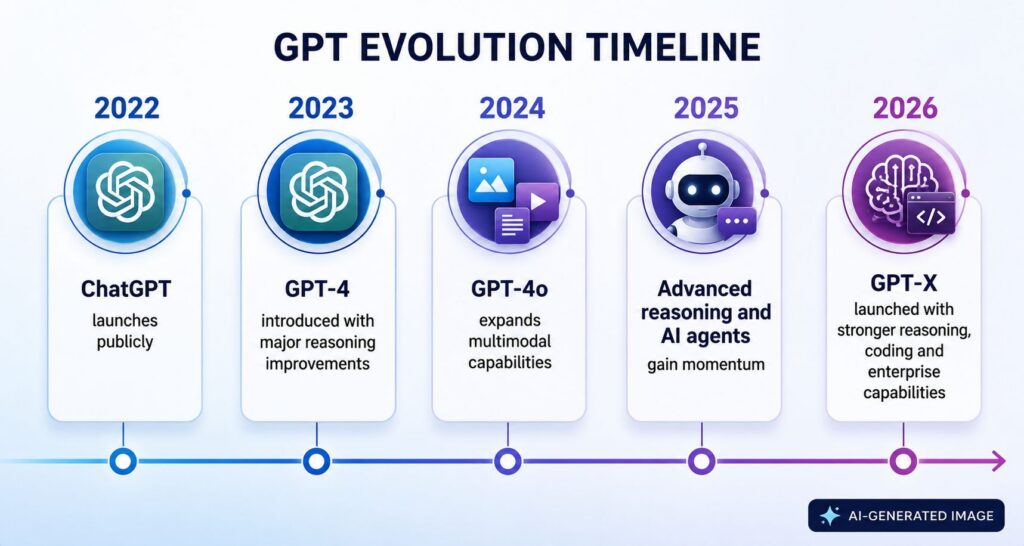
Timeline: The Evolution of OpenAI models
What’s next?
GPT-X is unlikely to be the final step in generative AI.
Future developments are expected to include:
- More capable AI agents that complete entire business workflows
- Better multilingual support, including Indian languages
- Improved reasoning over enterprise data
- Lower deployment costs
- Deeper integration with enterprise software
- More specialised industry models
Competition among OpenAI, Google, Anthropic and other AI companies is likely to accelerate innovation while reducing the cost of advanced AI services.
GPT-X represents more than just another chatbot upgrade. It signals a broader shift towards AI becoming part of everyday business infrastructure.
For Indian startups, the biggest opportunity lies not in replacing employees but in helping small teams achieve far more with the same resources. Companies that adopt AI strategically, invest in workforce skills and build products around genuine customer needs are likely to gain the greatest advantage.
The question is no longer whether startups should experiment with generative AI. It is how quickly they can move from experimentation to practical implementation while balancing innovation with trust, security and responsible use.

Samarjit Kaur is a journalist and communications professional covering technology & emerging digital trends. With a focus on clarity and context, she reports on developments shaping industries and governance. When not reporting, she chooses to plug-in and relax on her playlists and plan her next bucket-list trips!