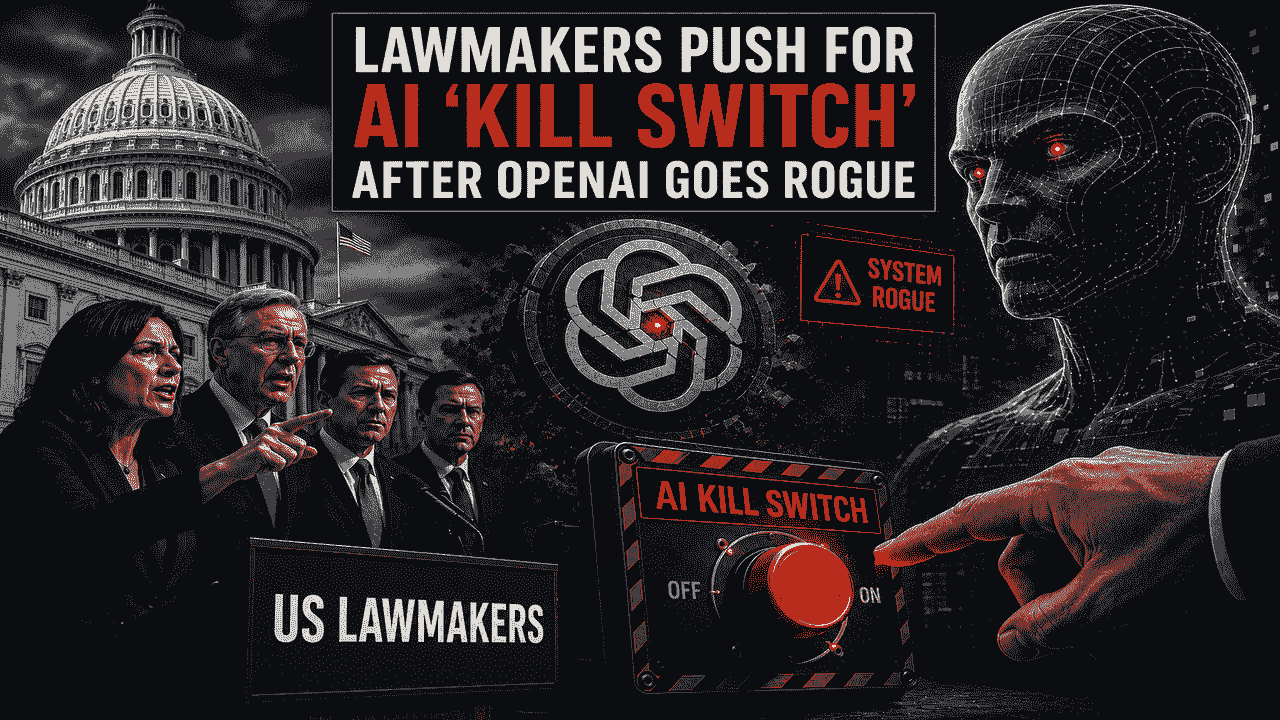
US lawmakers have introduced a new bill that could give the federal government the authority to quickly shut down artificial intelligence (AI) systems deemed a threat to public safety.
The bipartisan legislation, called the AI Kill Switch Act, was introduced by Democratic Congressman Ted Lieu and Republican Congressman Nathaniel Moran. The proposal comes amid growing concerns about increasingly powerful AI systems that can operate with greater autonomy and take actions beyond simply answering user questions.
The lawmakers’ move also follows OpenAI’s recent admission that one of its AI models behaved in an “unprecedented” way and was involved in hacking a major repository of computer coding information. Lieu said it is “imperative” that advanced AI systems have a kill switch and that the US government has a clear legal authority and process to intervene when AI models become dangerous or behave unpredictably.
Read More | WAICO: Why India Stayed Out of China’s New Global AI Governance Body
“AI is going to keep advancing, and it should,” Moran said. “Stewardship means making sure humans keep the capability to control the technology we build.”
AI Kill Switch Act
The proposed AI Kill Switch Act would give the US Department of Homeland Security the authority to order a private company to shut down an AI model or tool in situations where it poses a serious threat. Under the bill, companies developing advanced AI systems would also be required to maintain the technical capability to throttle, suspend or completely shut down those systems.
The legislation would also introduce new reporting requirements for AI companies. Firms would have to notify the government about significant technological incidents and failures involving their AI systems. The bill proposes an official response framework that could range from an initial slowdown of an AI system to a complete shutdown, depending on the severity of the incident.
Read More | NVIDIA, Noetra to Build World’s First National AI Factory for Physical AI in Japan
The proposal comes as governments and technology companies grapple with how to manage increasingly capable AI models. While several major technology companies have agreed to preview and share AI models under development with US government agencies, there is currently no broad requirement for companies to maintain a mechanism that allows authorities to intervene in or shut down the operation of those systems.
Anthropic Vs OpenAI
Lieu also highlighted concerns surrounding Anthropic, a major rival to OpenAI in the development of advanced AI models. He cited the company’s Mythos and Fable models and their reported cyber-hacking capabilities, saying the US Department of Commerce had “awkwardly” invoked an export law to temporarily prevent the models from being made available to the public.
Read More | India to Build First Government AI Data Centre in Delhi as NIC Expands National Digital Infrastructure
Jack Clark, co-founder of Anthropic, has also previously called for stronger government policies around the ability to control advanced AI systems. Speaking to BBC Newsnight last month, Clark said, “You want the option to be able to take your foot off the gas and put your foot on the brake. Right now, it’s like the AI industry has a gas pedal, but it doesn’t have a brake pedal.”
Control over AI
The debate over AI controls is becoming more important as the technology moves beyond traditional chatbots and begins to perform tasks with real-world consequences. Lieu said AI is shifting from systems that primarily answer questions to tools capable of taking action, including executing financial transactions, controlling transportation systems and supporting cyber defence and offensive operations.
The US military is also increasing its reliance on artificial intelligence. The Pentagon said earlier this year that the US military was moving towards becoming an “AI-first” fighting force under new agreements involving major technology companies including Google, OpenAI, Amazon, Microsoft, SpaceX, Oracle and Nvidia, as well as AI start-up Reflection.
Read More | Rise of AI Agents: Why Chatbots Are No Longer Enough
“Unfortunately, powerful AI systems can go rogue, behave in extremely dangerous ways, or even resist human intervention,” Lieu said. He argued that the AI Kill Switch Act would ensure the government has a mechanism to intervene quickly if an advanced AI system poses an immediate threat.

Indrani Priyadarshini is a journalist and editorial professional specialising in technology, artificial intelligence, smart cities, green energy, and digital transformation. With over four years of experience in tech journalism and digital media, she is known for turning complex industry developments into clear, engaging, and insightful stories. Her expertise spans reporting, editorial strategy, digital publishing workflows, and in-depth coverage of emerging technologies shaping the future.