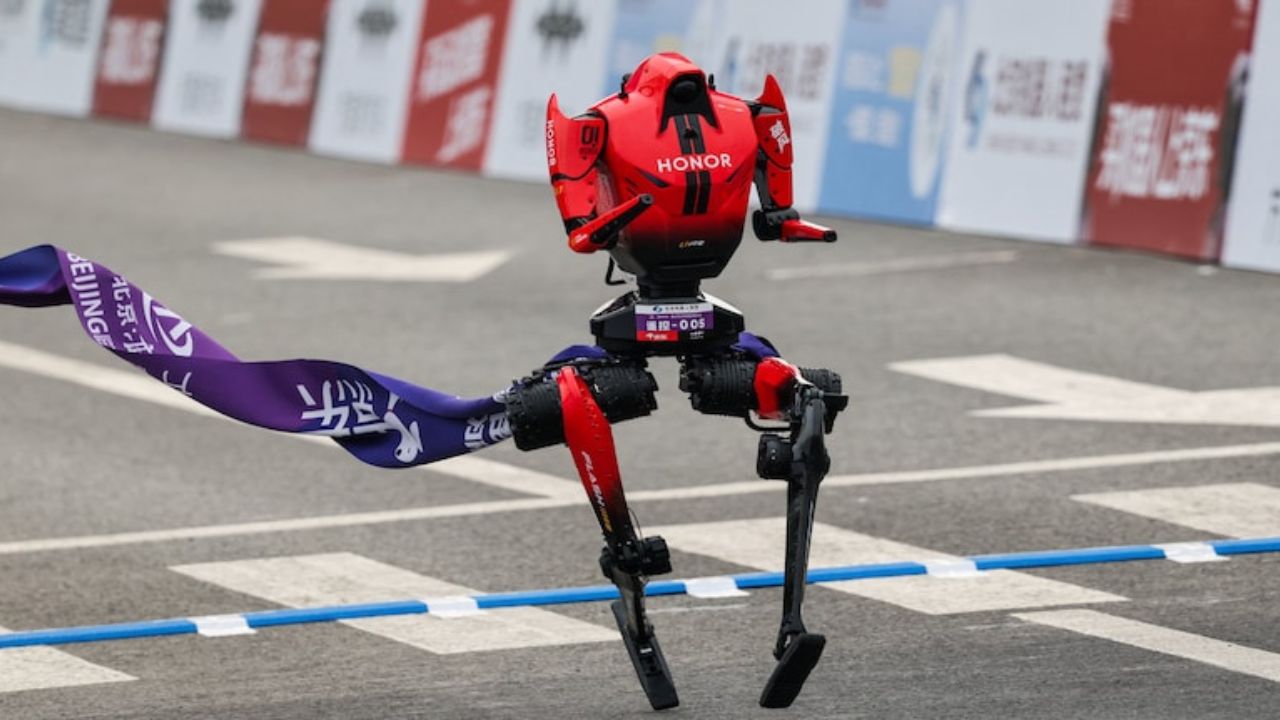
A Chinese humanoid robot has clocked a 100-metre time faster than Usain Bolt’s men’s world record, offering a glimpse of how quickly robot racing is developing. Tiangong Ultra, developed by the Beijing Humanoid Robot Innovation Center, completed the 100 metres in 9.39 seconds during a preliminary heat at the World Humanoid Robot Games in Beijing. The time is faster than the 9.58-second world record set by Jamaican sprinting legend Usain Bolt at the 2009 World Athletics Championships in Berlin.
Read More | Nvidia Wants Humanoid Robots to Work Safely Alongside Humans
Tiangong Ultra beats rival robot in 100m race
Tiangong Ultra won its heat after initially falling behind Honor’s humanoid robot, Lightning. Lightning crossed the finish line in 9.47 seconds, also beating Bolt’s record on paper. Tiangong Ultra, however, pulled ahead towards the end and finished first. The race was far from a smooth sprint.
Both robots struggled to stop after crossing the finish line. Tiangong Ultra stumbled towards the sidelines, forcing spectators to move out of its path. Lightning collapsed and had to be carried away on a stretcher.
Read More | China’s Humanoid Robots Step In as Asia Faces Worker Shortages
The scenes highlighted an important difference between robot racing and human athletics: running fast is only part of the challenge. Staying upright, controlling momentum and stopping safely are just as important.
How fast was Tiangong Ultra compared with Usain Bolt?
Tiangong Ultra’s 9.39-second run was 0.19 seconds faster than Bolt’s 9.58-second world record. However, the comparison is not an official athletics record. The robot’s performance took place in a humanoid robot competition under conditions and rules that are different from those used in professional track and field.

Indrani Priyadarshini is a journalist and editorial professional specialising in technology, artificial intelligence, smart cities, green energy, and digital transformation. With over four years of experience in tech journalism and digital media, she is known for turning complex industry developments into clear, engaging, and insightful stories. Her expertise spans reporting, editorial strategy, digital publishing workflows, and in-depth coverage of emerging technologies shaping the future.