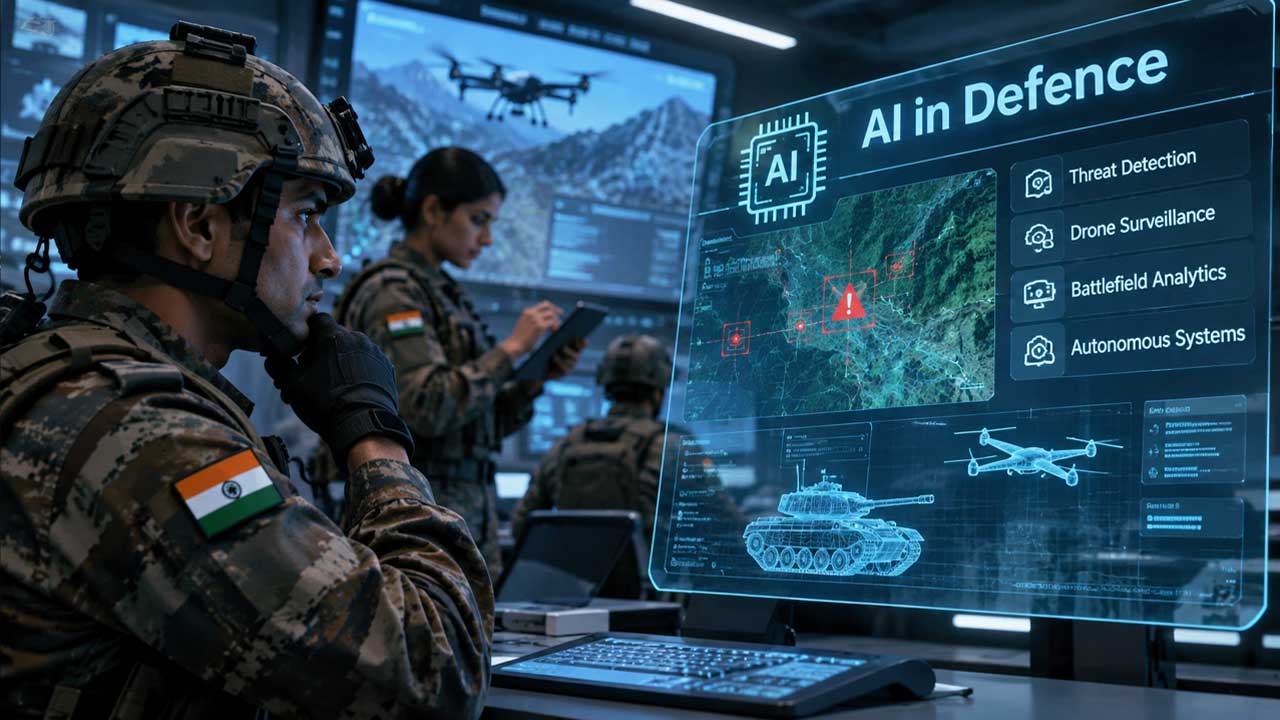
India’s private defence industry has called for artificial intelligence (AI) to speed up defence procurement, along with faster product testing, predictable government orders, and more flexible banking rules.
At the ANI National Security Summit 3.0 in New Delhi, Raphe mPhibr Chairman Vikas Mishra and Nibe Limited Executive Director Balaji Sominathan said policy changes were needed to help domestic manufacturers scale up and develop critical defence technologies.
Also Read: Sarvam Signs Five-Year MoU with Defence Ministry to Build AI for Army, Navy and Air Force
AI Could Speed Up Defence Procurement by Up to Three Times
“AI could reduce paperwork and delays in preparing Requests for Information (RFI), Requests for Proposal (RFP) and Expressions of Interest (EoI),” noted Mishra.
He added that procurement officials handle as many as 40 projects, often working weekends, and said delays were not necessarily intentional but stemmed from the volume of work.
An RFP for a standard military truck can run to nearly 120 pages and serves as a binding legal contract. Mishra noted that using AI to prepare such documents could make acquisition processes two to three times faster.
He also suggested more flexible policies and institutional protection for officials taking calculated risks under the General Financial Rules (GFR), arguing that fear of legal consequences could discourage decisions.
Also Read: Flying Wedge Defence Unveils India’s First AI-Piloted Fighter Jet Prototype
Defence Firms Seek Faster Testing and Predictable Orders
“The government needed to move from merely encouraging private participation to actively enabling it,” added Sominathan.
He also identified three priorities:
- Predictable order pipelines
- Faster testing
- Validation by government agencies
He also clearly defined operational requirements for industry.
He also questioned tender eligibility rules that assess deep-tech companies largely on turnover and existing balance sheets rather than their engineering capabilities and potential to develop future technologies.
Mishra highlighted another financial constraint. Defence manufacturing and testing can take at least 12 months before delivery, while conventional banking norms operate on 90-day cycles. He urged the Finance Ministry and banks to offer more flexible lending terms suited to the sector.
Indigenous Manufacturing and Defence Capabilities
Both executives rejected the view that private Indian defence companies primarily assemble imported equipment. Mishra said Raphe mPhibr operates a 700,000-square-foot facility, among the six largest globally and the largest of its kind in India.
Its drone portfolio ranges from five-kg payload platforms to 600-kg systems, including a 15-metre wingspan Medium Altitude Long Endurance (MALE) unmanned aerial vehicle (UAV) nearing supply, as well as multicopters and fixed-wing drones.
Sominathan cited Nibe’s 200-acre Shirdi manufacturing hub, which houses 11 facilities of two lakh square feet each and can produce five lakh bombs annually, alongside rocket launcher systems.
He also said an audit of Nibe’s universal rocket launcher programme found that 70-80% of its supply chain was already based in India, despite its technology partnership with an Israeli original equipment manufacturer.
Both leaders called for greater cooperation between public sector undertakings (PSUs), private manufacturers, start-ups and academia, rather than treating them as competing parts of the defence ecosystem.

Samarjit Kaur is a journalist and communications professional covering technology & emerging digital trends. With a focus on clarity and context, she reports on developments shaping industries and governance. When not reporting, she chooses to plug-in and relax on her playlists and plan her next bucket-list trips!