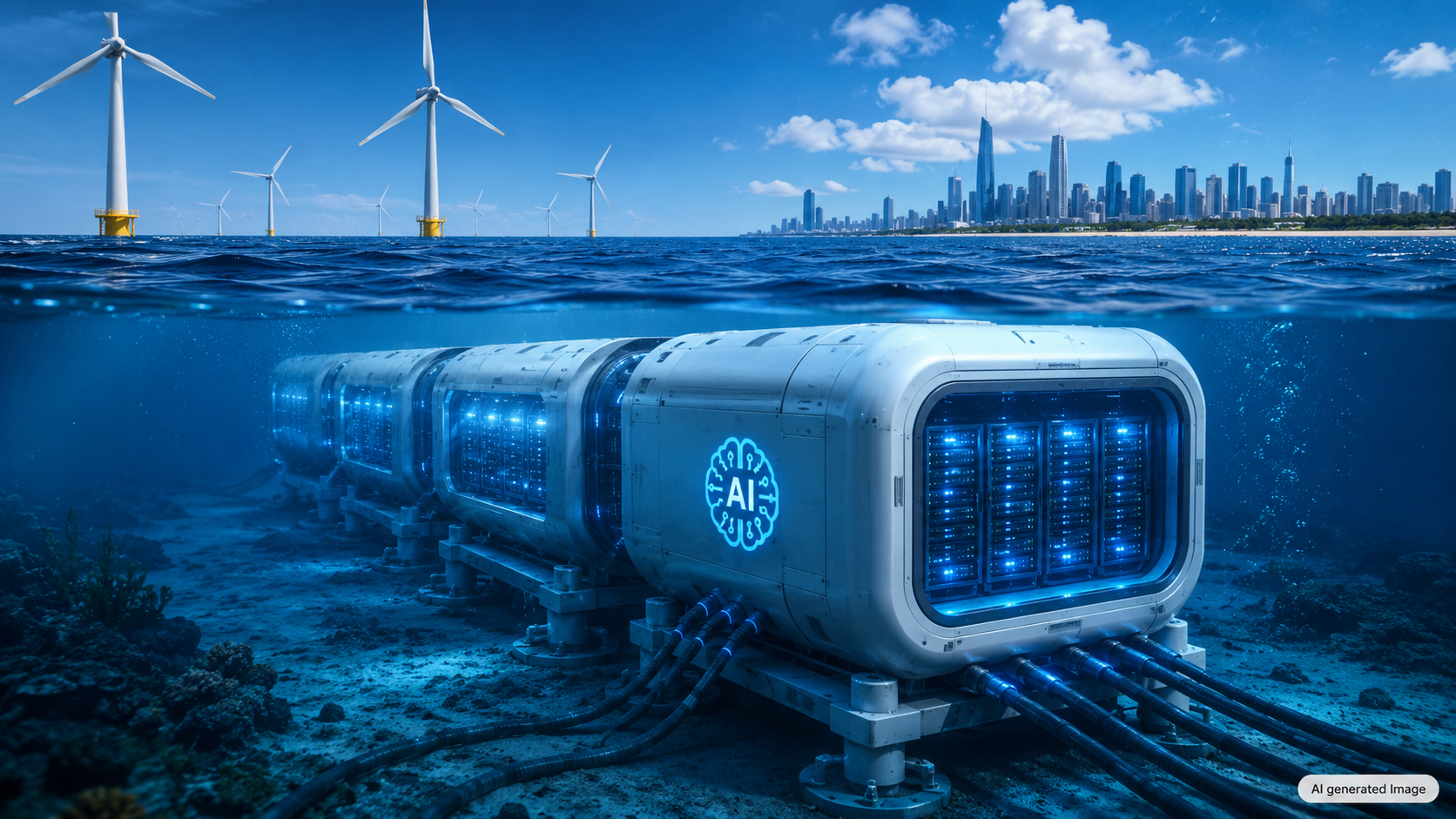
China has started commercial operations at what it claims is the world’s first offshore wind-powered underwater Artificial Intelligence (AI) data centre near Shanghai. The progress marks a new step in the country’s push to expand digital infrastructure while reducing energy use.
The facility, located off the coast of Shanghai’s Lingang Special Area, houses nearly 2,000 servers inside sealed underwater modules connected to nearby offshore wind farms. The project is designed to support AI computing, cloud services, big data processing and domestic large-language model development.
Also Read: China Built the World’s Largest Railway Station in 38 Months Using Robots
Offshore Wind and Seawater Cooling Drive the Project
Chinese developers said the data centre uses seawater from the surrounding area for natural cooling, reducing the need for conventional air-conditioning systems that consume large amounts of electricity in traditional server facilities.
The underwater setup is expected to lower overall power consumption and reduce freshwater use. Developers have projected a Power Usage Effectiveness (PUE) rating of around 1.15, placing the project among the more energy-efficient large-scale data centres currently in operation.
Also Read: Uber to Set Up First AI Data Centre in India with Adani Group
China Scales Up AI Infrastructure Amid Rising Computing Demand
The underwater facility is part of China’s broader strategy to build and grow AI infrastructure. The country also aims to secure additional computing capacity for future digital services.
The commercial rollout comes as countries and tech firms worldwide face rising energy demands linked to AI model training and cloud computing.
Industry analysts say underwater data centres are gaining attention because cooling systems account for a major share of operational costs in conventional facilities. By placing servers underwater and connecting them directly to renewable energy sources, operators aim to improve energy efficiency while reducing land use.
The Shanghai project also draws comparisons with Microsoft’s earlier experimental Project Natick, though China’s system has moved into full commercial operations.
While the model offers lower cooling costs, experts say long-term maintenance, underwater repairs and corrosion management will remain key operational challenges for large-scale deployment.

Samarjit Kaur is a journalist and communications professional covering technology & emerging digital trends. With a focus on clarity and context, she reports on developments shaping industries and governance. When not reporting, she chooses to plug-in and relax on her playlists and plan her next bucket-list trips!