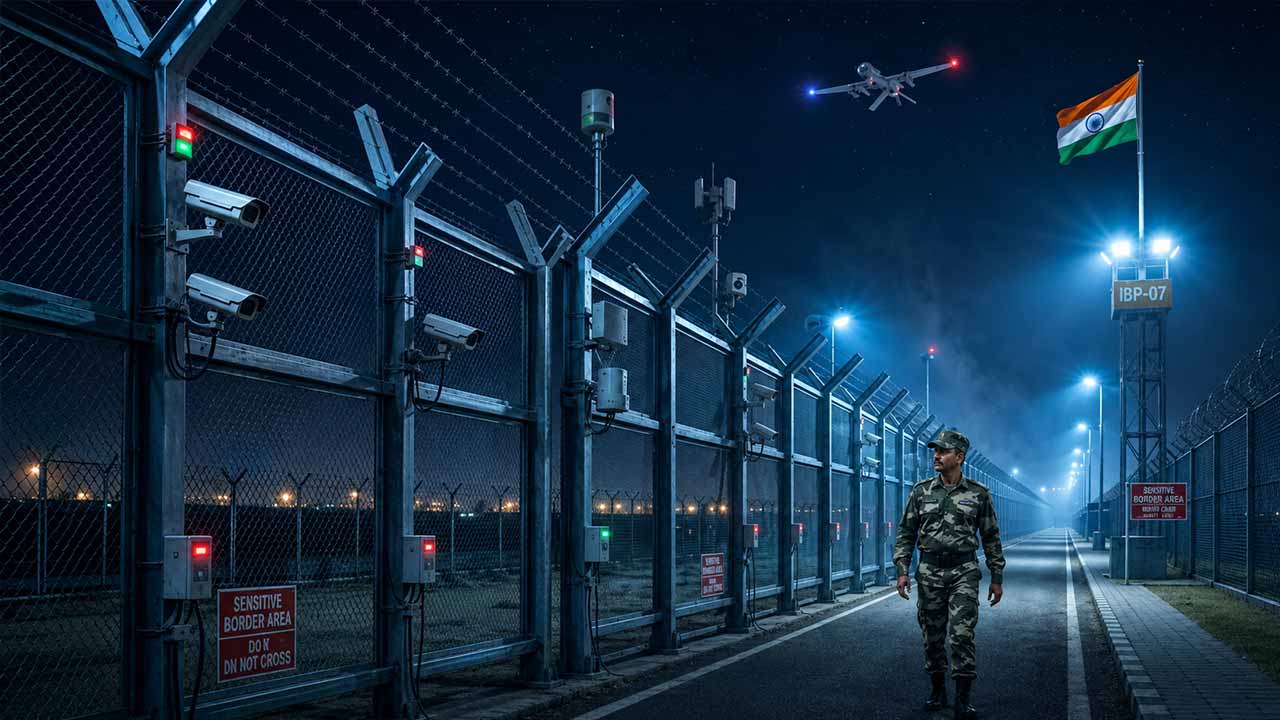
India is moving towards a technology-led smart border security system that will combine surveillance tools, security forces and local administration.
Union Home Minister Amit Shah has said the proposed Smart Border Project will strengthen the country’s borders with Pakistan and Bangladesh, covering nearly 6,000 km.
The plan aims to make border monitoring more continuous and to plug vulnerable stretches.
What Will India’s Smart Border Use?
The proposed security grid will bring together drones, radars, modern cameras, sensors and smart fencing. These systems are designed to monitor difficult stretches where traditional fencing or round-the-clock physical surveillance is difficult.
The project builds on the government’s earlier Comprehensive Integrated Border Management System (CIBMS), which uses technology to support the Border Security Force (BSF) in detecting infiltration and cross-border crimes. The approach is to integrate information from multiple surveillance systems to enable security personnel to respond more quickly.
The government has also used smart fencing technology along difficult sections of the India-Bangladesh border, including riverine areas where conventional fencing is impractical.
How will the New Security Grid Work?
The Smart Border plan is also expected to change how border security is managed. Shah has described a quadrangular security grid involving security personnel, local administration and modern technology.
The concept is that border protection cannot depend only on forces deployed at the frontier. District officials, police and local representatives would also have a role in identifying and reporting security concerns.
The Smart Border Project is at the finalisation stage, with pilot projects planned at seven to eight locations. The government will use the pilot phase to assess operational challenges before expanding the model.
Also Read: New Phase in Defence Technology Modernisation for India, AI-Enabled S-400 Received
Why is the Plan Important?
India’s borders cover difficult terrain, including rivers, forests and other areas where physical barriers are not always practical. Technology can help security forces keep watch over such stretches.
The government has also approved 119 km of new fencing in Tripura to replace part of around 650 km of fencing that is more than 15 years old.
For India’s defence-tech sector, the Smart Border Project signals a larger shift from manpower-led border guarding towards integrated surveillance. The success of the system will depend not only on the technology deployed, but also on how effectively security forces, local authorities and surveillance systems work together.

Samarjit Kaur is a journalist and communications professional covering technology & emerging digital trends. With a focus on clarity and context, she reports on developments shaping industries and governance. When not reporting, she chooses to plug-in and relax on her playlists and plan her next bucket-list trips!