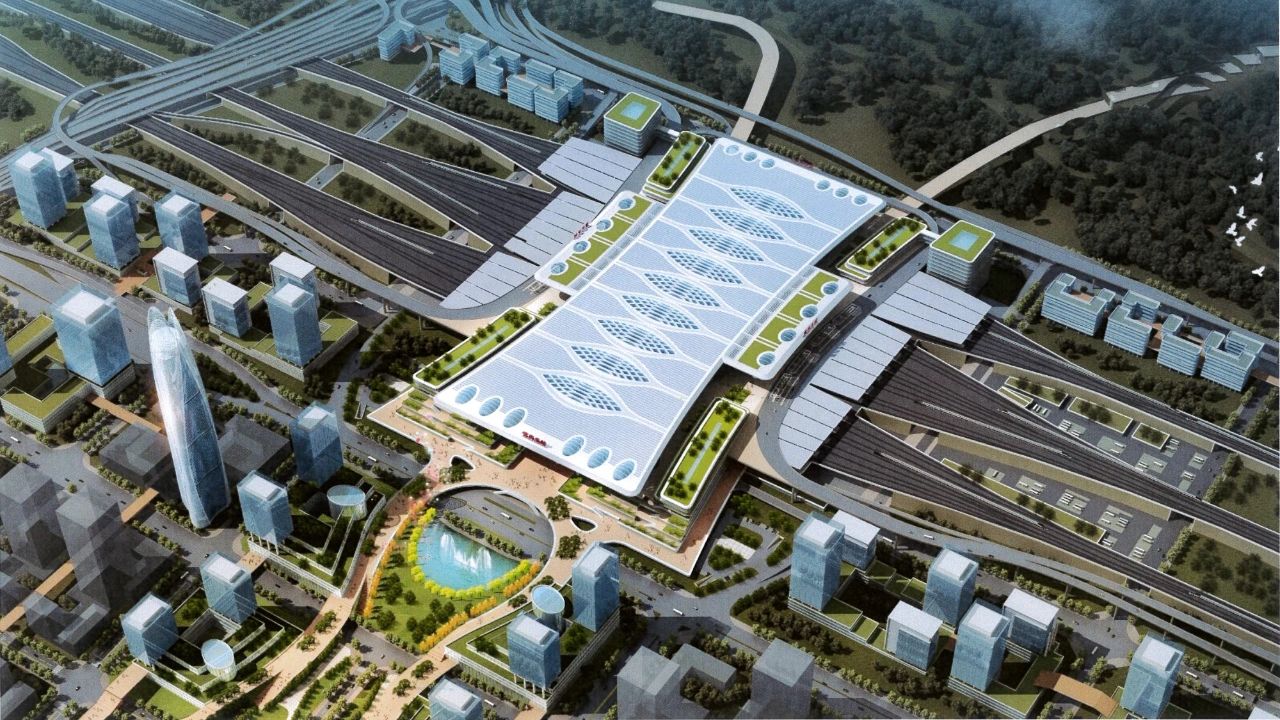
While visiting China with US President Donald Trump, billionaire businessman Elon Musk shared a video on X about the construction of Chongqing East Railway Station, the world’s largest railway station by floor area. But the bigger story is not Musk’s post. The real story is how China built the massive railway station in just 38 months using robots and advanced technology.
The Chongqing East Railway Station is a huge transport hub in China. It opened to the public in May 2025. The station quickly became famous for its futuristic design and large size. Musk’s repost gained huge attention online. The video received more than 50 million views. One popular comment under the post said, “Welcome to the future! China now operates the world’s largest high-speed rail network.”
Read More | Delhi Metro Starts Hydrogen-Powered Shuttle Bus Service in Central Vista
The six-minute video shows the station’s giant glass halls, multi-level structure, and modern transport system. Many internet users compared the station to scenes from science fiction movies because of Chongqing’s dramatic mountain skyline and futuristic look.
About Chongqing East Railway Station
The station is located in Nan’an District in Chongqing, China. It officially started operations in June 2025 along with the Chongqing East–Qianjiang section of the Chongqing–Xiamen high-speed railway line.
The railway line supports trains travelling at speeds of up to 350 kmph. The station is currently the largest high-speed railway station in western China. According to official reports, the complex covers around 1.22 million square metres. It has 15 platforms and 29 railway tracks.
What makes the station special is its “four-dimensional” transport system. It combines many transport services in one place. Passengers can easily switch between high-speed trains, metro lines, buses, taxis, and long-distance transport services.
Read More | Rajasthan Joins Namo Bharat Network as RRTS Corridor Set to Link Alwar With New Delhi
The station also uses smart passenger guidance systems and advanced digital technology to improve operations and make travel easier. Its steel-and-glass design and large skylights allow natural sunlight to enter the building. Chinese officials believe the station will improve regional connectivity and support economic growth in western China.
How China built it using robots
According to Chinese state media Xinhua News Agency, construction of the station was completed in just 38 months. Work started after the design plans were approved in May 2022 and finished in 2025.
The project used large numbers of robots during construction. State media described it as a “robot army.” The station was built on difficult mountainous land and in extreme summer heat that often crossed 40 degrees Celsius. Robots helped workers complete tasks faster and more safely.
Laser-guided screed robots used LiDAR, AI, and 5G technology to level concrete with very high precision. These robots worked almost three times faster than human workers and reduced labour costs by 40 per cent. Special robots were also used to install heavy glass panels weighing up to 800 kilograms. These robots improved installation speed and reduced accident risks by 90 per cent.
Other robots handled welding work and carried out 24-hour inspections across the construction site. Officials from China Railway 11th Bureau told Xinhua that robotics nearly cut labour costs in half, tripled work efficiency, and greatly improved safety during construction.

Indrani Priyadarshini is a journalist and editorial professional specialising in technology, artificial intelligence, smart cities, green energy, and digital transformation. With over four years of experience in tech journalism and digital media, she is known for turning complex industry developments into clear, engaging, and insightful stories. Her expertise spans reporting, editorial strategy, digital publishing workflows, and in-depth coverage of emerging technologies shaping the future.