For nearly 16 years, your mobile number has been your identity on WhatsApp. But that may soon change as Meta plans to introduce the WhatsApp username feature, allowing users to communicate without revealing their personal phone numbers.
While it may seem like a routine update, the move marks one of Meta’s biggest privacy-focused changes since end-to-end encryption became the norm.
The move reflects how WhatsApp itself has evolved. No longer just a messaging app, it has become a platform for business, education, commerce and communities. As more people use it beyond their personal circles, protecting contact information has become increasingly important.
Here is everything you need to know about the WhatsApp Username feature, how it works and why it matters.
Also Read: Why Did Meta Bet $900 Million on CRED? The Strategy Behind Kunal Shah’s WhatsApp Move
What is the WhatsApp Username feature?
WhatsApp’s upcoming ‘Username’ feature will allow users to create a unique identity on the platform without revealing their mobile number to everyone they interact with.
Currently, anyone who wants to contact you on WhatsApp generally needs your phone number. That number becomes your digital identity on the app.
The new system changes that. Instead of saying, “Save my number,” users will eventually be able to share a username, much like they do on Instagram, Telegram or X.
Once enabled, other users will be able to search for or connect with your username rather than your personal mobile number, depending on how Meta implements the feature globally.
While WhatsApp has not yet rolled out the feature to all users, references to usernames have appeared in beta versions of the application, indicating that the company is preparing for a wider release. The feature is expected to work alongside existing phone number verification rather than replace it entirely.
Also Read: India’s Data Protection Law Decoded: An Explainer on the DPDP Act
How does the WhatsApp Username feature work?
Although Meta is still testing the feature, early versions provide a fairly clear picture of how it will operate.
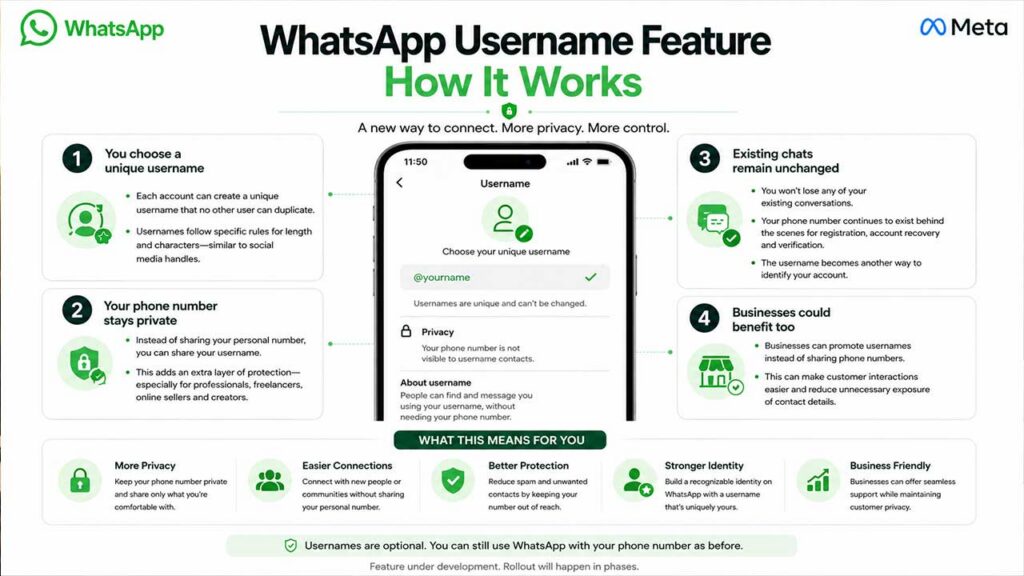
Why is WhatsApp introducing usernames now?
WhatsApp is adapting to the way people communicate today. The app has evolved beyond personal messaging and is now widely used for business, networking, online marketplaces and community groups.
In many of these interactions, sharing a personal phone number is unnecessary and can expose users to spam or privacy risks.
By introducing usernames, Meta is bringing WhatsApp closer to rivals such as Telegram and Signal, where users can connect without revealing their phone numbers.
The feature reflects a broader shift towards giving users more control over their digital identity while helping WhatsApp remain competitive in an increasingly privacy-focused messaging market.
This feature changes the relationship between identity and communication. In simple terms, usernames separate your identity from your phone number. That is a significant change.
Also Read: Nirmala Sitharaman Flags AI-Led Cybersecurity Risks in Banking
The WhatsApp Username feature: The opportunities and the trade-offs
Every major app update solves one problem but often creates another. WhatsApp’s Username feature promises greater privacy and convenience, but it also raises new questions around identity, trust and online safety.
Better privacy, less sharing of personal numbers
The biggest advantage is simple: you no longer have to share your mobile number with everyone you interact with.
Whether you’re selling something online, networking or joining a community group, a username lets you start a conversation without exposing your personal contact details.
For professionals such as journalists, consultants, teachers, lawyers and content creators, it offers a safer, more convenient way to stay accessible while keeping their primary number private.
WhatsApp catches up with modern messaging
Most major messaging and social media platforms have already moved beyond phone number-based identities.
Apps like Telegram, Signal, Discord and Instagram allow users to connect through usernames. By introducing a similar system, WhatsApp is aligning itself with changing user behaviour and making it easier to connect with new people.
Popular usernames could become difficult to get
Like email addresses and social media handles, desirable usernames are likely to be claimed quickly.
Businesses, brands and public figures may rush to secure their identities, while many users could find that their preferred username has already been taken.
Privacy improves, but impersonation risks remain
Usernames may hide your phone number, but they don’t automatically make conversations safer.
A fake account using a username that closely resembles a trusted business, bank, or public figure could still deceive users. Meta will need strong verification systems and quick reporting tools to prevent misuse.
Government and experts are urging caution
The concerns are no longer limited to cybersecurity experts. The Ministry of Electronics and Information Technology (MeitY) has issued a notice to Meta regarding the usernames feature, prohibiting its Indian roll-out until the final consultation concludes.
The Indian government has sought a detailed explanation of how the system will prevent impersonation, phishing and identity-based fraud. Authorities have indicated that the feature could make it easier for bad actors to mimic government agencies, financial institutions or public figures using lookalike usernames.
Responding to the Indian government’s concerns, Meta said WhatsApp’s upcoming Username feature will include several safeguards to prevent scams and impersonation. The company added that high-profile usernames will be reserved for their legitimate owners to minimise misuse. However, the feature is yet to be rolled out publicly and remains under development, with its launch expected to occur gradually as Meta completes testing and addresses regulatory concerns.
The debate furthered within the startup ecosystem.
Entrepreneur Ankur Warikoo has cautioned that while the feature improves privacy, it could become a “disaster” in India if robust verification measures are not in place, given the country’s growing incidence of online scams.
His comments echo broader concerns that stronger privacy controls must be matched by equally strong identity checks to maintain user trust.
Also Read: Meta Faces Landmark Antitrust Trial Over Instagram and WhatsApp Acquisitions
The bigger question: Is WhatsApp becoming more than a messaging app?
Looking beyond the feature itself, the WhatsApp Username update hints at Meta’s long-term ambitions. A username is not just another profile setting. It is the foundation of a digital identity.
Once every user has a unique identity beyond a phone number, WhatsApp can build entirely new experiences around it, from verified business profiles and AI assistants to creator discovery, customer support and even digital commerce.
Since the phone number is no longer the ‘ideal identifier’, the WhatsApp username will quietly transform WhatsApp into an ‘identity-first platform’.
Ultimately, the success of WhatsApp’s Username feature will depend less on the technology itself and more on Meta’s ability to strike the right balance between privacy, convenience and accountability. In a market like India, where cyber fraud is evolving rapidly, that balance could determine whether the feature becomes a privacy milestone or a new avenue for digital deception.

Samarjit Kaur is a journalist and communications professional covering technology & emerging digital trends. With a focus on clarity and context, she reports on developments shaping industries and governance. When not reporting, she chooses to plug-in and relax on her playlists and plan her next bucket-list trips!