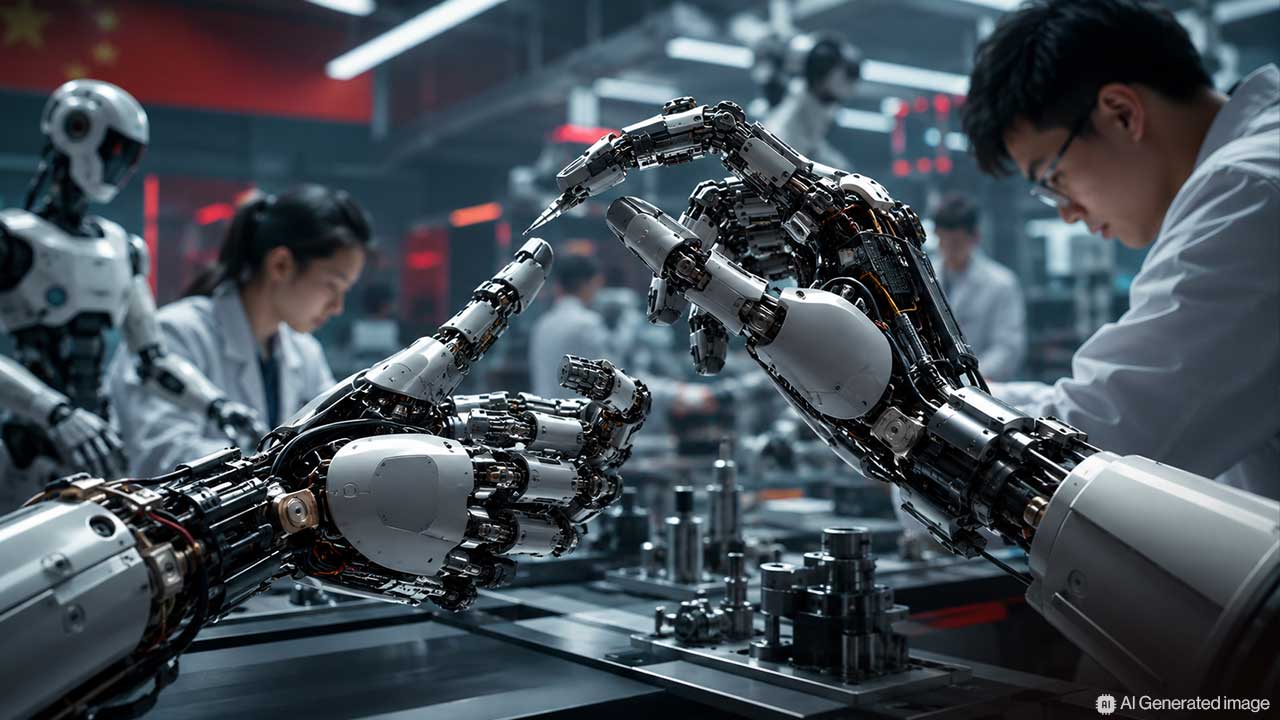
China’s push to lead the global humanoid robotics race is increasingly centred on one challenge: building robot hands that can work with the same speed, precision and flexibility as human hands.
While robots have become better at walking, seeing, and understanding their surroundings, handling everyday objects remains one of the biggest hurdles to their widespread deployment in homes, hospitals and factories.
Industry experts believe solving this problem could mark the next major leap in artificial intelligence (AI)-powered robotics.
Also Read: China is Mass-Producing Humanoids, But Where Are the Buyers?
Why Robot Hands Remain Robotics’ Toughest Challenge
Human hands perform thousands of complex movements every day without conscious effort. Tasks such as fastening buttons, tying shoelaces, or picking up delicate objects require precise coordination among muscles, nerves and the sense of touch.
Replicating those movements mechanically has proved far more difficult than developing robotic arms or legs. Engineers say the real obstacle is not simply designing the hardware, but teaching robots how to grip, adjust pressure and react instantly through software and AI models.
Also Read: BMW Deploys Figure AI Humanoid Robots at US Plant, Expands Automation Efforts
China is Betting on ‘Embodied AI’ to Lead the Next Robotics Wave
Chinese robotics companies are investing heavily in what the industry calls “embodied AI”, AI systems that allow machines to interact with the physical world rather than process information.
Start-ups, including LinkerBot and Wuji Technology, are focusing almost entirely on robotic hands. They use teleoperation systems, wearable gloves and human demonstrations to collect movement and touch data that trains AI models.
China’s mature manufacturing ecosystem, built largely through its electric vehicle supply chain, is also helping companies scale production of robotic components much faster than many international rivals.
Also Read: If a Humanoid Can Become a Monk, What Is Left That Only Humans Can Do?
Beyond Factories, the Technology has Wider Ambitions
Developers see applications extending well beyond industrial automation. More capable robotic hands could improve prosthetic limbs, assist elderly care, support healthcare workers and eventually enable humanoid robots to perform routine household tasks.
Industry experts argue that the goal is to fill labour shortages and improve productivity rather than replace every human worker.
However, experts also note that software capable of matching human dexterity remains years away despite rapid advances in AI.
The next battle in AI could be won by the companies that teach robots to handle the physical world with the same confidence as the human hand.

Samarjit Kaur is a journalist and communications professional covering technology & emerging digital trends. With a focus on clarity and context, she reports on developments shaping industries and governance. When not reporting, she chooses to plug-in and relax on her playlists and plan her next bucket-list trips!