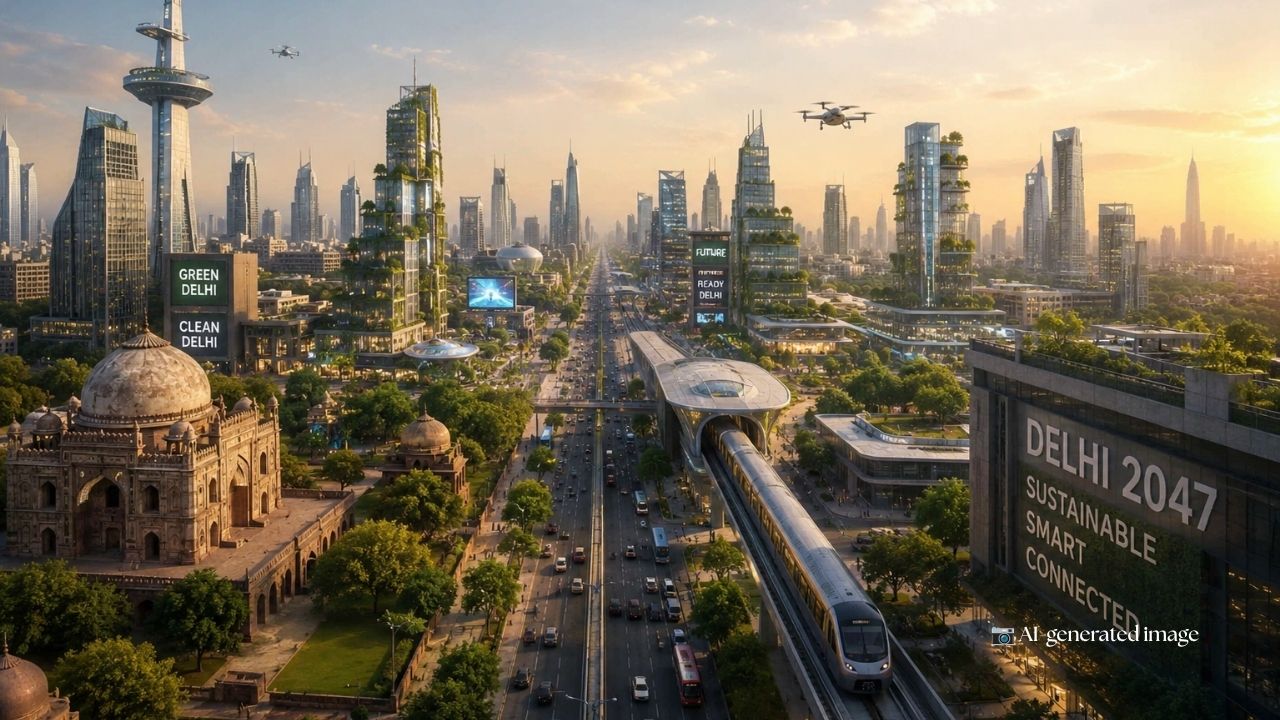
Delhi’s long-term urban blueprint is looking beyond roads, housing and transport. The newly notified Master Plan for Delhi 2047 puts technology, semiconductors, artificial intelligence (AI) and electronics among the sectors that could shape the capital’s economic growth over the next two decades.
As part of the plan, Delhi’s Department of Information Technology has proposed 41–62 acres of land for four technology and digital infrastructure projects. The proposals aim to build a stronger technology ecosystem while supporting new-age manufacturing, digital governance, and emerging technologies.
Read More | Delhi’s Cleanest Ward To Get Rs 1 Cr Every Month Under ‘Delhi Ko Kude Se Azadi-Swachhta Abhiyan 2026’
What does Delhi Master Plan 2047 propose?
The technology push centres on four proposed initiatives:
- Semiconductor and Electronics Ecosystem
- Drone Ecosystem and Innovation Initiative
- DISHA (Digital Innovation & Smart Hub for Advancement)
- AI-enabled State Data Centre and Government Cloud Infrastructure
The semiconductor and electronics ecosystem would require the largest share of land. The indicative requirement for the four projects ranges from 41 to 62 acres. The plan, however, does not yet identify where these facilities will be located.
Delhi plans a dedicated Technology & Innovation Zone
One of the more significant proposals is an integrated Technology & Innovation Zone. The idea is to bring several technology sectors closer together. These could include AI, semiconductor development, drones, start-ups, advanced computing and digital governance.
The proposed zone is still at the planning stage. The Master Plan does not specify a final location or confirm that all four projects will operate from one site. Suitable land parcels will have to be identified and allocated before the projects can move ahead.
Semiconductor and electronics get a major focus
Semiconductors and electronics are at the centre of Delhi’s technology ambitions. The proposed ecosystem is expected to support the development of electronics and other high-value technology activities. It also fits into the Delhi government’s broader plans to create a more technology-driven industrial base.
Read More | Hyderabad Urban Mobility Plan Puts Road Safety and Seamless Public Transport at the Centre of Future Growth
The Master Plan aims to encourage industries that generate higher economic value while reducing dependence on polluting activities. Electronics, electric vehicles, green industries, circular economy businesses and knowledge-based sectors are among the areas highlighted in its wider economic strategy.
AI and drones also feature in the plan
Delhi’s technology ambitions are not limited to semiconductor manufacturing. The proposed Drone Ecosystem and Innovation Initiative is intended to create space for drone-related innovation and development.
The plan also includes DISHA, a proposed digital innovation hub, along with an AI-enabled State Data Centre and government cloud infrastructure. These facilities could strengthen the digital backbone needed for government services and emerging technology applications.
AI, 5G and optical fibre to support Delhi’s digital infrastructure
The technology proposals sit alongside a wider digital infrastructure push under MPD-2047. The plan envisages stronger 5G connectivity, optical-fibre networks, smart poles and unified command-and-control centres. AI could also be used for areas such as traffic management, public transport and urban services.
The plan also provides for data centres in industrial areas. It proposes space or ducts for optical fibre in roads with a right-of-way of 12 metres or more, where feasible. This could help improve the connectivity needed for data-heavy services, cloud infrastructure and other digital businesses.
Read More | Maharashtra to Deploy AI, Geo-Tagging and GIS Mapping to Track Urban Development Projects Across the State
What is still unclear?
The proposals are ambitious, but several important details have not been finalised. The Master Plan does not specify the exact locations for the proposed technology projects. It also does not provide detailed project costs or implementation timelines.
It remains unclear whether the four initiatives will be developed together or at separate locations. The agencies responsible for developing and operating the facilities have also not been clearly identified. The proposed Technology & Innovation Zone is similarly still a framework rather than a fully defined project.
What does Delhi Master Plan 2047 mean for the technology sector?
The plan signals a broader shift in how Delhi views its future economic growth. The capital is looking to make more room for technology-led industries, digital infrastructure and emerging sectors. If the proposed projects move from planning to execution, Delhi could develop a stronger ecosystem around semiconductors, electronics, AI, drones and advanced digital services. For now, the Master Plan provides the direction. The next challenge will be turning that vision into land allocations, policies, investment and actual infrastructure.

Indrani Priyadarshini is a journalist and editorial professional specialising in technology, artificial intelligence, smart cities, green energy, and digital transformation. With over four years of experience in tech journalism and digital media, she is known for turning complex industry developments into clear, engaging, and insightful stories. Her expertise spans reporting, editorial strategy, digital publishing workflows, and in-depth coverage of emerging technologies shaping the future.