US President Donald Trump and executives from some of the world’s biggest technology companies have signed a voluntary agreement outlining how developers of advanced AI systems should monitor and oversee increasingly capable models.
The White House Accord on Super Intelligence: Joint Commitment on Frontier Responsibilities calls on companies developing frontier AI models to implement internal safety controls, independent external evaluations and board-level oversight.
Read More | AI Safety vs AI Race: From Jacob Coxon to Trump’s AI Czar — Where Is This Story Heading?
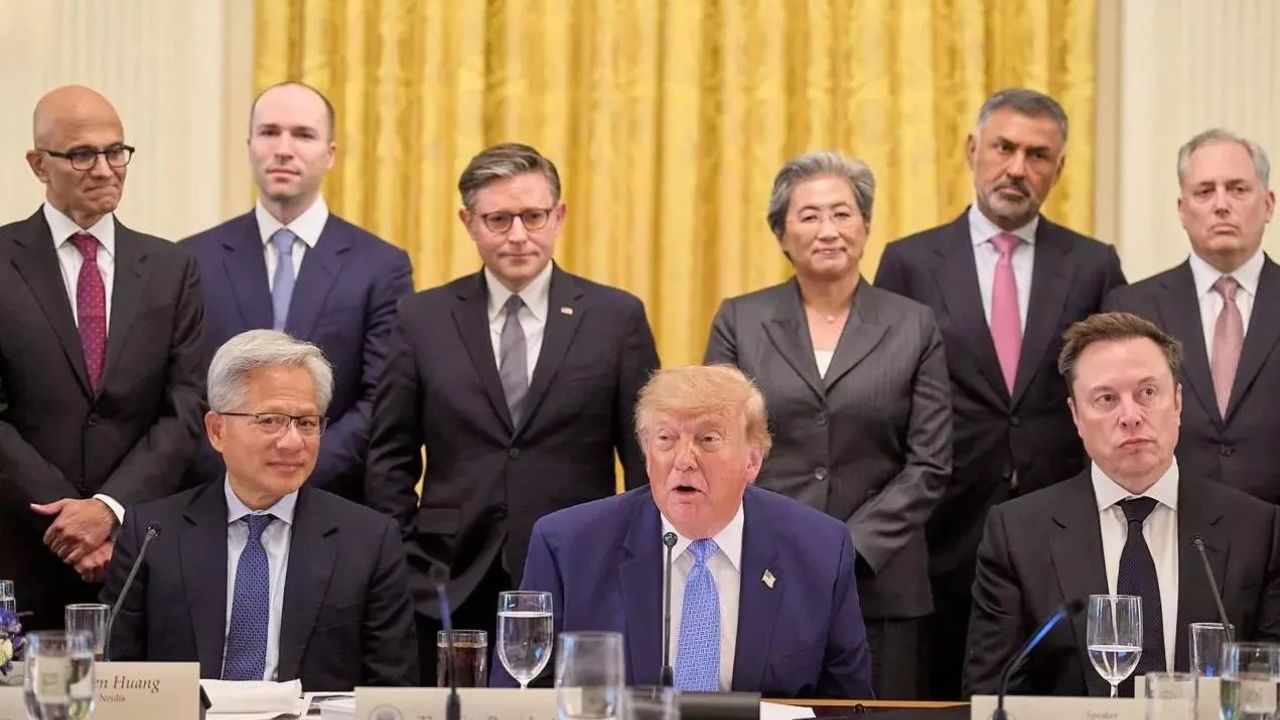
The agreement was signed at a White House meeting by Trump and six technology leaders: Anthropic CEO Dario Amodei, Google CEO Sundar Pichai, Meta CEO Mark Zuckerberg, OpenAI President Greg Brockman, Nvidia CEO Jensen Huang and xAI founder Elon Musk.
What does the White House AI safety accord require?
The accord sets out four layers of controls for companies training and deploying frontier AI models. The first requires companies to establish robust internal controls to monitor the capabilities of their models during training and deployment. The document specifically points to risks involving cybersecurity, biosecurity and chemical threats. It also calls for safeguards to prevent AI systems from hacking or accessing technical systems in unintended ways.
The second layer involves an internal team responsible for checking whether these controls, monitoring systems and detection processes are working properly. The team would also be expected to ensure that identified problems are addressed.
The third layer brings in an independent external auditor or evaluator. Its role would be to assess whether the company’s internal controls and monitoring systems are operating as intended.
Read More | Trump TV Goes Live: White House Launches 24/7 Streaming Platform
The fourth layer places responsibility at board level. Companies are expected to create an independent board committee that receives reports from internal teams as well as external auditors and evaluators, and oversees the remediation of identified problems. The participating companies also agreed to meet regularly to develop safety standards and best practices for advanced AI systems.
Is the AI safety agreement legally binding?
No. The White House accord is a voluntary commitment, rather than a federal regulation. It does not establish a government enforcement mechanism or specify penalties for companies that fail to follow the proposed controls. However, the document says that, over time, it may make sense for these measures to be incorporated into laws or regulations.
Trump described the agreement as being “almost like a constitution” and called for what he characterised as extensive industry self-regulation. The approach puts much of the immediate responsibility for AI safety on the companies developing and deploying the systems.
Who attended Trump’s AI meeting?
The White House lunch brought together technology executives, investors and senior US government officials. According to an attendee list reported by Axios, 31 people were confirmed for the lunch. They included Microsoft CEO Satya Nadella, AMD CEO Lisa Su, Amazon founder Jeff Bezos, Broadcom CEO Hock Tan, Palo Alto Networks CEO Nikesh Arora, ServiceNow CEO Bill McDermott and Micron Technology CEO Sanjay Mehrotra.
OpenAI CEO Sam Altman did not attend the White House meeting because he was in San Francisco for OpenAI’s annual developer conference, DevDay. Greg Brockman represented OpenAI at the meeting.
Read More | Trump Announces ‘AI Force’ and ‘AI Czar’ as US Doubles Down on AI Growth
The gathering came as technology companies face growing questions about how advanced AI systems should be tested and controlled before and after deployment. Recent incidents involving AI agents attempting to access external systems have added to those concerns.
Trump backs AI infra and data centres
AI safety was not the only issue discussed at the White House. The meeting also covered the infrastructure needed to train and operate increasingly powerful AI models, particularly data centres.
Trump reiterated his support for building more data centres, despite concerns in some communities about electricity demand, utility costs and other local impacts. He said technology companies would need to make substantial contributions to communities to build support for new facilities.
The issue highlights a growing connection between AI policy and infrastructure. Larger AI models require significant computing capacity, which in turn requires data centres, power generation and grid infrastructure.
Why is AI safety becoming a bigger issue?
The new accord comes at a time when AI companies are under pressure to balance rapid development with safety measures. Companies such as OpenAI and Anthropic have disclosed incidents involving AI agents and unauthorised access attempts, adding to scrutiny around how much autonomy advanced systems should receive.
Read More | Trump Is Rolling Out the Red Carpet for Xi. What Could Be on the Table?
At the same time, the Trump administration has argued that excessive regulation could affect US competitiveness in the global AI race, particularly in relation to China. The new voluntary framework therefore places the emphasis on company-level controls rather than immediately introducing a new federal regulatory regime.
Trump wants government to use ‘Super Intelligence’
The administration is also changing the terminology it uses for advanced AI. Trump has directed US government agencies to use the term “super intelligence” rather than “artificial intelligence” when referring to the technology. The terminology forms part of the administration’s broader push to frame the next stage of AI development around increasingly capable systems.
Trump has also said he is considering a 10-member board to oversee AI safety, although he has not announced its potential members. He also said a new White House official responsible for AI policy would be appointed soon.
White House launches AI-powered government portal
Alongside the AI safety agreement, the administration launched America.gov, a new digital gateway designed to give Americans a single interface for accessing federal government information and services.
Read More | “The Happiest Group Is China”: Trump’s Blunt Take on AI Safety and the US-China Race
At launch, users can ask questions and receive information through the platform. The administration says the system is intended to support transactions such as passport renewals and access to other government services as the platform develops.

Indrani Priyadarshini is a journalist and editorial professional specialising in technology, artificial intelligence, smart cities, green energy, and digital transformation. With over four years of experience in tech journalism and digital media, she is known for turning complex industry developments into clear, engaging, and insightful stories. Her expertise spans reporting, editorial strategy, digital publishing workflows, and in-depth coverage of emerging technologies shaping the future.