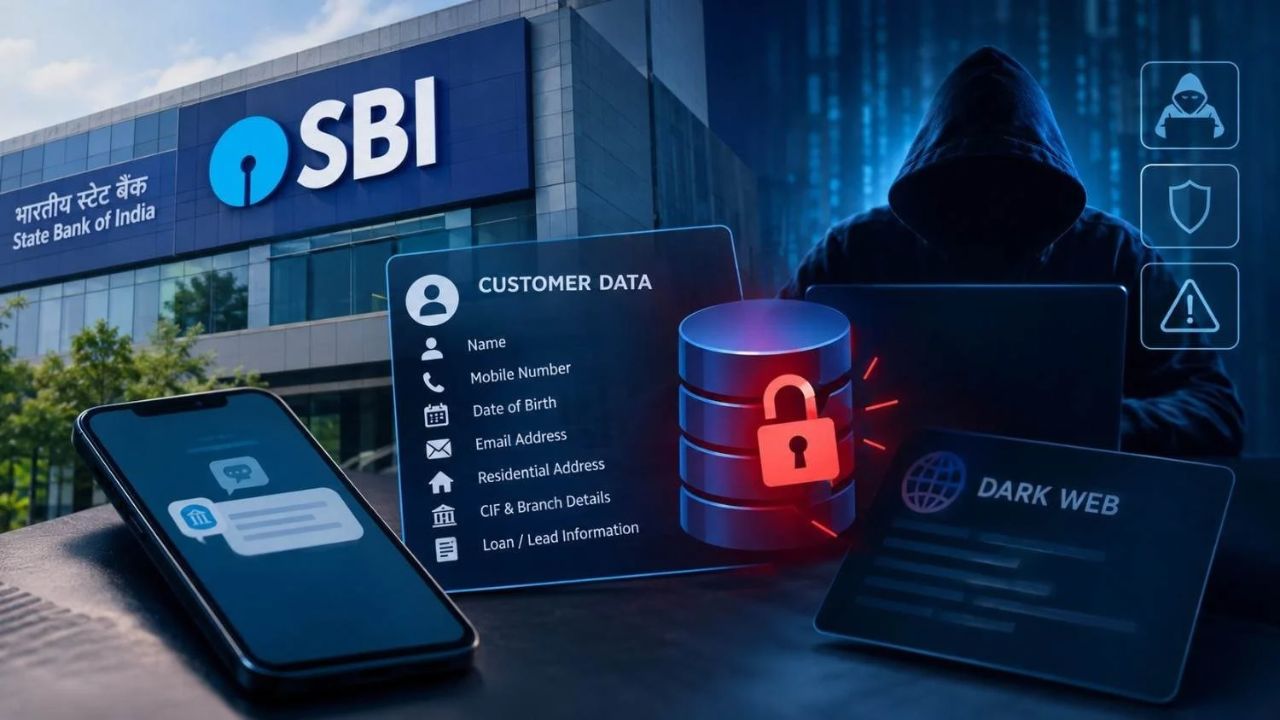
The State Bank of India (SBI) is investigating a suspected data leak after personal information linked to 3,897 customers was identified in a dataset found on the dark web. The incident does not currently mean that 3,897 bank accounts have been hacked or that money has been stolen. However, the exposure of personal information can create a different kind of risk. Criminals can use such details to make phishing calls, impersonation attempts and financial scams appear more convincing.
SBI disclosed the incident in a filing with the stock exchanges on October 21. The bank said its preliminary examination covered around 3.75 lakh records available on the dark web. Of these, 3,897 records were identified as containing personally identifiable information (PII).
The incident also raises a larger question for India’s banking and FinTech industry: how can financial institutions protect customer data when information is constantly moving between banking systems, apps, APIs, employees, vendors and third-party platforms?
What Exactly Has SBI Confirmed So Far?
SBI said it received alerts on October 16 from its Threat Intelligence Service Provider, the Defence Cyber Agency and the Indian Computer Emergency Response Team (CERT-In) about the suspected exposure.
Read More | Japan Declares Cybersecurity Emergency as AI-Driven Attacks Expose 14 Million Citizens’ Data
The information identified in the dataset includes customers’ names, gender, registered mobile numbers, dates of birth, email addresses and residential addresses. The records also contain branch details, Customer Information File (CIF) identifiers, lead IDs and metadata associated with loan and lead records.
SBI has activated its cyber incident response and containment procedures. It has also appointed an independent cybersecurity agency empanelled with CERT-In to investigate the incident. The bank said a detailed assessment is required to establish the authenticity and completeness of the exposed data, identify its possible source and determine the extent of the exposure.
In its exchange filing, SBI said, “The Bank promptly activated its cyber incident response and containment protocols.”
The lender added that the incident has not had a material impact on its business operations, financial performance or business continuity. “The Bank’s core business functions continue to operate normally without disruptions,” SBI said.
Why Is a Dark Web Data Leak a Serious Concern?
The dark web is not automatically a place where every piece of information is stolen. However, it has become a marketplace and communication layer where cybercriminals can share, sell or publish stolen information.
For banks, the concern is not only the loss of data itself. It is what criminals can do with that data afterwards. A name and mobile number may appear harmless on their own. But when combined with an address, date of birth, loan information or customer identifier, they can provide enough context for a scammer to create a believable story.
This is particularly dangerous in financial services because customers are accustomed to receiving calls about loans, credit cards, account verification and transactions. A scammer who already knows some of a customer’s information may therefore sound much more credible than someone making a completely random call.
Does the SBI Data Leak Mean Your Bank Account Has Been Hacked?
Not necessarily. A personal data exposure and unauthorised access to a bank account are two different things. SBI’s preliminary findings identify personal information and loan-related metadata among the exposed records. The information currently available does not establish that customer passwords, PINs, account credentials or transaction details have been compromised.
It also does not establish that 3,897 bank accounts were accessed or that money was withdrawn from those accounts. The bank is still investigating where the information came from and whether the exposed records are authentic and complete.
Customers should therefore avoid panic while taking sensible precautions. The immediate concern is that exposed information could be used as a starting point for targeted fraud.
How Could Leaked Customer Data Be Misused?
Sarthak Dubey, Co-founder and COO at Mitigata, told the media that sensitive customer information can exist across many systems outside a bank’s core infrastructure.
“Loan applications, KYC documents and account-opening forms typically sit across loan origination systems, employee email accounts, shared drives and third-party platforms used by sourcing agents and document-processing vendors. These systems can create exposure beyond a bank’s core banking infrastructure,” he said.
According to Dubey, possible entry points can include compromised employee or vendor credentials, phishing, infostealer malware and incorrectly configured storage systems or application programming interfaces (APIs). However, the exact source of the SBI exposure has not yet been established.
“Investigators will need to establish whether the data originated from SBI’s systems, a third-party service provider or another source before drawing conclusions,” Dubey said.
The problem goes beyond simply losing a database. “The danger is not just that someone has your data. It is that they can use it to make a fraudulent interaction look entirely legitimate,” he added.
Could AI Make Financial Scams More Convincing?
AI is adding another layer to the problem. A criminal does not necessarily need sophisticated hacking skills to make use of leaked information. AI tools can help analyse large datasets, generate personalised messages, translate communications and create convincing scripts for fraudulent calls.
For example, a scammer could potentially use known customer information to create a highly targeted phishing message instead of sending the same generic message to thousands of people. AI-generated voice technology can also make impersonation attempts harder to identify by allowing criminals to mimic voices or create realistic conversations.
This makes data protection increasingly important. The more information criminals have about a person, the easier it can become to construct a convincing social-engineering attack. For banks and FinTech companies, cybersecurity therefore has to address both the theft of data and its potential use in automated fraud.
Why Banks Must Secure More Than Core Banking Systems
A modern bank is no longer a single computer system. Customer information can move through mobile applications, internet banking platforms, payment systems, loan-processing software, cloud infrastructure, APIs, call centres, employee systems and third-party service providers.
This creates multiple potential points of exposure. Dubey said the SBI incident highlights the need to secure every system through which customer information passes rather than concentrating only on core banking infrastructure. That means banks need visibility across their entire digital environment.
Read More | Google Launches Gemini 4 Argon With a Strong Focus on Cybersecurity
A database may be secure, but an incorrectly configured cloud storage system, outdated application, exposed API or compromised employee account can still become an entry point for attackers.
How Third-Party FinTech Platforms Can Become a Weak Link
Banks increasingly depend on external technology providers for services ranging from KYC processing and lending to analytics, cloud computing and customer support. This can improve efficiency, but it also creates additional security responsibilities.
If customer information is shared with a vendor, the bank needs to know where that information is stored, who can access it, how it is transmitted and how long it is retained. Vendor cybersecurity checks should therefore be treated as part of the bank’s security programme rather than as a separate administrative exercise. Access should also be limited to only the information and systems a vendor actually needs.
Why APIs Are Becoming a Major Cybersecurity Target
APIs allow different software systems to communicate with each other. They are essential to modern banking and FinTech services, but poorly protected APIs can expose sensitive information. Banks can strengthen API security through authentication, authorisation, encryption, rate limits, continuous monitoring and regular security testing.
Access logs can also help security teams identify unusual activity, such as a system suddenly requesting unusually large amounts of customer information. The goal is not to stop banks from using APIs. It is to make sure that every connection is authenticated, monitored and restricted.
How Can Technology Help Keep Banking Data Secure?
Technology can reduce the risk of data theft, although no single security tool can guarantee complete protection. Encryption can make stolen information harder to use by converting readable data into an encoded format. Sensitive information should be protected both when it is stored and when it is being transmitted.
Tokenisation can replace sensitive information with tokens that have limited value outside the authorised system. This can reduce the amount of usable financial information exposed if another system is compromised.
Multi-factor authentication can provide another layer of protection when a password or credential is stolen. Zero-trust security takes a more restrictive approach. Instead of automatically trusting a user or device because it is inside a corporate network, access is continuously verified based on identity, device, permissions and other security signals. Banks can also use security monitoring systems to detect unusual login behaviour, abnormal data transfers and suspicious access patterns.
How Can AI and Machine Learning Help Banks Detect Fraud?
The same technology that can make attacks more sophisticated can also help banks defend themselves. AI and machine learning systems can analyse large volumes of transactions and user activity to identify patterns that may indicate fraud.
For example, a system could flag unusual transaction behaviour, unexpected account access, abnormal device activity or a sudden change in a customer’s normal behaviour. AI can also help security teams prioritise alerts. Instead of treating every unusual event equally, automated systems can identify activity that deserves immediate investigation.
Read More | North Korean Hackers Develop AI Tools to Automate Cyberattacks: Report
However, AI should complement human security teams rather than replace them. False positives, incomplete data and new attack techniques can still challenge automated systems.
What Should SBI Account Holders Do?
Customers do not need to automatically close their accounts because of the reported exposure. They should, however, be cautious about unexpected communications involving their banking information.
Never share an OTP, PIN or password, even if the caller claims to be from SBI. Keep transaction alerts enabled and regularly review account activity. Report transactions that you do not recognise immediately.
Customers should use SBI’s official website, app or verified customer-service channels rather than clicking on links received from unknown senders. It is also useful to monitor credit reports for unfamiliar loans, credit cards or credit enquiries.
If a customer suspects financial fraud, they should report it immediately through India’s cybercrime helpline at 1930 or the official cybercrime reporting system, and contact SBI through its official channels. Most importantly, customers should remember that a caller knowing their name, mobile number or other personal information does not prove that the caller is genuine.
What Can SBI Do Now?
SBI’s immediate priorities should be to establish where the exposed data came from, contain any ongoing exposure and protect potentially affected customers. The bank needs to verify the sample data, establish its origin and recency, identify the systems or third parties involved and determine the potential scale of the incident.
It should also review employee and vendor credentials, access permissions, storage systems and API connections for possible weaknesses. If affected customers are identified, the bank should provide appropriate guidance and strengthen fraud monitoring around those accounts.
As Dubey told the media, “A breach response cannot end with closing the vulnerability. The real test is whether the organisation can prevent the stolen information from being turned into fraud.”
Can Banks Prevent Similar Data Leaks?
No security system can make a bank completely immune to cyberattacks. The objective is to make attacks harder to execute, detect them quickly and limit the damage when something goes wrong. Banks need to follow a layered security model that combines encryption, identity controls, multi-factor authentication, network monitoring, endpoint protection, API security and regular vulnerability testing.
They also need to examine the security practices of vendors and other organisations that handle customer information. Regular employee training remains important as well. Phishing and stolen credentials continue to be common routes into corporate systems, making employees an important part of the security chain. Data minimisation can further reduce risk. If a system does not need certain customer information, it should not automatically have access to it.
Are SBI’s Core Banking Operations Still Normal?
SBI has said that the suspected data exposure has not materially affected its core business operations, financial performance or business continuity. The investigation is continuing, and the bank has said it will take appropriate remedial and preventive measures based on its findings.
For customers, the SBI incident is a reminder that banking security extends beyond passwords and transaction systems. Personal information itself has value.
Read More | India Expands Cyber Defence Push as Government Orders Sector-Wide Drills Against AI-Powered Cyber Threats
The larger challenge for banks and FinTech companies is therefore to secure the entire customer-data chain, from the moment information is collected to the systems where it is stored, processed and shared.
For customers, the message is equally straightforward: stay alert, verify unexpected requests independently and never share confidential banking credentials.

Indrani Priyadarshini is a journalist and editorial professional specialising in technology, artificial intelligence, smart cities, green energy, and digital transformation. With over four years of experience in tech journalism and digital media, she is known for turning complex industry developments into clear, engaging, and insightful stories. Her expertise spans reporting, editorial strategy, digital publishing workflows, and in-depth coverage of emerging technologies shaping the future.