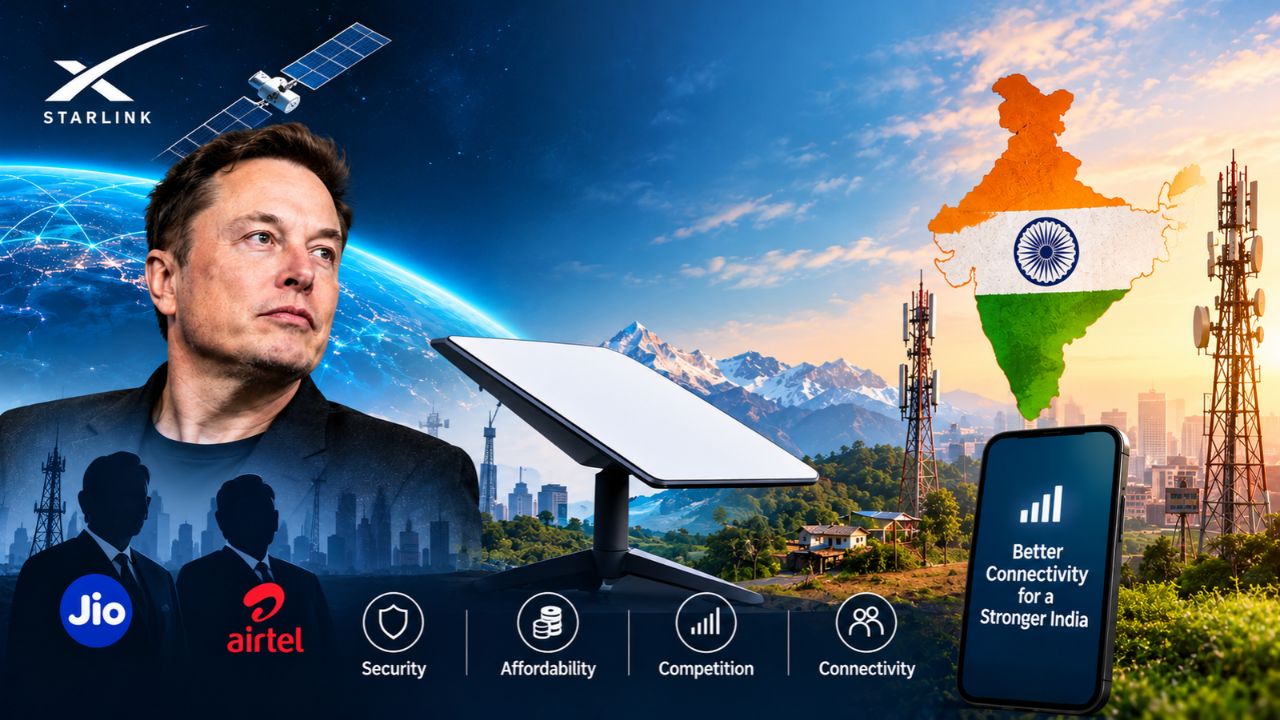
Elon Musk has accused powerful Indian business interests of blocking Starlink to protect their dominance over the country’s telecom market. In a post on X, he wrote: “Unfortunately, we are being blocked by certain oligarchs in order to maintain their monopolistic chokehold on the Indian people. You can guess who they are. This is a crime against the people of India!”
The SpaceX founder’s comments triggered a heated debate online, with some users supporting his demand for greater competition and others questioning whether his campaign was really about improving internet access or expanding his business in India.
The controversy took another turn when an X user shared a response from Grok, Musk’s artificial intelligence chatbot, listing the potential disadvantages of allowing Starlink to operate in India. The response highlighted national security, data protection, affordability and dependence on a foreign technology provider.
The debate raises an important question: if Indians deserve better internet connectivity, should Starlink be welcomed without hesitation? Or should the government be more cautious about giving a foreign company greater control over an essential part of the country’s digital infrastructure?
The answer lies somewhere between the two positions. India needs better connectivity and more competition, but neither Musk’s claims nor the government’s assurances should be accepted without scrutiny.
Why is Elon Musk accusing Indian business leaders of blocking Starlink?
Starlink is SpaceX’s satellite internet service. Unlike conventional broadband, which relies on fibre-optic cables or mobile towers, it uses satellites in low Earth orbit to provide internet connectivity to compatible terminals on the ground.
Musk’s argument is that Starlink could give Indian consumers another option in a market dominated by a small number of large telecom operators. He believes that keeping the service out of India limits competition and denies people access to better connectivity.
His comments were widely interpreted as targeting Reliance Jio chairman Mukesh Ambani and Bharti Airtel chairman Sunil Mittal, whose companies dominate India’s telecom market. However, an allegation of deliberate obstruction is not proof that either company has engaged in anti-competitive conduct.
Read More | Reliance Jio Unveils 1,600-Satellite Plan to Challenge Starlink in India
The Indian government has rejected Musk’s suggestion that regulatory decisions are being influenced by powerful business interests. It has maintained that satellite operators must meet the applicable security requirements and obtain the necessary approvals before offering services commercially.
The dispute has also drawn attention to the relationship between India’s telecom companies and satellite internet providers. Both Jio and Airtel have entered into partnership arrangements with Starlink, demonstrating that the relationship between established operators and the satellite provider is not simply one of opposition.
So, is Starlink being deliberately kept out of India, or is it facing the same regulatory hurdles as other satellite operators? Answering that question requires looking beyond social media posts and examining the approval process.
What did Grok say about the disadvantages of Starlink in India?
The viral Grok response added an unexpected dimension to the controversy. While Musk argued that Starlink’s absence was hurting Indian consumers, the chatbot identified several concerns that policymakers would need to address.
These concerns can be grouped into four broad areas.
National security risks: Satellite internet can provide connectivity without depending on local mobile towers. This is valuable in remote regions, but it can also create enforcement challenges in border areas and other sensitive locations. Authorities need effective ways to identify terminals, enforce lawful restrictions and respond to security threats.
Data sovereignty and lawful interception: India must ensure that communications services operating within its jurisdiction comply with applicable laws. Satellite networks can involve complex international infrastructure, making it important to understand where data is processed, who can access it and how lawful government requests are handled.
Affordability: Starlink requires specialised equipment and a subscription. Even if the monthly fee is reduced, the initial cost of purchasing and installing a terminal could put the service beyond the reach of many Indian households.
Dependence on a foreign provider: If critical businesses, public institutions or emergency services become heavily dependent on one foreign-controlled network, disruptions or changes in commercial and geopolitical relationships could create risks. India would need alternative systems and clear safeguards to avoid excessive dependence.
These are legitimate issues to examine, but Grok’s response should not be mistaken for an official security assessment. It identifies potential risks; it does not prove that Starlink will necessarily create those problems.
Is India’s telecom market a monopoly?
Musk’s criticism has found an audience partly because India’s telecom market has become highly concentrated.
Read More | Reliance Enters Satellite Race—Is India Building Its Own Starlink Rival?
Reliance Jio and Bharti Airtel are the country’s two leading telecom operators. Vodafone Idea remains another major player, while BSNL serves consumers across the country. However, the competitive position of these companies differs between mobile services, wired broadband and other connectivity segments.
TRAI’s broadband market-share figures for January 2026 put Jio’s share at 49.16% and Airtel’s at 34.13%. Together, they accounted for approximately 83.3% of broadband connections in that dataset. These figures point to significant market concentration.
Nevertheless, a market dominated by two large operators raises questions about consumer choice, pricing and the availability of alternatives. What happens if customers have few practical options in their area? How easily can they switch providers? Are smaller competitors able to access the infrastructure and resources they need to compete?
These are questions regulators should continue to examine, and Starlink could introduce another form of competition, particularly in places where conventional broadband is difficult to provide. But satellite internet is not a direct replacement for mobile networks or fibre connections. Its equipment costs, service characteristics and business model make it better suited to certain use cases than others.
The arrival of Starlink would therefore not automatically solve India’s telecom competition problem. It could, however, give consumers and businesses another option where existing services fall short.
Does India actually need Starlink?
India could benefit from satellite internet, particularly in areas where reliable terrestrial connectivity remains difficult or expensive to deliver. But the country does not need Starlink at any cost, nor should one company be treated as the only answer to its connectivity challenges.
Consider a resort in the Himalayas, a research station in a remote forest or a small business operating in a village far from a fibre network. Reliable internet could help these establishments manage bookings, communicate with customers, use cloud-based tools and access digital services.
Satellite connectivity could also support schools, healthcare centres and public institutions in underserved areas. Doctors could conduct remote consultations, teachers could access online learning resources, and businesses could reach customers beyond their immediate location.
There is also a role for satellite networks during emergencies. Floods, landslides, cyclones and earthquakes can damage terrestrial infrastructure and interrupt communications. Satellite connections could provide an alternative when conventional networks are disrupted, although emergency services should never depend on a single commercial provider. These benefits are particularly relevant in a country as geographically diverse as India.
Read More | Starlink to Pilot Satellite Connectivity in Meghalaya’s Hard-to-Reach Areas
However, satellite internet has limitations. It cannot replace the need for mobile towers, fibre-optic networks and reliable electricity. Service performance can also depend on congestion, obstructions and local conditions. In densely populated urban areas, existing fibre and mobile broadband services may remain more practical and affordable.
The question, then, is not whether India should have satellite internet. It is where the technology provides the greatest value, who can afford it and how it can complement existing infrastructure.
How much will Starlink cost Indian consumers?
Affordability could determine whether Starlink becomes a useful alternative for a broad range of Indian customers or remains a specialised service for businesses and wealthier households. Musk has said that Starlink would need to be affordable to succeed in India. However, a promise of affordability is not the same as a confirmed price.
Read More | Starlink India Pricing Revealed: Satellite Internet Nears Official Launch
The total cost involves more than the monthly subscription. Customers may also need to purchase a satellite terminal, router and installation services. For households already using inexpensive mobile data, these additional expenses could make the service difficult to justify.
For context, Starlink’s website briefly displayed Indian pricing in December 2025, including a monthly plan of ₹8,600 and a hardware kit priced at ₹34,000. Those figures were subsequently clarified as not being officially announced Indian prices and should not be treated as current tariffs.
A final assessment will require confirmed Indian pricing, details of any installation charges, service terms and evidence of actual performance after launch. The potential customers most likely to benefit include remote businesses, tourism operators, institutions and organisations that lack reliable alternatives. For many urban households, conventional broadband may continue to offer better value.
Could Starlink change the market if it introduces substantially lower prices? Possibly. But until its Indian tariffs are officially announced, claims about how affordable the service will be remain speculative.
Why is the Indian government concerned about security?
Satellite internet is not simply another consumer product. Communications networks can be important to national security, emergency response and the functioning of essential services.
Starlink’s small terminals can be installed in locations where conventional infrastructure is unavailable. That flexibility is one of the technology’s biggest advantages, but it also makes regulatory oversight important.
Indian authorities need to understand how terminals are identified, how service restrictions can be enforced in sensitive areas and how the operator responds to lawful directions. They must also assess data handling, network access and the technical arrangements needed to meet India’s regulatory requirements.
Reports of Starlink equipment being recovered during investigations in India have added to these concerns. However, the presence of a device during an investigation does not, on its own, establish wrongdoing by Starlink or SpaceX.
The government has maintained that security checks and other regulatory requirements apply to satellite operators. Reports reviewed for this article indicate that Jio Satellite Communications, Eutelsat OneWeb and Starlink have all been involved in the process, with their compliance demonstrations taking place at different times.
Read More | Starlink Resubmits Application for Gen 2 Satellite Constellation in India
This chronology matters. It complicates the claim that Starlink is being singled out solely to protect existing telecom businesses. At the same time, it does not mean every regulatory decision should be accepted without question.
The government should explain outstanding requirements and approval milestones as clearly as possible without disclosing sensitive technical information. Independent testing and enforceable compliance conditions would help establish whether the concerns are being addressed adequately.
Is Musk fighting for Indian consumers or his own business?
This is perhaps the most important question raised by the controversy. Musk has presented Starlink’s entry as a matter of consumer choice and better connectivity. There is a valid argument behind that position: greater competition can encourage companies to improve their services, invest in infrastructure and offer better value.
However, Starlink is also a commercial venture. India represents a significant potential market and securing regulatory approval would allow SpaceX to expand its customer base and generate revenue. Musk’s business interests therefore need to be considered alongside his public statements about consumer welfare.
His wider commercial activities also show why governments should be cautious about treating technology companies as neutral participants. Companies compete for markets, protect their commercial interests and operate within broader geopolitical relationships. These incentives do not automatically make their products harmful, but they mean that public-interest claims should be examined critically.
The same standard should apply to India’s established telecom operators. Their investments in networks and services are important, but their market positions should not shield them from scrutiny if credible evidence of anti-competitive conduct emerges.
The Competition Commission of India should investigate such evidence where appropriate. Equally, Musk’s allegations should not be treated as proof of wrongdoing simply because he has a large public platform.
India should neither make regulatory decisions to please a foreign billionaire nor allow established domestic businesses to enjoy protection from fair competition.
What should India do next?
The government has an opportunity to move the debate away from personalities and towards a clearer framework for connectivity, competition and security. First, it should provide a transparent approval roadmap for satellite internet operators. The public should be able to understand the broad requirements that remain outstanding, even if sensitive technical details must remain confidential.
Second, the same applicable security and operational standards should be enforced consistently across Starlink, Jio Satellite Communications, Eutelsat OneWeb and future entrants. No operator should receive preferential treatment, and no company should be excluded without a clear regulatory basis.
Third, security claims should be independently tested. Regulators should assess whether companies can comply with lawful interception requirements, protect data and respond effectively to emergencies. Company assurances alone are not enough.
Fourth, India should strengthen competition oversight. Regulators must examine whether consumers have meaningful alternatives, whether smaller providers can compete and whether dominant companies engage in exclusionary practices.
Fifth, affordability should remain central to connectivity policy. Satellite internet could be valuable for schools, healthcare facilities and remote public institutions, but any public support should be tied to clear outcomes rather than given to one company without conditions.
Finally, India should continue building its own digital infrastructure. Domestic satellite capabilities, fibre networks, telecom equipment and resilient emergency communications can reduce dependence on any single provider. The objective should be to create a market where consumers benefit from competition while the country retains the ability to protect its strategic interests.
Where is the Starlink controversy heading?
The next phase will depend on regulatory decisions, spectrum allocation, security compliance and Starlink’s ability to offer a commercially viable service. If the outstanding requirements are met, Starlink could begin a phased launch, potentially focusing first on businesses and locations where terrestrial broadband is limited. Its success will depend on actual pricing, coverage, reliability and customer demand.
If approvals remain delayed, Musk may continue to challenge the government publicly. That could intensify questions about transparency, but it would not by itself prove that the process is politically motivated.
A third possibility is that India’s satellite internet market develops into a more competitive environment, with Starlink, Jio Satellite Communications and OneWeb serving different customers and use cases. That would give regulators a stronger basis for comparing their prices, services and compliance.
The debate could also become more politically sensitive if market access is drawn into wider diplomatic or trade discussions. India would need to keep commercial competition separate from decisions involving national security.
The developments to watch are straightforward: a formal announcement on spectrum allocation, confirmation of Starlink’s remaining approvals, publication of Indian tariffs and any credible evidence of anti-competitive conduct.
Indians deserve reliable internet, meaningful choice and services they can afford. Starlink could help deliver some of those benefits, especially in remote areas. But neither Musk’s promises nor the government’s assurances should replace evidence, accountability and transparent regulation.
India does not have to choose between welcoming satellite internet and protecting its national interests. It needs a framework that can do both.

Indrani Priyadarshini is a journalist and editorial professional specialising in technology, artificial intelligence, smart cities, green energy, and digital transformation. With over four years of experience in tech journalism and digital media, she is known for turning complex industry developments into clear, engaging, and insightful stories. Her expertise spans reporting, editorial strategy, digital publishing workflows, and in-depth coverage of emerging technologies shaping the future.