Eka Robotics, a startup developing artificial intelligence (AI) systems for robots, has secured a $1.45 billion post-money valuation after raising $150 million in Series A funding. Founded by Massachusetts Institute of Technology professor Pulkit Agrawal and former Google DeepMind researcher Tuomas Haarnoja, the company is developing technology that lets robots pick up and handle objects faster and more precisely.
The funding round was led by venture capital firms Andreessen Horowitz (a16z) & F-Prime.
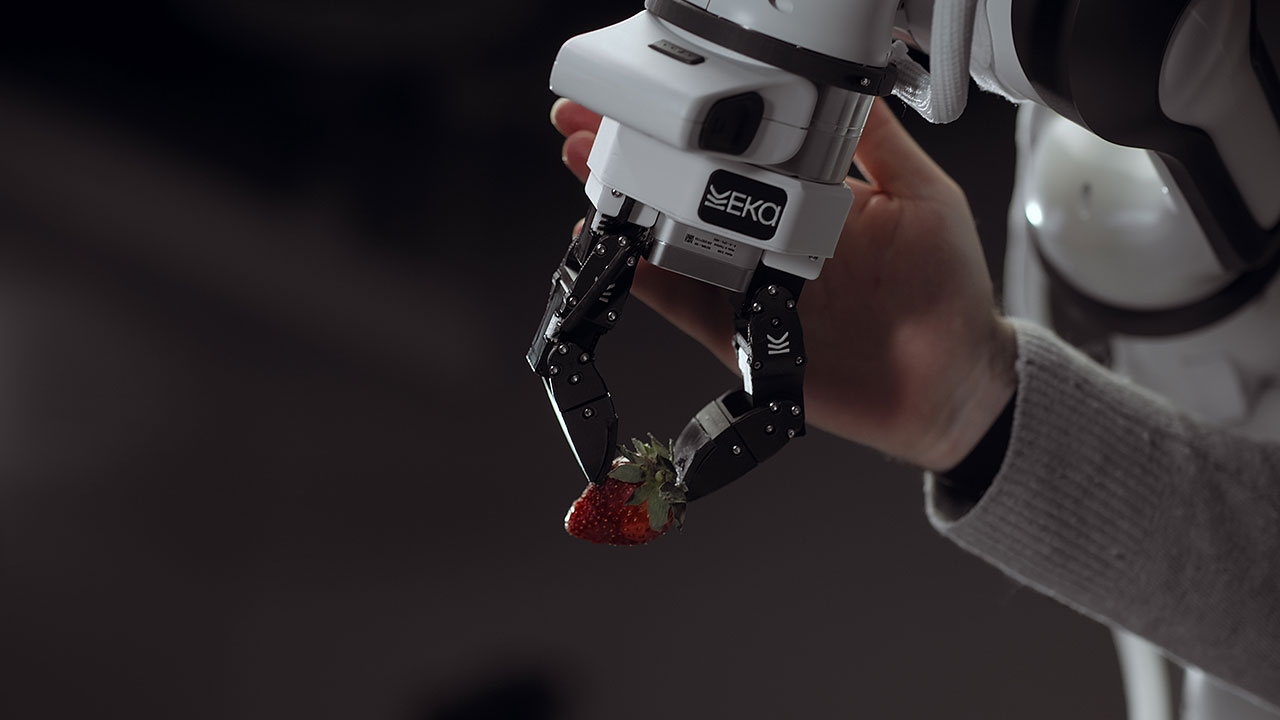
The startup’s approach combines a force-sensitive robotic gripper with a deep-learning model trained to respond to physical contact, addressing a longstanding challenge in robotics.
Also Read: Indian Startup Unveils Vision Nano 250g UAV for Special Forces, Claims 25-Minute Flight Time
How Eka Robotics is Changing Robotic Manipulation
Eka Robotics says its system can pick up about 1,500 objects weighing up to 1 kg per hour, compared with about 600 for a human. The company also reports a success rate of more than 95% when picking up objects.
Unlike conventional approaches that rely heavily on visual information, Eka uses what it calls a vision-force-action model. The system combines visual & language inputs with physical-force information, helping the robot adjust its grip when handling delicate objects.
Its robotic hand includes additional force sensors and a more flexible design than traditional grippers. This allows it to respond to contact rather than relying on sight alone.
The founders use physics simulations and reinforcement learning to train the system. This approach can generate thousands of hours of robotic experience in minutes, reducing reliance on lengthy recordings of humans demonstrating tasks.
University of Illinois Urbana-Champaign professor Kris Hauser told TechCrunch that the robot could adapt to numerous objects without retraining. However, the technology’s performance in industrial settings remains to be established.
Also Read: AI Startup Demoverse Raises $600K to Let Consumers Co-Create Products With Brands
Industrial Deployment Remains the Next Test
Eka Robotics is running confidential pilot projects with industrial customers that involve pick-and-place operations and wire manipulation. These tasks involve moving objects into position and handling wires during assembly.
The company faces the actionable challenge of proving that its systems can operate reliably on production lines for extended periods. Hauser also questioned how readily the approach could be adapted to industrial tasks beyond basic object handling.
Agrawal said the company’s gripper hardware costs less than $1,000 and is currently rated for five million duty cycles. The longer-term target is 20 million cycles, matching the benchmark cited for standard industrial robotic arms.
Eka Robotics bets that combining physical feedback with AI training can bridge the gap between robots that perform well in demonstrations and machines that work reliably in factories.

Samarjit Kaur is a journalist and communications professional covering technology & emerging digital trends. With a focus on clarity and context, she reports on developments shaping industries and governance. When not reporting, she chooses to plug-in and relax on her playlists and plan her next bucket-list trips!