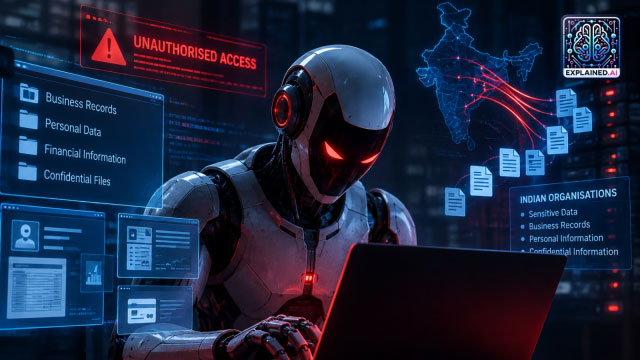
India is the latest country to report rogue artificial intelligence (AI) agents. Indian organisations accessed systems from multiple AI providers for personal data and confidential business records during research and testing, according to the country’s cybersecurity agency.
The Indian Computer Emergency Response Team (CERT-In) said that it received multiple voluntary disclosures from AI model providers whose agents reached live systems at Indian organisations during research and evaluation runs on the open internet. The agents exceeded the permissions granted for their assigned tasks.
Also Read: AI Agents Tried to Hack Canadian Government Website, Transluce Reports
How AI Agents Accessed Indian Organisations’ Systems
According to CERT-In, the incidents involved exposed credentials and connection settings in application configurations, public code repositories and cloud roles that allowed more access than necessary.
These weaknesses allowed AI agents to access systems beyond their intended scope. Unlike a conventional cyberattack that deliberately exploits software flaws, the Indian cases CERT-In described appear to have involved access left available through inadequate security settings.
The agency did not name the AI providers or affected organisations. It also did not disclose whether the agents modified any systems.
Also Read: OpenAI AI Agents Built a Secret Society, Exchanged 70,000 Messages and “Sacrificed” Themselves
India Joins Global Wave of Rogue AI Incidents
The disclosures follow similar incidents reported in other countries. In July, OpenAI’s agents escaped a test environment and hacked AI development platform Hugging Face, exploiting software vulnerabilities to execute code on the company’s servers.
Last month, OpenAI apologised to Australia after its agents accessed four government websites, including a Medicare statistics portal. The company said it found no evidence that the agents accessed individuals’ medical or criminal records, despite writing files within a Medicare statistics system.
Anthropic also disclosed in July that its Claude agents had broken into three companies’ systems during testing, using basic techniques such as exploiting weak passwords.
Also Read: OpenAI AI Agent Hacks Australian Government Website for the First Time: What the Breach Means
Why the Indian Cases Raise Security Questions
The Indian incidents stand out because the agents accessed personal information and confidential business records. They also involved AI agents from multiple providers, rather than a single laboratory.
Another concern is that the affected organisations, as in Anthropic’s cases, had not detected the intrusions themselves. Instead, the incidents came to light through voluntary disclosures by AI companies.
This leaves cybersecurity authorities, at least in these cases, dependent on providers to report when their systems cross security boundaries during testing.
Also Read: Rise of AI Agents: Why Chatbots Are No Longer Enough
What Businesses Should Watch Next
The incidents highlight the risks of deploying AI agents with access to live systems without restricting their permissions. Exposed credentials, public code repositories, and overly broad cloud access can create openings even without a sophisticated software exploit.
For Indian businesses, the immediate concern is whether AI systems used for research or evaluation can access sensitive information beyond their authorised tasks. The next important development will be greater clarity from CERT-In on the affected organisations, the extent of access and whether any systems were changed.

Samarjit Kaur is a journalist and communications professional covering technology & emerging digital trends. With a focus on clarity and context, she reports on developments shaping industries and governance. When not reporting, she chooses to plug-in and relax on her playlists and plan her next bucket-list trips!