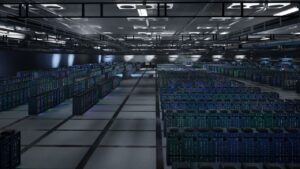
Google is exploring an ambitious idea that could redefine the future of data infrastructure — building AI data centers in outer space. The initiative, reportedly named Project Suncatcher, envisions a constellation of solar-powered satellites orbiting Earth, designed to handle the massive computing demands of artificial intelligence systems.
Data Centers Beyond Earth
According to early design details, Project Suncatcher proposes a network of small satellites, each equipped with solar panels, computing chips, and high-speed communication systems. Working together, these satellites would form a synchronised cluster in orbit — effectively functioning as a single, distributed data center in space.
The system would rely on Google’s Tensor Processing Units (TPUs), chips purpose-built for machine learning workloads. These TPUs have already undergone radiation testing and are capable of operating for up to five years in space without sustaining long-term damage.
To ensure uninterrupted energy supply, the satellites would orbit within regions of constant sunlight, allowing their solar arrays to continuously collect power. This positioning also minimizes the delay in sending data back to Earth, although some latency may still occur depending on ground-based communication hubs.
Also Read| Sustainability in Tech Infrastructure: A Mere Buzzword?
High-Speed Optical Links and Smart Formation Control
A key innovation of the project lies in its use of optical links — systems that transmit data through light rather than traditional radio waves. This enables faster, higher-capacity communication between satellites while reducing signal interference.
Each satellite would maintain a formation roughly a kilometer wide, guided by machine learning models that monitor positioning and prevent collisions. The result would be a tightly coordinated orbital network capable of self-regulation and adaptation to environmental conditions in space.
Cooling Without Air: A Major Design Challenge
One of the toughest engineering challenges for space-based computing is cooling. Since space has no air, heat generated by processors cannot dissipate through convection as it does on Earth. Google’s engineers are reportedly experimenting with advanced thermal materials that can transfer heat efficiently through solid surfaces to radiators, which then release the excess energy into space.
Modular and Cost-Effective Design
Project Suncatcher’s modular approach also marks a strategic shift. Instead of launching one massive structure, Google plans to deploy smaller, self-contained satellites that can function independently. This approach reduces both risk and cost — if one unit fails, the rest of the network can continue operating seamlessly.
The timing may also align with falling launch costs. Industry estimates suggest that by the 2030s, sending payloads to low-Earth orbit could cost as little as $200 per kilogram, making orbital data centers a more feasible reality.
Also Read| Perplexity and Snapchat Team Up in $400M Deal for In-Chat AI Search
The Road Ahead
While still in its research phase, Google’s space data center project signals a long-term vision for sustainable, high-performance AI infrastructure. The company intends to conduct real-world tests involving satellite communications and autonomous flight control in the coming years. Future iterations aim to improve cooling efficiency, radiation resistance, and automated fault recovery — bringing the concept of space-based data centers closer to reality.
If successful, Project Suncatcher could mark a historic step — not just for Google, but for the broader tech ecosystem — by moving one of the most power-hungry parts of AI computation beyond Earth’s atmosphere and into the endless energy of the sun.

Indrani Priyadarshini is a journalist and editorial professional specialising in technology, artificial intelligence, smart cities, green energy, and digital transformation. With over four years of experience in tech journalism and digital media, she is known for turning complex industry developments into clear, engaging, and insightful stories. Her expertise spans reporting, editorial strategy, digital publishing workflows, and in-depth coverage of emerging technologies shaping the future.