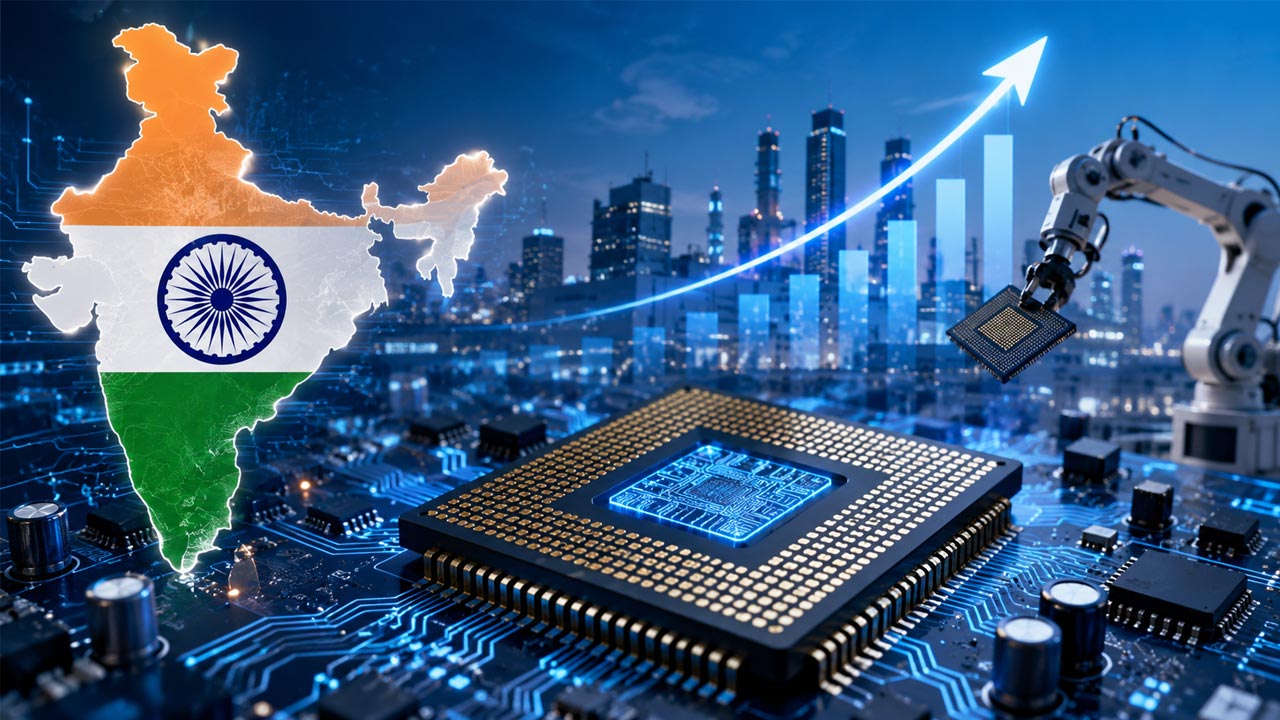
The Indian semiconductor market is on course for rapid expansion, with the domestic market expected to reach $205 billion by 2034.
The projection highlights the growing role of chips in everything from smartphones and data centres to electric vehicles (EVs), artificial intelligence (AI) systems and connected devices.
The sector, valued at around $20 billion in 2020, is now emerging as one of the country’s most closely watched technology growth stories.
Also Read: India’s Semiconductor Mission: From Assembly Hub to Powerhouse
Government Push Strengthens Industry Momentum
A key driver behind the projected growth is continued policy support from the Centre.
Programmes such as the India Semiconductor Mission and ISM 2.0 focus on strengthening domestic chip design, manufacturing capabilities, research, and talent development.
The government’s incentive schemes have also encouraged both domestic and global companies to invest in chip-related projects across the country.
Industry experts say these measures are helping India move beyond basic assembly operations and build a broader semiconductor ecosystem that can support future demand.
AI, EVs and Electronics Fuel Demand
Demand for semiconductors is rising across multiple sectors. The rapid growth of AI applications, the expansion of data centre infrastructure, the rollout of 5G networks and the increasing adoption of EVs are all creating a greater need for chips. Consumer electronics continue to remain a major contributor, while automotive and industrial applications are expected to gain a larger share in the coming years.
India’s ambitions to become a global manufacturing hub are expected to boost semiconductor consumption as more electronic products are assembled and manufactured locally.
Southern India Leads the Semiconductor Landscape
The Indian semiconductor ecosystem is developing across all states. Southern India accounts for the largest share of industrial activity.
Northern states remain another important centre for manufacturing and design, while western and central India are attracting fresh investments. This regional spread is expected to strengthen supply chains and support long-term industry growth.
Also Read: ₹1.2 lakh crore: India Braces for Massive Boost in Semiconductor & Chip Manufacturing Ecosystem
Building Long-Term Self-Reliance
Despite the positive outlook, India still imports a significant portion of its semiconductor requirements. Industry experts believe the next decade will be crucial to reducing this dependence through domestic capabilities in fabrication, packaging, testing and design. Several approved projects under the semiconductor mission are expected to contribute towards that goal.
As global demand for advanced technologies continues to rise, India is positioning itself to become a more important player in the international semiconductor value chain.
India’s semiconductor story is no longer centred solely on future potential. The next phase will be defined by execution, how quickly investments translate into factories, skilled talent and commercially viable chip production. If current momentum holds, the sector could become one of the country’s most significant engines of growth in technology and manufacturing over the next decade.

Samarjit Kaur is a journalist and communications professional covering technology & emerging digital trends. With a focus on clarity and context, she reports on developments shaping industries and governance. When not reporting, she chooses to plug-in and relax on her playlists and plan her next bucket-list trips!