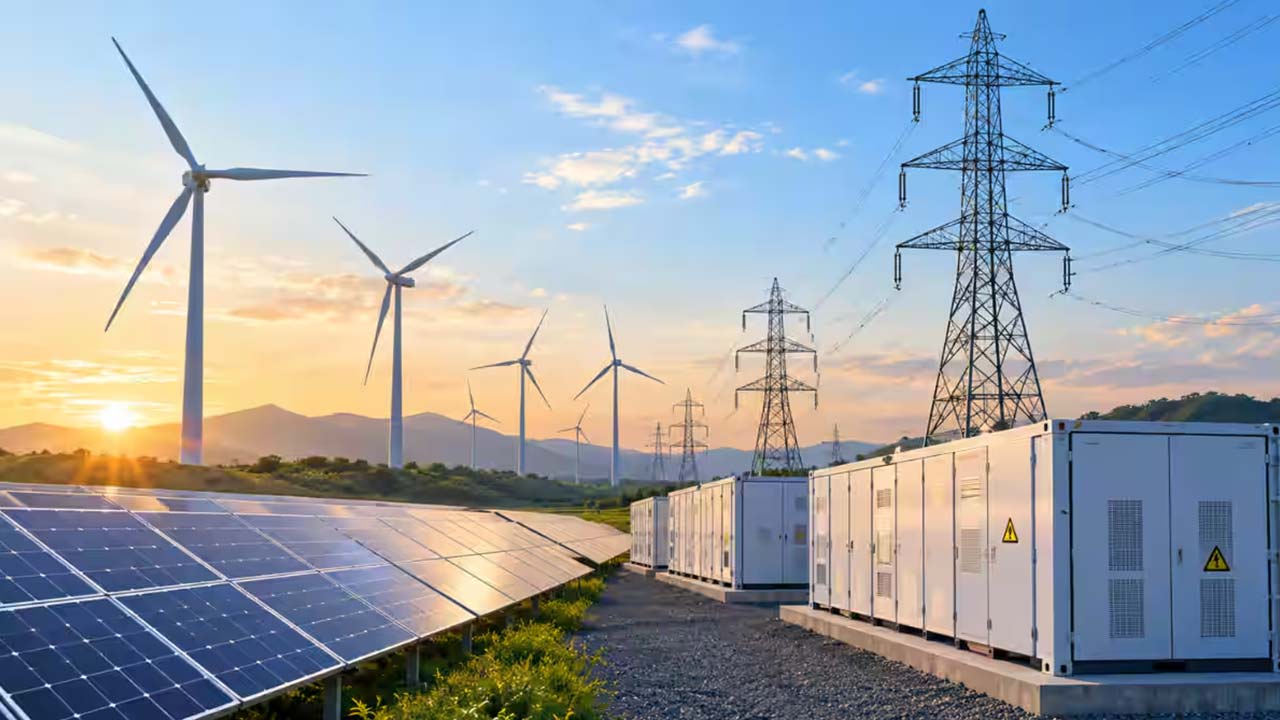
The Union Cabinet has approved the Green Energy Corridor Phase-III (GEC-III), a ₹1,86,405-crore programme to strengthen electricity networks in states and Union territories and enable the evacuation of up to 135 gigawatts (GW) of renewable energy.
The scheme, approved on Wednesday, also includes 50 gigawatt-hours (GWh) of battery energy storage systems (BESS), with the programme targeted for completion by FY 2032-33.
Green Energy Corridor-III to Add Transmission and Battery Storage
The Green Energy Corridor-III addresses a basic problem with solar and wind power: generation is not constant. Solar power is available only when the sun shines, while wind generation depends on weather conditions.
At times, electricity production can also exceed what existing power lines can carry. This can leave some renewable electricity unused, particularly during peak solar generation hours.
Under GEC-III, ₹1,36,378 crore has been earmarked for strengthening the Intra-State Transmission System (InSTS). Another ₹50,000 crore will go towards 50 GWh of BESS.
The batteries can store surplus electricity when generation is high and release it during evening demand peaks or when solar generation is unavailable. Renewable energy developers or generators can install the storage systems at their premises, or at other locations important for grid flexibility.
Also Read: India’s Renewable Energy Problem: Why Green Power Is Going to Waste
₹54,082 Crore Central Contribution; Projects to Follow Two Models
The Central Government will contribute ₹54,082 crore towards the overall programme.
New, or greenfield, transmission projects will be awarded through Tariff Based Competitive Bidding, under which bidders compete on the lowest tariff. Selected Transmission Service Providers will operate the assets under a Build-Own-Operate-Maintain model.
Existing infrastructure upgrades, or brownfield projects, will follow a Cost Plus Basis, where the actual cost is reimbursed along with an agreed margin. State Transmission Utilities will oversee this work.
Information and Broadcasting Minister Ashwini Vaishnaw said at the Cabinet briefing that India’s power generation capacity has crossed 500 GW, with renewable sources accounting for 52%.
The Green Energy Corridor-III is linked to India’s target of reaching 900 GW of installed non-fossil capacity by 2035. The government said the programme is intended to reduce fossil-fuel dependence, pollution and carbon emissions while strengthening long-term energy security.
The key number to track now is not only renewable generation capacity, but how quickly transmission and storage infrastructure can keep pace. GEC-III puts both pieces into the same programme, with implementation extending through FY 2032-33.

Samarjit Kaur is a journalist and communications professional covering technology & emerging digital trends. With a focus on clarity and context, she reports on developments shaping industries and governance. When not reporting, she chooses to plug-in and relax on her playlists and plan her next bucket-list trips!