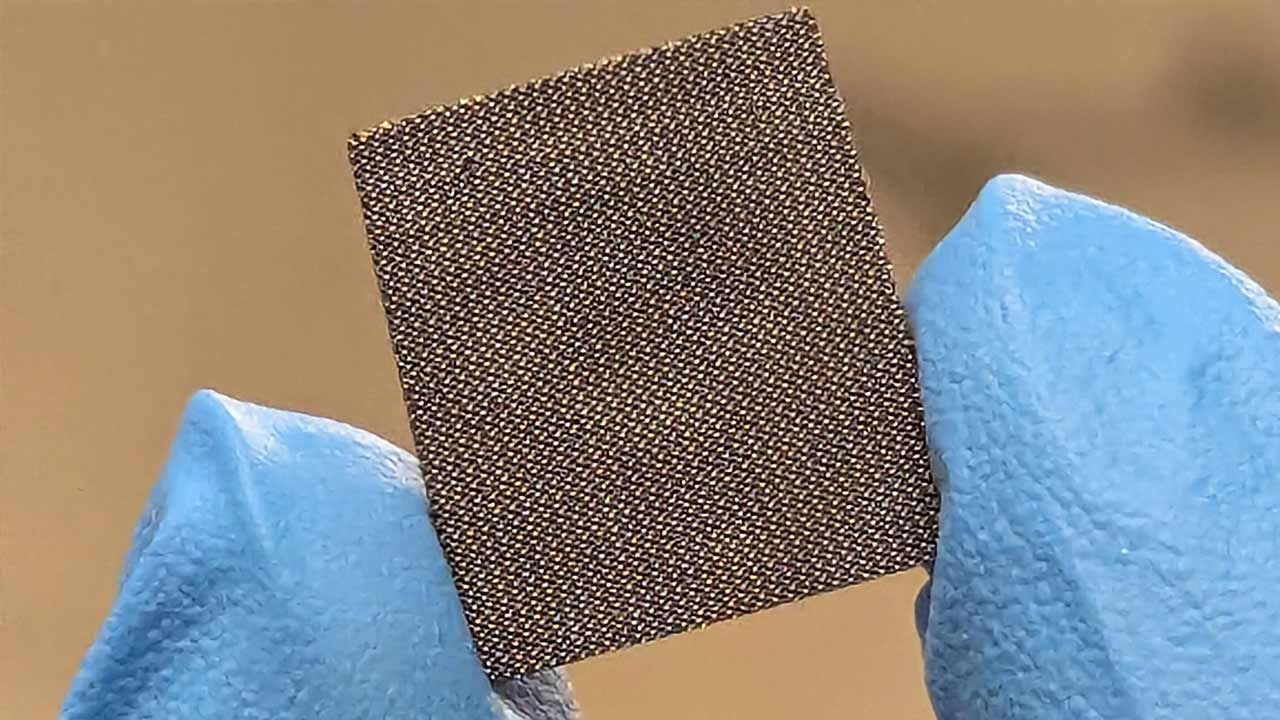
Researchers at the University of Waterloo have developed a 3D-printed electrode that could improve how large amounts of electricity from wind and solar farms are stored.
The design, inspired by structures found in nature, increased the performance of a redox flow battery by 52% in tests and could help make grid-scale renewable energy storage more efficient.
Also Read: Adani Green Hits 20 GW Renewable Milestone, Strengthening India’s Clean Energy Leadership
3D Printing Targets a Key Problem in Renewable Energy Storage
The research team, led by University of Waterloo chemical engineering professor Dr Maxime van der Heijden, redesigned an important component of redox flow batteries (RFBs).
Unlike lithium-ion batteries used in phones, electric vehicles and many energy-storage systems, RFBs store energy in liquid electrolytes held in external tanks. The system uses water-based electrolytes, which make it a potentially safer option for large-scale storage than batteries that use flammable materials.
Another advantage is scalability. Increasing the size of the electrolyte tanks can increase the amount of energy stored, making redox flow batteries suited to grid and community-scale applications.
That matters as wind and solar generation grows. Both sources are intermittent, meaning electricity is not always produced when demand is highest. Storage systems can hold excess power and return it to the grid when required.
Nature-Inspired Electrode Delivers 52% Performance Gain
The researchers used 3D printing to produce porous electrodes with greater control over their internal structure and the flow of liquid through them.
They tested several triply periodic minimal surface (TPMS) designs — complex, repeating three-dimensional structures that can resemble patterns found in nature. The diamond-shaped design performed best, improving performance by 52%.
The structures were produced using a digital light-processing 3D printer and then heat-treated to form conductive carbon electrodes capable of carrying electricity.
The team tested the electrodes first in laboratory flow-cell experiments and then in a working vanadium redox flow battery. The tests showed that the printed structures could operate inside a functioning battery.
The study, published in the Journal of Energy Storage, is a proof of concept rather than a commercial deployment. Researchers now plan to increase electrode surface area, improve manufacturing methods, and explore advanced design tools to achieve more efficient structures.
The findings put 3D-printed electrode design alongside other efforts to improve the efficiency and scalability of long-duration renewable energy storage, with the next step focused on refining the technology for larger-scale applications.

Samarjit Kaur is a journalist and communications professional covering technology & emerging digital trends. With a focus on clarity and context, she reports on developments shaping industries and governance. When not reporting, she chooses to plug-in and relax on her playlists and plan her next bucket-list trips!