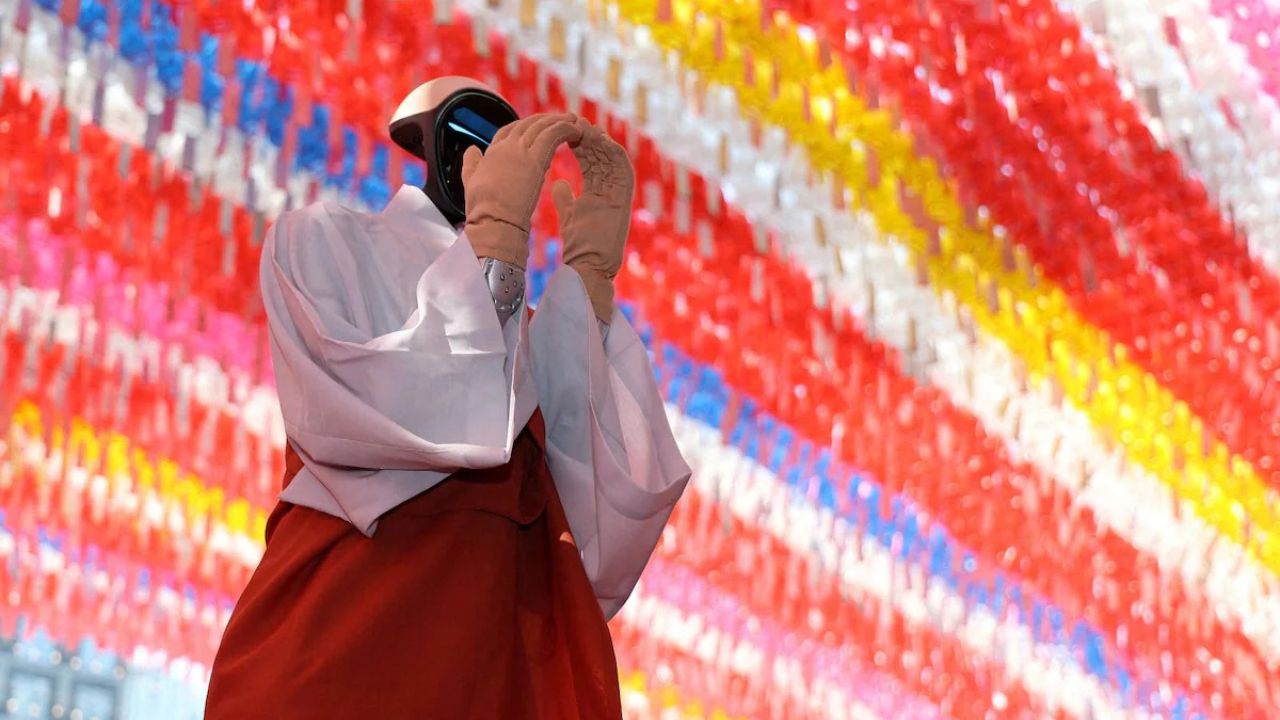
If someone had said a decade ago that humanoid robots would one day stand inside temples, participate in rituals and become part of culturally significant institutions, it would have sounded like science fiction. Yet here we are, watching AI slowly move beyond factories, workflows and automation systems into spaces once considered deeply human.
The latest example is Gabi, the humanoid robot that reportedly became a monk at a Buddhist temple in South Korea. Before that, the humanoid robot Pepper gained attention for performing Buddhist funeral rites in Japan. At first glance, these stories appear bizarre, experimental or even amusing. Social media reactions were quick to dismiss the idea, arguing that robots cannot attain enlightenment, that vows are merely programmed responses and that machines cannot understand rituals they perform.
But perhaps that reaction misses the larger technological story unfolding underneath. This is not really about whether robots are becoming religious. It is about how humanity is reshaping its relationship with intelligent machines.
From Factory Floors to Human Spaces: Is AI Crossing a New Boundary?
For decades, artificial intelligence and robotics were built around one central promise: efficiency.
Machines would automate factories. AI would optimise workflows. Robots would handle repetitive labour. Algorithms would process data faster than humans ever could. That was the original boundary. But something is now changing.
Read More | What Happens if China’s Humanoid Robotics Boom Becomes Its Next Big Crisis?
AI is no longer confined to productivity, coding, customer service or industrial systems. It is now entering symbolic and culturally significant human spaces — spaces once viewed as socially exclusive.
And that changes the conversation entirely.
For years, humanoid robotics focused primarily on utility. Machines were designed to lift objects, assist in warehouses, automate assembly lines and improve industrial productivity. Even conversational AI largely existed inside smartphones, enterprise software and support systems.
Now the role of humanoids is evolving rapidly.
Read More | Is the AI Revolution Built on Genius or on Gimmicks?
They are becoming receptionists, assistants, companions, educators and public-facing social entities. Their purpose is no longer just functional. It is increasingly relational.
And that transition, from functional AI to socially embedded AI, may become one of the defining technological shifts of this decade.
What Happens When Machines Stop Feeling Like Tools?
Religious spaces simply make this transition more visible.
Temples and ceremonial institutions carry symbolic weight. When a humanoid enters that environment, the reaction becomes stronger because people instinctively view it as crossing an invisible boundary between machine functionality and human identity.
Read More | Are We Confiding Too Much in ChatGPT? OpenAI’s Data Reveals a Disturbing Trend
But is that boundary still fixed anymore?
AI has already entered creative industries once believed to be uniquely human. It now generates music, writes articles, creates visual art and produces films. AI systems are participating in emotional conversations, providing companionship and acting as digital personalities online.
Humanoid robots entering cultural institutions may simply be the next stage of that progression. And if society eventually accepts AI in symbolic spaces, where does that expansion stop?
Read More | Is India Prioritising Data Centres Over Water Security?
Could humanoids eventually become permanent ceremonial assistants? Could they become cultural representatives in museums, public events or national ceremonies? Could AI-powered robots become trusted public-facing figures simply because they are adaptive, scalable and always available?
These questions no longer sound theoretical.
The Rise of Socially Embedded AI
The humanoid robotics industry is rapidly evolving beyond industrial deployment into social deployment. Companies developing humanoids are increasingly focused on conversational realism, facial expressions, emotional interaction and behavioural familiarity.
In other words, robots are not just being engineered to perform tasks. They are being engineered to exist alongside humans naturally.
Read More | Humans Left Behind as ‘Lightning’ Robot Smashes Beijing Half-Marathon Record
That distinction matters. Because once humanoids are designed for social integration, society inevitably begins assigning them symbolic roles. And symbolism changes everything. A factory robot tightening bolts is easy to define. A humanoid participating in a ritual is far more complex because it forces society to confront a difficult technological question:
At what point does a machine stop feeling like infrastructure and start feeling like presence?
Is Society Slowly Accepting AI as Participation?
The discomfort surrounding robot monks may actually reveal a broader public anxiety around AI’s expanding social role.
People were once told AI would replace repetitive labour. Few imagined it would eventually enter spaces linked to culture, tradition and identity.
Yet that is precisely where the technology is heading.
Read More | Humanoid Robots Are Getting Faster: Unitree H1 Nears Elite Human Sprint Speed
Not because machines suddenly developed consciousness, but because humans are increasingly designing systems capable of mimicking participation in human environments.
Modern AI does not understand rituals the way humans do. Humanoids process data, execute programmed behaviours and respond through trained models. Their actions are generated through code, sensors, datasets and machine learning architectures.
But if a humanoid can successfully perform social participation, does society eventually begin treating simulation as acceptance? And if humans culturally accept machine participation, does the distinction between “real” and “artificial” behaviour slowly become less relevant in public spaces?
Are Humanoids Being Built to Assist Humans or Coexist With Them?
Because the rise of socially embedded AI is not just about intelligence. It is about integration.
The convergence of AI, robotics and humanoid systems is steadily pushing machines into areas where technology was previously absent. The future battlefield for AI may no longer be productivity alone. It may be social legitimacy.
And perhaps this is why the robot monk story resonates so strongly online. Not because people genuinely fear a machine joining a temple, but because it symbolises something much larger. It symbolises AI moving beyond utility and entering civilisation itself.
Factories were only the beginning. Now AI is entering institutions, culture and symbolic spaces. Tomorrow, where else might it go?
Read More | LG Group Eyes Humanoid Robotics Supply Chain with Integrated Component Push
And if humanoids continue integrating into environments once considered exclusively human, will society eventually redefine what qualifies as participation, presence and belonging in the age of artificial intelligence?
Or are we witnessing the early stages of a future where machines are no longer viewed as external tools but as embedded actors within human civilisation itself?

Indrani Priyadarshini is a journalist and editorial professional specialising in technology, artificial intelligence, smart cities, green energy, and digital transformation. With over four years of experience in tech journalism and digital media, she is known for turning complex industry developments into clear, engaging, and insightful stories. Her expertise spans reporting, editorial strategy, digital publishing workflows, and in-depth coverage of emerging technologies shaping the future.