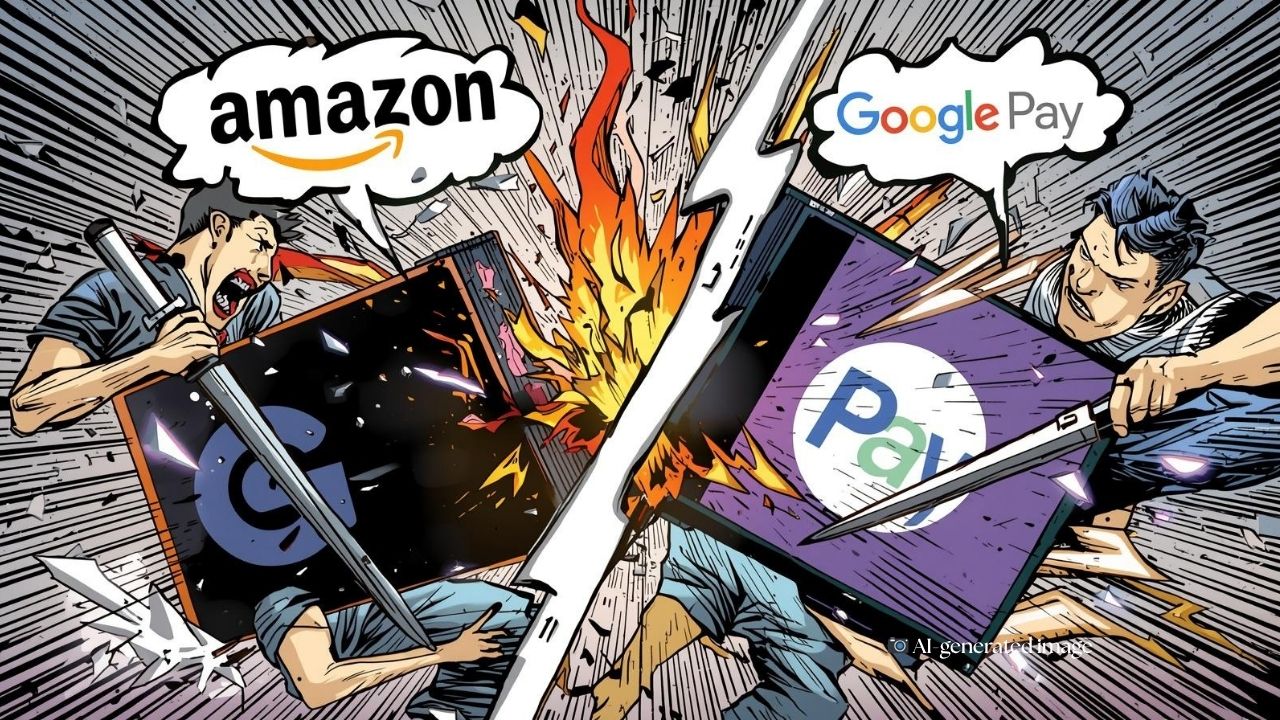
India’s digital payments battlefield is heating up—and this time, it’s not just a skirmish. It’s shaping into a full-blown corporate faceoff. At the center of the clash are two entrenched giants: Google Pay and PhonePe. Together, they control nearly 80% of India’s UPI transaction volume—an advantage built over years of aggressive expansion, deep pockets, and the sheer force of network effects. For millions of users and merchants, these platforms have become the default. Now, a coalition of challengers is stepping into the ring.
The Underdogs Rally
Amazon and Meta are joining forces with smaller fintech players like MobiKwik, CRED, and Super.money. Their shared goal: push India’s payments regulator, the National Payments Corporation of India, to enforce long-standing market share limits that have so far remained on paper.
Read More | No More Free UPI? Survey Reveals Strong User Backlash to Charges
The rule in question—a 30% cap on UPI market share—was introduced in 2020 to prevent exactly this kind of dominance. But enforcement never followed. The deadline passed, and the leaders kept growing. Now, rivals want that to change.
The Leaders: Scale, Speed, and a Locked-In Ecosystem
PhonePe and Google Pay aren’t just ahead—they’re entrenched. Their advantage is structural. The more users they attract, the more merchants sign up. The more merchants onboard, the more indispensable they become to users. It’s a self-reinforcing loop that’s incredibly hard to break.
PhonePe, backed by Walmart, has leveraged its financial muscle and distribution reach to dominate both urban and rural markets. Google Pay, on the other hand, rides on Google’s ecosystem and early-mover advantage in simplifying UPI for the masses. Together, they’ve built something close to a duopoly—efficient, scalable, but increasingly difficult for others to penetrate.
The Challengers: Big Names, Limited Ground
For Amazon, the stakes go beyond payments. Amazon Pay was meant to be the glue binding its India ecosystem—from shopping to bill payments to financial services. Instead, it remains stuck in the margins, unable to convert its massive user base into payment dominance.
Read More | Google Pay’s ‘Pocket Money’ Feature Lets You Pay Without a Bank Account — Here’s How
Meta faces a different kind of frustration. With over 500 million users in India, WhatsApp looked like a natural payments powerhouse. But regulatory delays slowed its rollout, and by the time it scaled, the market leaders had already cemented their positions. Meanwhile, smaller players like MobiKwik and CRED are fighting on narrower fronts—loyal user niches, differentiated features—but without the scale to challenge the top two head-on.
The Strategy: Regulation as Leverage
Unable to outspend or outscale the incumbents, the coalition is turning to regulation as its strongest weapon.
Their argument is straightforward: unchecked dominance in a system as critical as UPI isn’t just a competition issue—it’s a systemic risk. If two players control the majority of transactions in what has become national financial infrastructure, the consequences of disruption—technical or otherwise—could be significant. By pushing the National Payments Corporation of India to enforce the 30% cap, they’re hoping to force a redistribution of market share—or at least slow the leaders’ momentum enough to create breathing room.
The Regulator: Referee Under Pressure
The spotlight now shifts to the National Payments Corporation of India. Enforcing the cap isn’t straightforward. Any aggressive move risks destabilizing a payments ecosystem that handles billions of transactions seamlessly every month. At the same time, continued inaction could cement a two-player market for years to come.
Read More | Fintech India Innovation Awards 2026: A Look at this Year’s Standout Performers
Industry watchers expect a middle path—perhaps a revised compliance timeline or phased enforcement. But whether that will meaningfully alter market dynamics remains uncertain.
Who Holds the Upper Hand?
For now, the advantage clearly lies with PhonePe and Google Pay. They have scale, user trust, merchant acceptance, and momentum. None of that can be undone overnight—even with regulatory intervention.
Read More | AI Summit 2026: NPCI Extends ‘UPI One World’ Wallet to International Delegates
But the challengers are playing a longer game. By aligning their interests and applying collective pressure, they’ve turned what was once a fragmented struggle into a coordinated push. If regulation shifts—even slightly—it could open cracks in the leaders’ dominance.
The Bigger Picture
This isn’t just a fight between companies. It’s a test of how India manages success. UPI has become a global benchmark for digital payments—fast, inclusive, and scalable. But its next phase will depend on whether it remains competitive or consolidates further. For Amazon and Meta, this is a battle for relevance. For smaller fintech firms, it’s a fight for survival. And for the incumbents, it’s about defending ground they’ve spent years capturing.
The next move belongs to the regulator—but the outcome will shape India’s digital payments landscape for the next decade.

Indrani Priyadarshini is a journalist and editorial professional specialising in technology, artificial intelligence, smart cities, green energy, and digital transformation. With over four years of experience in tech journalism and digital media, she is known for turning complex industry developments into clear, engaging, and insightful stories. Her expertise spans reporting, editorial strategy, digital publishing workflows, and in-depth coverage of emerging technologies shaping the future.