Finance Minister Nirmala Sitharaman on Sunday, February 1, presented the Union Budget 2026–27, becoming the first Budget in India’s history to be tabled on a Sunday and her ninth consecutive Budget under Prime Minister Narendra Modi.
India’s economy is set to grow 7.4% in FY26, with growth estimated at 6.8–7.2% in FY27, supported by ongoing regulatory reforms, macroeconomic stability and higher private investment.
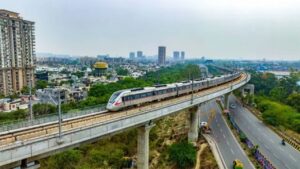
Finance Minister Nirmala Sitharaman laid focus on infrastructure and rail connectivity in her Union Budget 2026–27 speech. The policy lines outlined the expansion of high-speed corridors, urban infrastructure investments and targeted support for logistics and industrial clusters.
The Finance Minister uncovered plans to develop seven high-speed rail corridors to enhance sustainable passenger mobility.
The routes quoted in the Budget include:
- Mumbai-Pune
- Hyderabad-Bengaluru
- Delhi-Varanasi
- Varanasi-Siliguri
- Pune-Hyderabad
- Hyderabad-Chennai
- Chennai-Bengaluru
The corridors are expected to improve travel efficiency and reduce carbon emissions by shifting long-distance journeys to faster rail options.
Investments via instruments such as Infrastructure Investment Trusts (InvITs), Real Estate Investment Trusts (REITs), National Investment and Infrastructure Fund (NIIF) and the National Bank for Financing Infrastructure and Development (NaBFID) will underpin this expansion.
Sitharaman further announced a whopping ₹10,000 crore scheme. The focus remains on container manufacturing over five years to strengthen logistics and reduce import dependence. A new infrastructure support scheme for construction, metro tunnelling and high-altitude connectivity was also highlighted, aimed at improving project execution in complex terrains.
The announcement outlines the importance of capital expenditure and improvements in safety and passenger amenities. It is a broad call for long-term clarity on rail modernisation strategies and investment frameworks.
Samarjit Kaur is a journalist and communications professional covering technology & emerging digital trends. With a focus on clarity and context, she reports on developments shaping industries and governance. When not reporting, she chooses to plug-in and relax on her playlists and plan her next bucket-list trips!