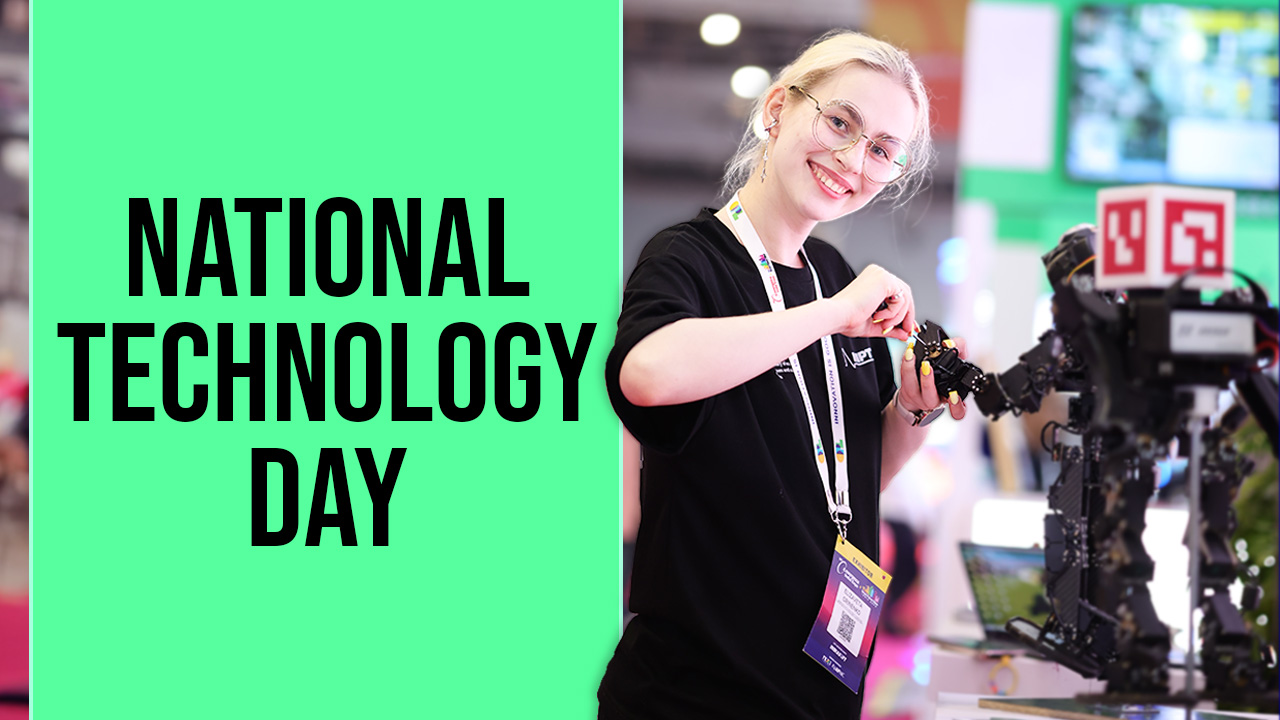
India marks National Technology Day on May 11th each year. The day commemorates the country’s technological milestones while highlighting its growing focus on artificial intelligence, semiconductor manufacturing, deep-tech innovation and digital infrastructure.
The day traces its origin to the 1998 Pokhran nuclear tests, officially known as Pokhran-II, as well as the successful test flight of the indigenous Hansa-3 aircraft and the Trishul missile trial.
The occasion was later declared National Technology Day by former Prime Minister Atal Bihari Vajpayee.
Also Read: If a Humanoid Can Become a Monk, What Is Left That Only Humans Can Do?
India Expands Focus Beyond Strategic Technology
This year’s observance reflected India’s broader technology ambitions beyond defence and strategic programmes. Government institutions, research bodies and technology leaders used the occasion to underline the country’s push towards indigenous innovation, digital transformation and the commercialisation of industrial-scale research.
Recent discussions around National Technology Day have centred on artificial intelligence (AI), semiconductor ecosystems, cybersecurity, climate-tech solutions and sustainable digital infrastructure.
Industry experts have also called for responsible and ethical deployment of emerging technologies as India scales its innovation economy.
The Department of Science and Technology said the annual observance recognises scientists, engineers, innovators and entrepreneurs who contribute to India’s technological growth and self-reliance.
Also Read: How GIS Can Strengthen Mapping of India’s Commons: A Policy Explainer
From Pokhran To AI, India’s Technology Narrative Evolves
Taking to his social media on X, Prime Minister Narendra Modi said, “Technology has become a key pillar in building a self-reliant India. It is accelerating innovation, expanding opportunities and contributing to the nation’s growth across sectors.”
India’s technology journey has advanced significantly since the late 1990s. From nuclear capability to aerospace development, the focus has shifted to startups, deep-tech research, digital public infrastructure, culture and next-gen manufacturing.
Institutions, including the IIT Madras, have recently emphasised stronger collaboration among academia, industry and government to accelerate innovation-led growth and support the country’s long-term “Viksit Bharat 2047” vision.
Technology experts and policymakers say India’s next phase of growth will increasingly depend on indigenous research, AI adoption, electronics manufacturing, green technology and scalable digital systems. The country is also targeting stronger global positioning in sectors such as semiconductors, biotech, defence technology and advanced computing.
While the day remains rooted in India’s historic scientific achievements, National Technology Day has also become a platform to showcase the country’s ambitions to emerge as a global innovation and technology hub.

Samarjit Kaur is a journalist and communications professional covering technology & emerging digital trends. With a focus on clarity and context, she reports on developments shaping industries and governance. When not reporting, she chooses to plug-in and relax on her playlists and plan her next bucket-list trips!