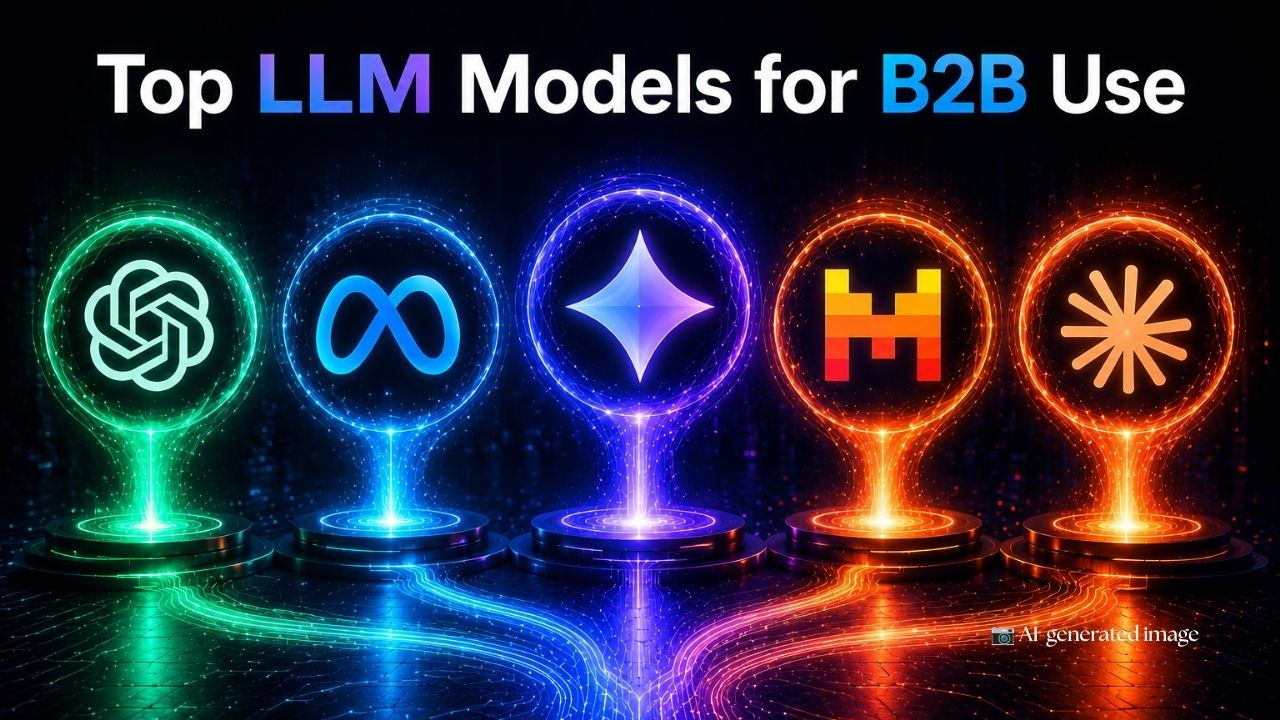
Large Language Models (LLMs) have moved far beyond chatbots. In 2026, they are becoming a core part of business operations across industries. Companies are using them to automate repetitive work, improve customer service, create content, analyse large amounts of data, assist employees, and support decision-making.
For business leaders, however, the biggest challenge is no longer understanding what an LLM is. The real challenge is choosing the right model. The market is crowded with options. OpenAI, Anthropic, Google, Meta, Mistral, Cohere, Alibaba, and several other companies now offer powerful models with different strengths.
Read More | India Now Leads the World in LLM Adoption: Bofa Report
This article will help you understand the leading LLM models in 2026 and explain which ones are best suited for different business needs. You will also learn how organisations are using these models to create measurable business value. By the end, you will have a clearer idea of which LLM fits your company’s goals, budget, and technology strategy.
Understanding LLMs in Simple Terms
An LLM is an artificial intelligence system trained on massive amounts of text and data. It can understand questions, generate responses, summarise documents, write reports, analyse information, and assist with many knowledge-based tasks. Think of an LLM as a highly skilled digital assistant. It can read thousands of pages in minutes, answer questions, draft content, and help employees complete tasks faster.
Read More | China is Mass-Producing Humanoids, But Where Are the Buyers?
However, not all LLMs are the same. Some are better at reasoning. Some excel in coding. Others are designed for privacy, multilingual support, or enterprise deployment. This is why choosing the right model is important.
High-Impact LLM Use Cases Transforming B2B Operations
Businesses are finding practical ways to use LLMs that deliver real results. Customer support is one of the biggest examples. AI assistants can answer common questions, handle service requests, and guide customers through troubleshooting steps. This reduces response times and allows support teams to focus on more complex issues.
Sales teams are also benefiting. LLMs can summarise customer meetings, draft follow-up emails, prepare proposals, and analyse customer interactions. This helps sales professionals spend more time building relationships and less time on administrative work.
In the legal sector, companies are using LLMs to review contracts, identify risks, and summarise lengthy legal documents. Tasks that once took hours can now be completed much faster.
Read More | Top Three Ways to Avoid Being Fooled by the “AI Slop”
Marketing departments rely on LLMs to create content, generate campaign ideas, optimise SEO strategies, and analyse market trends. Teams can produce more content while maintaining quality.
Human resources teams use AI to screen resumes, prepare job descriptions, answer employee questions, and support onboarding processes. Manufacturing companies are deploying LLMs to analyse maintenance records, generate reports, improve documentation, and assist engineers with troubleshooting. Financial institutions use AI to summarise reports, identify patterns in data, assist analysts, and improve customer engagement.
Across industries, the goal remains the same. Businesses want employees to spend less time on repetitive tasks and more time on strategic work.
Top LLM Models for B2B Use in 2026
OpenAI GPT-5
GPT-5 is widely regarded as one of the most capable enterprise AI models available in 2026. It offers strong reasoning, advanced document understanding, coding assistance, and multimodal capabilities.
Businesses choose GPT-5 because it performs well across a broad range of tasks. It can analyse complex reports, support customer service operations, generate high-quality content, and help employees with research. Large enterprises often prefer GPT-5 because it combines flexibility with strong enterprise-grade features. It works particularly well for organisations looking for one model that can handle multiple business functions.
Read More | Will India’s Data Centre Boom Create a New Noise Pollution Problem?
Anthropic Claude
Claude has become a leading choice for companies that work heavily with documents and large amounts of text. The model is known for handling long documents exceptionally well. Businesses use it for contract analysis, policy reviews, compliance work, and research tasks.
Claude is often selected by legal firms, consulting organisations, and enterprises that need accurate document processing. Many users appreciate its ability to provide detailed and structured responses.
Google Gemini
Gemini continues to gain traction among businesses that already use Google’s ecosystem. Companies using Google Workspace often find Gemini attractive because of its integration with email, documents, spreadsheets, and cloud services.
Gemini performs strongly in research, multimodal tasks, and enterprise productivity. Organisations looking to connect AI directly into their daily workflows frequently consider Gemini a strong option.
Meta Llama
Llama remains one of the most important open-source AI models available. Businesses that want greater control over their AI systems often choose Llama. Since it can be deployed privately, companies can keep sensitive data within their own infrastructure.
This approach appeals to organisations with strict security requirements or industries that face regulatory challenges. Llama is especially popular among enterprises building custom AI applications.
Read More | If a Humanoid Can Become a Monk, What Is Left That Only Humans Can Do?
Mistral
Mistral has emerged as a strong player in the enterprise AI market by offering efficient and cost-effective models. Businesses often choose Mistral when they need good performance without the higher costs associated with premium models.
The company has built a reputation for delivering powerful open and commercial models that can be customised for different use cases. For organisations focused on balancing performance and budget, Mistral is frequently considered.
Cohere Command
Cohere has positioned itself as a business-focused AI provider. Its models are designed specifically for enterprise applications such as retrieval, search, knowledge management, and customer support.
Read More | Top 10 Real-World Use Cases of Natural Language Processing (NLP) for Businesses in 2026
Many companies use Cohere to build internal knowledge assistants that help employees find information quickly. Organisations with large knowledge bases often find Cohere particularly useful.
Alibaba Qwen
Qwen has become increasingly important, especially for businesses operating in Asian markets. The model performs well in multilingual environments and supports a wide range of business applications.
Companies serving global customers often evaluate Qwen because of its language capabilities and growing ecosystem.
How to Choose the Right LLM for Your Business
Choosing an LLM should start with a clear understanding of business goals. If your company needs a general-purpose AI platform capable of handling multiple departments, GPT-5 may be the strongest option.
If your teams spend most of their time analysing lengthy documents, Claude may provide better results. Organisations deeply invested in Google services may benefit from Gemini’s ecosystem integration.
Businesses requiring complete control over data and infrastructure often prefer Llama or Mistral. For knowledge management and enterprise search, Cohere can be a strong choice. Companies operating across multiple languages and regions may find Qwen particularly attractive.
Read More | Is India Prioritising Data Centres Over Water Security?
Cost should also be considered. The most advanced model is not always the best choice. Many organisations achieve excellent results with smaller, more efficient models that are cheaper to operate.
Turning LLM Potential into Real B2B Impact
Successful organisations begin by identifying repetitive tasks that consume employee time. They then introduce AI to automate those processes and measure the results.
For example, a customer support team might reduce response times by 60%. A legal department might review contracts twice as fast. A sales team might spend more time selling because AI handles administrative work.
The most effective companies also invest in employee training. People need to understand how to work alongside AI rather than viewing it as a replacement.
Read More | Are We Confiding Too Much in ChatGPT? OpenAI’s Data Reveals a Disturbing Trend
Data quality is another critical factor. Even the most advanced LLM will struggle if it is connected to incomplete or inaccurate information. Businesses that achieve the highest returns treat AI as part of a broader transformation strategy. They combine technology, process improvement, and employee adoption to create long-term value.
Key Challenges Businesses Should Consider
Despite their advantages, LLMs are not perfect. Accuracy remains an important concern. AI systems can occasionally generate incorrect information. Human oversight is still necessary, especially for critical decisions.
Read More | OpenAI Launches ChatGPT for PowerPoint: Create AI Presentation Slides With Simple Prompts
Data privacy is another major consideration. Organisations must ensure that sensitive information is handled securely. Compliance requirements can also influence model selection. Some industries require private deployments or specific security controls. Cost management matters as well. Large-scale AI deployments can become expensive if usage is not monitored carefully. Companies should begin with targeted projects, measure outcomes, and expand gradually.
LLMs have become one of the most important business technologies of the decade. In 2026, they are helping organisations improve productivity, reduce costs, enhance customer experiences, and accelerate innovation.
Frequently Asked Questions (FAQs)
1. What is the best LLM for B2B use in 2026?
GPT-5 is often considered the most versatile option, while Claude is strong for document analysis, Gemini works well within Google’s ecosystem, and Llama is preferred for private deployments.
2. How are businesses using LLMs today?
Businesses use LLMs for customer support, content creation, sales automation, legal document review, employee assistance, research, data analysis, and knowledge management.
3. Are open-source LLMs suitable for enterprises?
Yes. Open-source models such as Llama and Mistral are increasingly used by enterprises that need greater control, customisation, and data privacy.
4. What should companies consider before choosing an LLM?
Organisations should evaluate business goals, security requirements, integration needs, cost, scalability, language support, and regulatory compliance before selecting a model.
5. Will LLMs replace employees in B2B organisations?
In most cases, LLMs are designed to assist employees rather than replace them. They automate repetitive tasks and help workers become more productive, allowing people to focus on higher-value activities.

Indrani Priyadarshini is a journalist and editorial professional specialising in technology, artificial intelligence, smart cities, green energy, and digital transformation. With over four years of experience in tech journalism and digital media, she is known for turning complex industry developments into clear, engaging, and insightful stories. Her expertise spans reporting, editorial strategy, digital publishing workflows, and in-depth coverage of emerging technologies shaping the future.