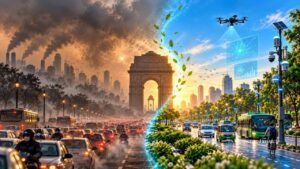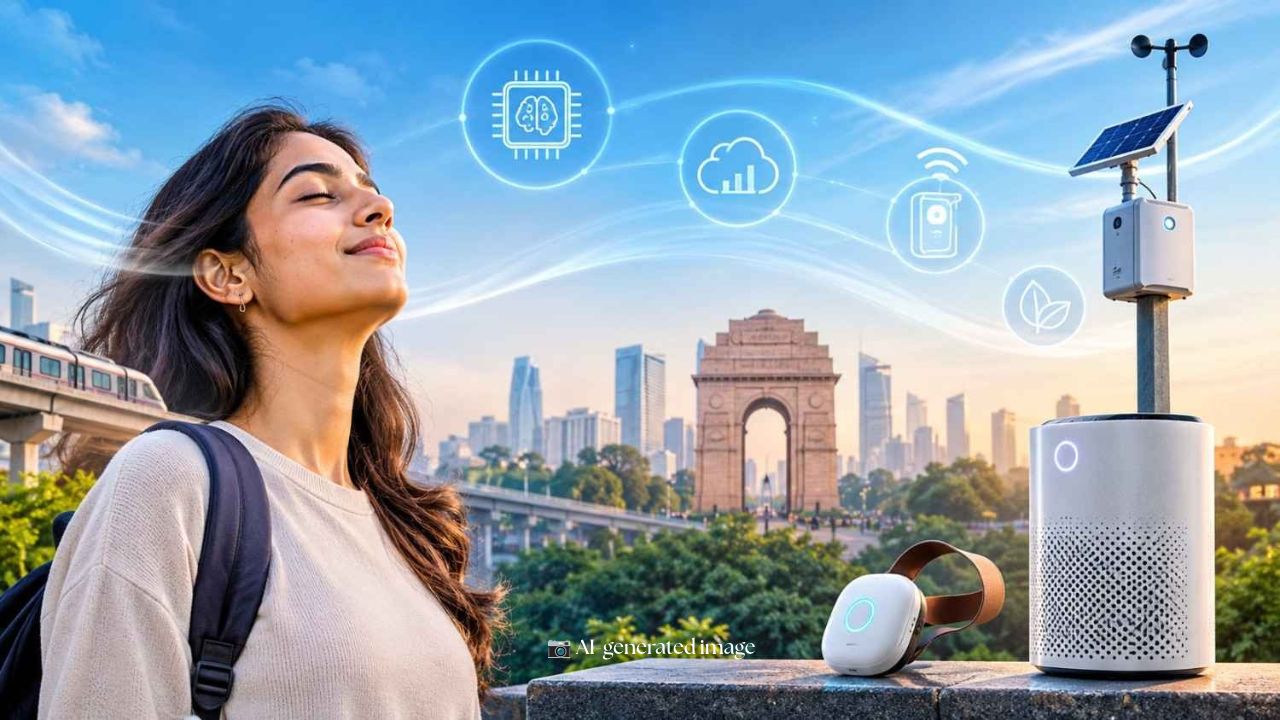
Air purifiers are becoming an increasingly common sight in Indian homes, particularly during the winter months. As air pollution levels rise across several cities after Diwali, more households are turning to technology for something that should never have been difficult to access: clean air. The growing demand for air purifiers in India is also bringing attention to the role of AI, smart technology and connected infrastructure in managing air quality.
From checking AQI levels before leaving home to switching on an air purifier at night, managing air quality is becoming part of everyday life for many urban Indians. But there is a bigger question behind this growing dependence on technology.
Read More | Delhi’s Winter Pollution Crisis: Can AI and Smart City Technology Help Clear the Air?
Can we use the same technology to make our cities cleaner, rather than simply finding ways to protect ourselves indoors?
How Does an Air Purifier Actually Clean the Air?
An air purifier is an electronic device that removes certain airborne pollutants from indoor spaces. It draws in surrounding air, passes it through filters and releases cleaner air back into the room.
Most conventional air purifiers use a combination of filtration technologies. One of the most common is the HEPA (High-Efficiency Particulate Air) filter, which captures fine airborne particles such as dust, pollen, smoke and PM2.5. A properly rated HEPA filter can capture at least 99.97% of particles measuring 0.3 microns under standard test conditions.
Many devices also use activated carbon filters, which help absorb certain gases, odours and chemical compounds. A pre-filter catches larger particles such as hair and visible dust before they reach the main filter.
Read More | What Is an AI Agent: Explained Without the Jargon
The device’s fan pulls air through this filtration system and circulates the cleaned air back into the room. Its performance is often measured through Clean Air Delivery Rate (CADR), which indicates how much filtered air a device can deliver over a given period.
However, air purifiers are not a complete solution to pollution. They are designed primarily for indoor spaces and cannot clean the air across an entire neighbourhood or city.
What If AI Could Predict Air Pollution Before It Rises?
Today, air quality monitoring systems collect information about pollutants, weather conditions and other environmental factors. AI can analyse this information to identify patterns and predict how air quality may change over time.
For instance, an AI-powered forecasting system could study historical pollution readings, temperature, wind speed, humidity and traffic patterns to predict when pollution levels may rise in a particular area.
This information could help residents plan their outdoor activities, while schools, hospitals and offices could prepare for periods of poor air quality.
Read More | Your Smart TV Could Become an AI Host: How Serious Is Anthropic’s Self-Replicating AI Warning?
AI could also make indoor air management more personalised. Imagine an air purifier that learns the pollution patterns inside your home. It could recognise when indoor pollution usually increases, adjust its filtration settings automatically and notify you when the air quality changes.
The technology could go a step further by connecting indoor sensors with outdoor air quality information. If pollution levels are expected to rise outside, an intelligent system could adjust filtration settings in advance.
Another useful application is predictive maintenance. Instead of relying only on fixed filter replacement schedules, AI-powered devices could estimate filter life based on usage and pollution exposure. This could help users avoid unnecessary replacements and reduce maintenance costs.
What If an Entire City Could Function Like One Connected Air Quality Monitoring System?
This is an important question for India’s Smart Cities vision. A smart city is about digital services, connected transport, intelligent streetlights and modern infrastructure. It should also be about creating healthier environments for the people who live and work there.
Imagine a city where air quality sensors are installed across residential neighbourhoods, schools, hospitals, offices, public transport stations and industrial areas. Instead of depending on a limited number of monitoring locations, residents could access more detailed information about the air quality in their immediate surroundings.
These sensors could collect information about PM2.5, PM10 and other pollutants. AI systems could analyse the data, identify pollution hotspots and help authorities understand how air quality changes across different locations and times of the day.
India has already taken steps towards connected air quality monitoring. The System of Air Quality Forecasting and Research (SAFAR), developed by the Indian Institute of Tropical Meteorology, provides air quality information and forecasts.
Read More | AI Agents Can Shop for You. So Why Are Websites Blocking Them?
Another development is PAVAN-I3C, the Commission for Air Quality Management’s integrated command and control platform for Delhi-NCR. According to the Ministry of Environment, Forest and Climate Change, the platform brings together more than 30 data streams, including air quality, weather, satellite, mobility and emissions information.
Such initiatives demonstrate how digital infrastructure can support better environmental monitoring. The next opportunity is to make air quality information more accessible and useful at the neighbourhood level.
Can Every Neighbourhood Have Its Own Air Quality Monitor?
One of the biggest challenges in understanding urban air pollution is that air quality can vary considerably from one location to another. A reading from a monitoring station in one part of a city may not accurately represent the conditions in another neighbourhood. Traffic, construction activity, industrial areas and local weather can influence pollution levels.
This creates an opportunity for affordable air quality monitoring technology.
Read More | How AI Is Helping Indian Farmers Without Smartphones
Indian startups are already exploring ways to make environmental monitoring more accessible. Companies such as Respirer Living Sciences are developing sensor-based systems that collect street-level air quality data. Their monitoring devices can measure pollutants and feed information into digital dashboards for analysis. The company has also worked on large-scale sensor deployments with IIT Kanpur across locations in Uttar Pradesh and Bihar.
Similarly, SENSurAir, an IIT Madras-incubated startup, is working on low-cost air quality and personal exposure monitoring solutions using sensors, IoT and machine learning.
Such innovations could help create denser networks of air quality monitors across Indian cities. Schools, housing societies, offices and community organisations could potentially become part of these networks. The more reliable information available at a local level, the better equipped citizens and urban planners will be to understand pollution patterns.
Can You Carry Clean Air Wherever You Go?
While connected monitoring systems can help cities understand pollution, personal air purification technology could offer another layer of innovation. Traditional air purifiers are designed for homes and offices. But millions of Indians spend several hours outdoors travelling to work, attending classes or working in delivery, construction and other outdoor occupations.
This has encouraged startups to explore wearable air purification devices.
One Indian example is Atovio, which has developed a wearable air purifier called Atovio Pebble. The device is designed to be worn around the neck and creates a localised zone of filtered air around the user’s breathing space.
Read More | Delhi Students Develop Rs 140 Fan Filters to Tackle Air Pollution, Win 2026 Diana Award
The startup was founded by Anmay Shahlot, Siddharth Goel, an electronics engineer from IIT Kanpur, and entrepreneur Aditi Agrawal. Its wearable device was tested at IIT Kanpur.
The idea is to make personal air purification portable rather than restricting it to indoor spaces. However, wearable devices need independent performance testing to establish how effectively they reduce pollution exposure under different real-world conditions. They should not be treated as complete protection against outdoor pollution.
Atovio is one example of how Indian entrepreneurs are approaching an everyday problem through product innovation. There is considerable scope for more such developments.
Startups could explore lightweight wearable filtration devices, portable purifiers for commuters, affordable air quality monitors and compact solutions for people who spend long hours outdoors.
What Will the Future of Clean-Air Technology Look Like?
Air purifiers can help improve indoor air quality, but they cannot solve the larger problem of outdoor pollution. That requires better urban planning, cleaner transport, effective waste management, responsible industrial practices and informed environmental decisions.
Technology can support these efforts by making air quality easier to monitor and understand.
Read More | AI Safety vs AI Race: From Jacob Coxon to Trump’s AI Czar — Where Is This Story Heading?
AI can help predict pollution patterns. IoT sensors can provide neighbourhood-level information. Smart buildings can respond to changing indoor conditions, while startups can develop affordable devices for individuals and communities.
India’s Smart Cities vision should look beyond connected infrastructure and digital convenience. It should also consider the quality of life that technology can create for residents.
The real opportunity is to move from individually protecting ourselves against polluted air to collectively building healthier urban environments. A city cannot be truly smart if its people have to worry about every breath they take.
As India builds the cities of tomorrow, should our biggest technological ambition be to develop smarter ways to live with pollution, or to create cities where the next generation no longer has to think about the air they breathe?

Indrani Priyadarshini is a journalist and editorial professional specialising in technology, artificial intelligence, smart cities, green energy, and digital transformation. With over four years of experience in tech journalism and digital media, she is known for turning complex industry developments into clear, engaging, and insightful stories. Her expertise spans reporting, editorial strategy, digital publishing workflows, and in-depth coverage of emerging technologies shaping the future.