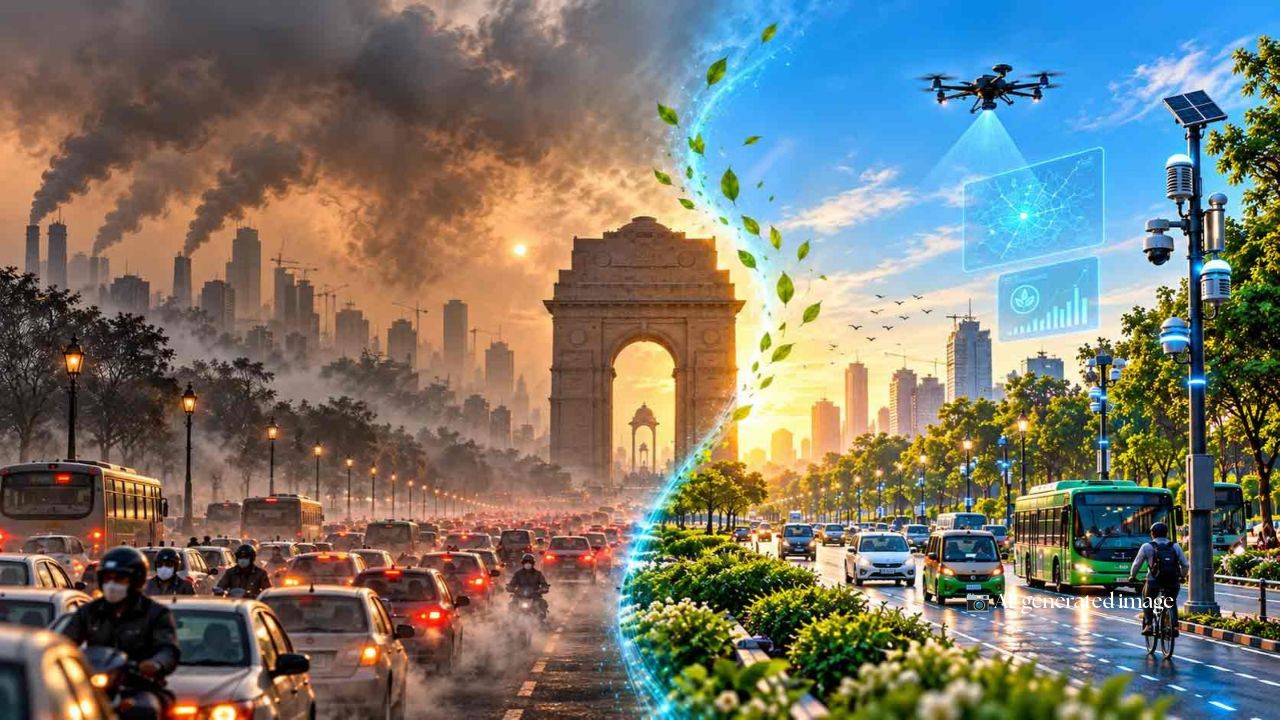
Delhi’s air can change dramatically in just a few days. One moment, the city is going about its usual routine; soon, a grey haze settles over its roads, buildings and parks. People reach for masks, schools and outdoor activities face disruption, and authorities bring back emergency restrictions.
Every winter, the pattern repeats. This year, restrictions on certain vehicles entering Delhi from neighbouring cities are scheduled to remain in place from 1 November 2026 to 31 January 2027. Such steps may help reduce some emissions.
But they also raise a bigger question: Can Delhi use technology to spot a pollution crisis before it reaches dangerous levels, identify where it is coming from and take action in time?
AI, air-quality forecasting, smart sensors and cleaner transport could help cities move away from reacting to pollution after it has worsened. India is also taking steps in this direction, including a new air pollution analysis facility for Delhi-NCR. However, technology alone cannot clean the air. Its real value will depend on how quickly authorities use the information to make changes on the ground.
Why does Delhi’s air become so polluted every winter?
Delhi’s winter pollution does not come from one source. Vehicle exhaust, factory emissions, power generation, construction work, road dust and waste burning all add to the problem. Smoke from crop-residue burning in neighbouring states can also affect the region.
Weather conditions make matters worse. During winter, slower winds and changes in temperature can prevent polluted air from rising and spreading out. Instead, pollutants remain closer to the ground, where people breathe.
Read More | Namo Bharat Trip Pass: How Commuters Can Buy 40 Trips in Advance and Benefit From Prepaid Travel
This is why a single measure, such as restricting certain vehicles, cannot solve the entire problem. Authorities need to understand which sources are contributing most to pollution, where they are affecting the city and how conditions may change over the next few days.
Can AI predict when Delhi’s air will become dangerous?
AI could make air-quality forecasts more useful by helping scientists study large amounts of information at the same time. This can include weather conditions, past pollution levels, traffic movement, industrial activity and readings from air-quality monitoring stations.
By finding patterns in this information, forecasting systems can estimate when and where pollution may rise. For example, if weather conditions are expected to trap pollutants over a particular part of Delhi, an early warning could give authorities time to prepare.
Beijing offers an example of how this approach is developing. The city’s environmental authorities began research into AI-based air-quality forecasting in 2025 and put the technology into use in 2026. The system combines AI with existing weather and pollution forecasting models to improve the accuracy and local detail of its predictions. It is designed to help officials understand changing air quality more clearly, rather than acting as a solution that prevents pollution on its own.
Read More | How AI Is Helping Indian Farmers Without Smartphones
For Delhi, better forecasts could help authorities prepare for pollution spikes before they happen. But a prediction is useful only when it leads to timely action.
Can sensors and satellites show where pollution comes from?
Knowing that air quality is poor is only part of the challenge. Authorities also need to understand what is causing it.
This is where ground-based sensors and satellite observations can help. Air-quality sensors placed across a city can measure pollution levels in different neighbourhoods. When readings from several locations are studied together, they can help identify areas where pollution is rising.
Satellites offer a wider view. They can help track large fires, observe weather conditions and study how pollution moves across regions. However, satellite images cannot identify every source of pollution at street level. Local sensors and scientific analysis are needed to build a more complete picture.
When these sources of information are brought together, officials can make better decisions. If readings point to rising pollution near a busy road, for instance, traffic and vehicle emissions may need closer attention. If dust levels increase around construction areas, those sites may require inspection.
How is India using technology to monitor Delhi’s air?
A recent development in Delhi-NCR is the Integrated Atmospheric Chemistry and Aerosol Toxicity Analysis Laboratory, or AATAL, inaugurated on 24 October 2026 under the Ministry of Earth Sciences’ Mission Mausam.
AATAL is important because it is designed to look beyond the overall pollution reading. It will help scientists examine what pollutants are made of, identify their possible sources and understand their potential health effects. These sources include vehicle emissions, industrial activity, crop-residue burning, construction and road dust.
Read More | India’s Renewable Energy Problem: Why Green Power Is Going to Waste
The facility is integrated with the Indian Institute of Tropical Meteorology’s AIRWISE system, which combines air-quality observations, forecasts and information about pollution sources. According to the Ministry of Earth Sciences, AIRWISE can provide forecasts for the next 72 hours at a resolution of 400 metres. This means pollution conditions can be examined across smaller areas of Delhi instead of treating the entire city as one location.
The information is expected to help the Commission for Air Quality Management and other agencies decide where action is needed and assess whether their measures are working. It is important to distinguish between the two systems: AATAL analyses pollution and its sources, while AIRWISE provides forecasts and decision support.
What if Delhi could test pollution-control plans in a virtual city?
Another technology that could support cleaner cities is a digital twin. In simple terms, it is a computer-based model of a real place. It can use information about roads, buildings, traffic, energy use and pollution to show how a city may respond to different changes.
Delhi could potentially use such a model to examine questions before making costly decisions. What might happen if a busy road had fewer private vehicles? Would improving public transport reduce traffic in a particular area? Could changing the location of construction activity or improving waste collection help reduce pollution?
A digital model could allow planners to compare different possibilities before putting them into practice. However, this should be seen as a potential use of the technology, not as an existing city-wide system that Delhi is already using to control pollution.
Can electric vehicles, smart traffic and clean energy make a difference?
Transport is an important part of the air pollution challenge, so cleaner mobility has a role to play. Electric buses, cars and two-wheelers do not release exhaust fumes while being driven. Replacing older, more polluting vehicles with cleaner options can therefore help improve roadside air quality.
However, electric vehicles are not completely pollution-free. The electricity used to charge them may still come from power stations that burn coal or other fossil fuels. This makes the shift towards renewable energy, such as solar and wind power, equally important.
Technology can also help make existing roads less polluting. Smart traffic signals can adjust their timings according to traffic conditions, helping reduce long queues and unnecessary idling. Better public transport information and connected travel systems can make buses and metro services easier to use.
At the same time, cleaner energy for buildings and industries, better control of construction dust and improved waste management are necessary. Cleaner transport alone cannot address pollution caused by factories, power generation or burning waste.
What can Beijing, London and Singapore teach Delhi?
Other cities show that technology works best when it supports clear rules and consistent enforcement.
Beijing’s use of AI in air-quality forecasting shows how better predictions can help authorities prepare for changing pollution conditions. London, meanwhile, uses cameras to check vehicle number plates and enforce its Ultra Low Emission Zone, which sets emission standards for vehicles entering the area. Singapore uses electronic road pricing to manage traffic by charging vehicles for using certain roads at busy times.
These approaches address different problems, but they share an important idea: cities need reliable information to guide decisions and systems that ensure rules are followed. Delhi can learn from these examples while adapting them to its own traffic, geography and regional pollution challenges.
Can AI really solve Delhi’s winter pollution crisis?
AI can help predict pollution, sensors can show where it is rising, and scientific facilities can help identify the sources. But none of these technologies can stop vehicle emissions, control construction dust or prevent waste burning without action from people, businesses and government agencies.
Read More | Mumbai’s Data Centre Boom: How Much Can the City Take?
Imagine a situation in which a forecast warns that pollution is likely to rise sharply in a particular part of Delhi over the next two days. Sensors then help identify the affected areas, while scientific analysis points to the likely sources. Authorities could respond with focused traffic management, construction-site checks or inspections of nearby industrial activity. They could then monitor the readings to see whether the steps made a difference.
This is an example of how a connected system could work, not a claim that Delhi already has a fully automated process in place. The bigger opportunity is to make air pollution management a year-round effort rather than a series of emergency measures every winter. Delhi needs cleaner transport, reliable public services, better energy choices, regional cooperation and consistent enforcement.
Technology can give authorities a clearer picture of the problem and more time to respond. The real test will be whether that information leads to action. Can Delhi move from fighting the same winter pollution crisis every year to preventing it from becoming one in the first place?

Indrani Priyadarshini is a journalist and editorial professional specialising in technology, artificial intelligence, smart cities, green energy, and digital transformation. With over four years of experience in tech journalism and digital media, she is known for turning complex industry developments into clear, engaging, and insightful stories. Her expertise spans reporting, editorial strategy, digital publishing workflows, and in-depth coverage of emerging technologies shaping the future.