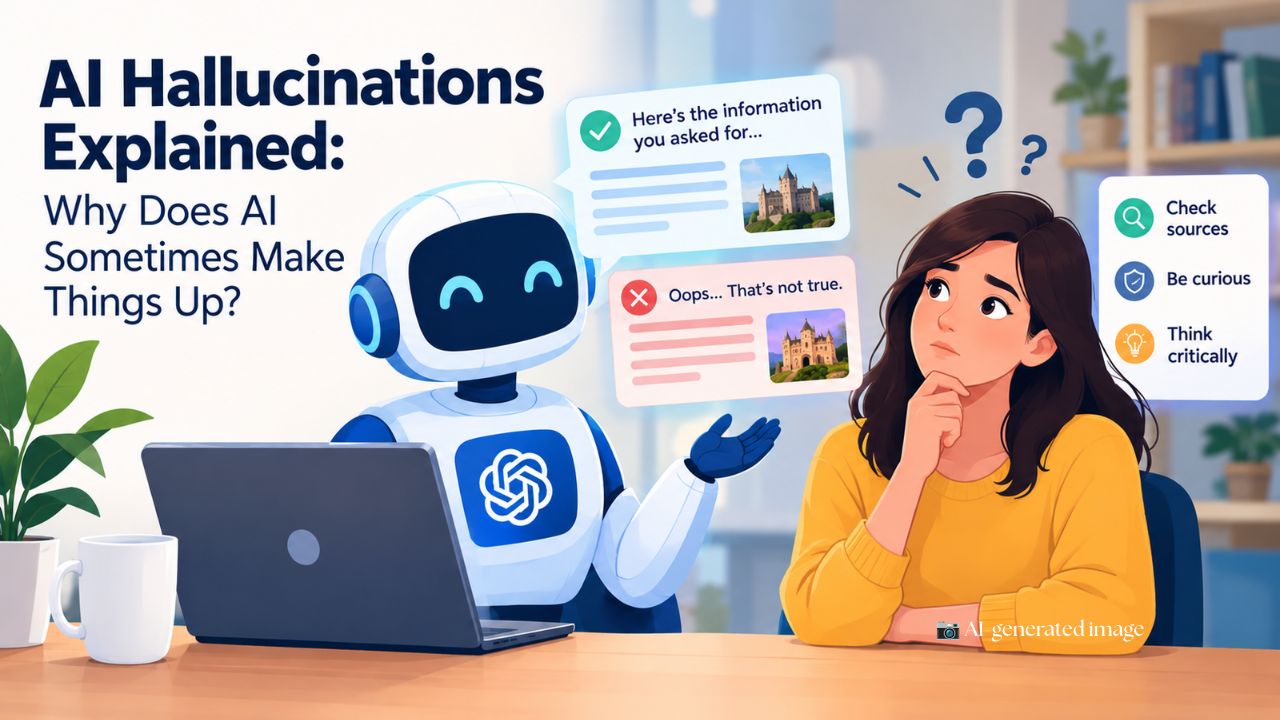
You ask an AI chatbot a simple question. It gives you a detailed answer, sounds completely confident and even provides names, dates or sources. There is just one problem: some of the information is not true. And this is what we have labelled as AI hallucination. An AI can sometimes generate information that looks believable but is incorrect, incomplete or entirely made up.
As AI tools become part of everyday life, understanding why this happens is becoming increasingly important. Whether you are using AI to research a topic, write an email, understand a document or find an answer, knowing when an AI response may be unreliable can help you avoid passing on false information.
So, what exactly is an AI hallucination, and why does it happen?
What is an AI hallucination?
An AI hallucination happens when an AI system produces information that is not supported by facts, even though the answer may sound convincing.
For example, imagine asking an AI chatbot to tell you about a book written by an author who does not exist. Instead of telling you that it cannot find reliable information, the chatbot might create a book title, publication date and description.
Read More | AI Safety vs AI Race: From Jacob Coxon to Trump’s AI Czar — Where Is This Story Heading?
Everything may look perfectly reasonable. But none of it is real.
AI can also make smaller mistakes. It may give you the wrong date for an event, confuse two people with similar names, invent a statistic or provide a website that does not exist. Importantly, an AI hallucination does not mean that the machine is seeing or imagining something in the way humans do. It is simply a term used to describe AI-generated information that is false or unsupported by reliable evidence.
Why does AI sometimes make things up?
The simplest answer is that AI does not understand information in exactly the same way humans do. AI models are trained using enormous amounts of information. During training, they learn patterns in language and how words and pieces of information are commonly connected.
When you ask a question, the AI uses what it has learnt to generate a response. It is essentially working out what answer is most likely to fit the question. That usually produces useful results. But the system does not always know whether every detail it generates is true.
Read More | AI Tokens Explained: What Are Tokens and How Do They Work?
If there is missing, unclear or conflicting information, it can produce an answer that sounds right without actually being right. AI works with far more sophisticated systems, but the basic idea of predicting what comes next helps explain why mistakes can happen.
Does AI lie?
Lying usually means deliberately saying something you know is false. An AI does not have human intentions, beliefs or motives. When it gives you incorrect information, it is not necessarily trying to deceive you.
Read More | Your Smart TV Could Become an AI Host: How Serious Is Anthropic’s Self-Replicating AI Warning?
The problem is that an AI response can sound as though it knows the answer, even when it does not.
This is one of the biggest reasons AI hallucinations can be difficult to spot. A chatbot may write a polished paragraph, use a professional tone and provide several specific details. None of those things guarantees that the information is accurate. This is why users should not treat confidence in an AI response as proof that the answer is correct.
Why can AI sound so confident when it is wrong?
AI systems are designed to produce useful, natural-sounding responses. They do not normally add a warning every time they are uncertain. As a result, an incorrect answer can be written in exactly the same confident tone as a correct one.
For instance, if you ask an AI about a historical event, it might provide a date and a detailed explanation. If the date is wrong, the rest of the answer may still sound perfectly convincing. There is no obvious signal telling you, “This part is probably made up.”
This is particularly important when AI is used for research. We reading a confident answer may assume the information has been checked. But unless the AI is connected to reliable, up-to-date sources or the information is independently verified, that assumption can be risky.
What causes AI hallucinations?
There is no single reason why hallucinations happen. Several factors can contribute to them.
- Lack of reliable information: If an AI does not have enough information about a subject, it may generate an answer based on related patterns rather than verified facts.
- Ambiguous questions: A question with several possible meanings can lead the AI towards the wrong interpretation.
- Outdated information: AI systems may not always have access to the latest developments. This can be a problem when asking about current events, products, laws or technology.
- Incorrect information in training data: AI learns from large collections of information, and not everything available online is accurate.
- Highly specific questions: The more obscure a question is, the greater the chance that an AI system may struggle to provide a reliable answer.
Can AI hallucinations be prevented?
They cannot be eliminated, but they can be reduced. AI companies use different methods to improve the accuracy of their systems. These can include giving models access to reliable information sources, improving their training, adding systems that check responses and making it easier for AI to say when it is uncertain.
Some AI tools can also search the internet or access specific databases before answering a question. This can help with information that changes frequently. However, no AI system should be treated as automatically error-free.
Read More | https://www.convergence-now.com/explainers/ai-agents-can-shop-for-you-so-why-are-websites-blocking-them/
The responsibility also falls on the person using it. The more important the information, the more carefully it should be checked.
How can you tell if an AI answer might be wrong?
There is no foolproof way to identify a hallucination simply by reading an AI response. However, there are some warning signs. Be careful when an answer contains very specific information that you cannot find anywhere else. Be particularly cautious about unfamiliar names, statistics, research papers, quotations, dates and links.
You should also double-check an answer if the AI makes a strong claim about something important but does not provide a reliable source. And if the answer seems strangely perfect, overly specific or simply “too good to be true”, it is worth checking.
How should you verify information generated by AI?
The safest approach is simple: use AI as a starting point, not your final source of truth. For important information, check the answer against reliable sources.
Read More | How AI Is Helping Indian Farmers Without Smartphones
If the AI gives you a statistic, look for it on the website of the organisation that published the original data. If it mentions a government policy, check the relevant government website. If it refers to a research paper, find the original paper or the journal that published it.
You can also ask the AI to provide sources, but do not assume that every citation it gives you is genuine. Check that the source exists and that it actually supports the claim being made.
Why do AI hallucinations matter?
AI hallucinations may seem like a minor inconvenience when you are asking a chatbot a casual question. But the consequences can become much more serious when AI is used for work, education, finance, healthcare, law or business decisions.
Read More | What Happens When AI Gets Permission to Spend Your Money?
The bottom line: Can you trust AI?
You can use AI as a powerful tool, but you should not assume that every answer it gives you is a fact. AI is very good at finding patterns, generating text, summarising information and helping people work through ideas. But it can sometimes fill gaps in its knowledge with information that sounds plausible but is not true.
That is why the best approach is not to avoid AI altogether. It is to know when to trust it, when to question it and when to check it.

Indrani Priyadarshini is a journalist and editorial professional specialising in technology, artificial intelligence, smart cities, green energy, and digital transformation. With over four years of experience in tech journalism and digital media, she is known for turning complex industry developments into clear, engaging, and insightful stories. Her expertise spans reporting, editorial strategy, digital publishing workflows, and in-depth coverage of emerging technologies shaping the future.