A few days ago, I was trying to understand something that kept appearing whenever I read about AI: tokens. I had come across AI models with prices such as $10 for one million tokens. But what did that actually mean? Was I really using millions of tokens every time I spoke to an AI? And why were companies charging for something called a “token”?
So, I decided to do some research and break the whole thing down in the simplest way possible. Here’s what I found.
First, what exactly is a token?
A token is a small piece of text that an AI model uses to understand and process language. Think of a chocolate bar. You can break the bar into smaller pieces, but it is still the same chocolate. AI does something similar with text. It breaks your sentence into smaller pieces called tokens. For example:
“AI is changing the world.” An AI model might break this into pieces such as:
AI | is | changing | the | world | .
These pieces are tokens.
But there is one important thing to remember: one word does not always equal one token. A long or unusual word may be split into smaller pieces.
Read More | What Happens When AI Gets Permission to Spend Your Money?
What is tokenisation?
The process of breaking text into tokens is called tokenisation. It works roughly like this:
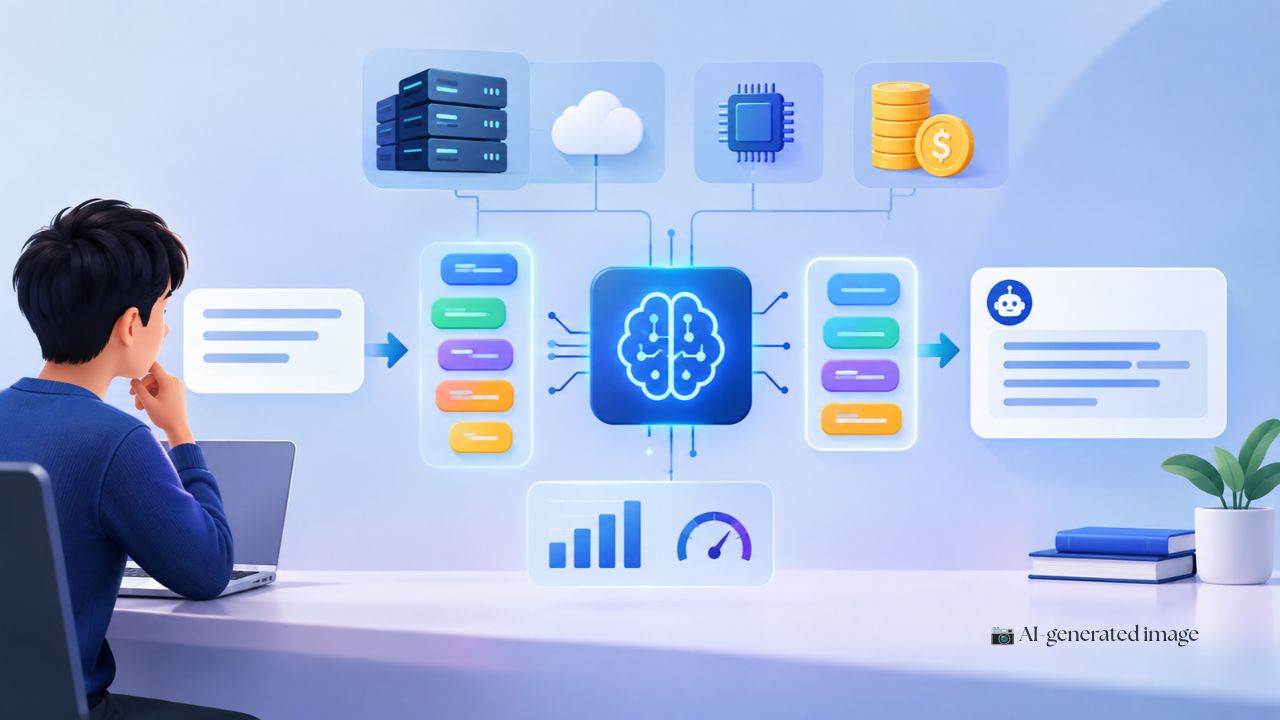
Your message → Tokenisation → Tokens → AI processes them → AI creates new tokens → Your answer
The AI does not simply read your sentence in the same way a human does. The text is broken into tokens and then converted into numerical representations that the model can process. This is one of the basic steps that allows an AI model to work with language.
What are the common types of tokenisation?
There are different ways of breaking text into tokens. The exact method depends on the AI model.
| Type | What it does | Simple example |
| Word tokenisation | Breaks text into complete words | AI | is | useful |
| Character tokenisation | Breaks text into individual characters | A | I |
| Subword tokenisation | Breaks words into smaller pieces | un | believe | able |
| Byte-level tokenisation | Uses smaller digital units to represent text and symbols | Can handle a wide range of text |
Modern AI models often use tokenisation methods based on smaller pieces of words or bytes because this allows them to handle a much wider range of language and text. The same sentence can also be broken into tokens differently by different AI models.
What happens when you ask an AI a question?
Let’s say you type, “Explain AI to me.” Your message becomes input tokens. The AI model processes those tokens and then generates output tokens. Those output tokens are put together to create the answer you see. So, the basic journey looks like this: You → Input tokens → AI model → Output tokens → You. This is why you may hear AI companies talk about input tokens and output tokens.
Read More | Top Three Ways to Avoid Being Fooled by the “AI Slop”
Input tokens
These are the tokens you send to the AI. Your question, instructions, uploaded text and other information provided to the model can all contribute to the input.
Output tokens
These are the tokens the AI generates in response. A short answer will generally use fewer output tokens than a long answer. For example, if your question uses 20 input tokens and the AI generates 500 output tokens, the request has used 520 tokens in total. Some AI systems also track other categories of usage, depending on the model and service.
How does AI know how many tokens I have used?
You do not normally have to count them yourself. The system counts the tokens automatically when your text is processed. For developers using an AI API, the usage information may show the number of input tokens, output tokens and total tokens. Some AI platforms also provide dashboards where users can see their usage.
The number of tokens is not always obvious from the number of words on your screen. A long conversation, a large document or extra information given to the AI can increase the number of tokens being processed.
Do I have to buy tokens?
Not always. This is where things can become confusing because different AI services use different pricing systems. Some charge based on token usage. Others offer monthly subscriptions, credits or a combination of different payment methods.
If a service uses a credit system, you may buy credits first and then use them as the AI processes your requests. A simple way to think about it is mobile data. You do not buy “the internet”. You pay for an amount of data you can use. In a similar way, token-based AI pricing measures how much text the AI processes and generates.
Why do AI companies charge by tokens?
Running an AI model requires a lot of computing power. AI companies need specialised chips, data centres, electricity and other infrastructure to run these systems. Tokens provide a practical way to measure how much an AI system is being used.
For example, if an AI service charges $10 per one million tokens, the calculation would be:
Tokens used ÷ 1,000,000 × price per million tokens = cost
So if you used 100,000 tokens at $10 per million:
100,000 ÷ 1,000,000 × $10 = $1
The actual price depends on the AI model and service. Input and output tokens can also have different prices.
Read More | What Happens When You Get Rich and Let Technology Run Your Life?
Why do tokens matter?
1. They help measure cost
The more tokens an AI service processes, the more computing work it may have to do. Token usage therefore gives companies a way to measure and price that usage.
2. They affect how much information AI can handle
AI models have something called a context window. You can think of this as the size of the AI’s working desk. If the desk is small, there is only so much information you can keep on it at one time. If the desk is bigger, the AI can work with more text and information in a single interaction. The context window is measured in tokens.
3. They affect how much AI can generate
Output is also measured in tokens. So, if an AI model has a limit on the number of output tokens, that can affect how long its answer can be.
Does using more tokens mean the AI is smarter?
No. This is an important distinction. A model using 10,000 tokens is not automatically smarter than a model using 1,000 tokens. Think about two students writing an answer to the same question. One student may write 500 words, while another explains the same thing in 200 words.
The longer answer is not automatically the better answer. In the same way, token count is a measure of usage, not intelligence.
So, does the number of tokens determine an AI’s value?
Again, no. Tokens tell us how much text an AI system is processing or generating. They can help us understand usage and cost, but they do not tell us how useful, reliable or capable an AI system is.
An AI’s value depends on what it can actually do, how well it performs a task, how reliable its answers are and whether it solves a real problem. So, tokens are not a price tag for intelligence. They are more like a unit for measuring AI usage.
Read More | Mumbai’s Data Centre Boom: How Much Can the City Take?
The simplest way to remember it
If you remember only one thing, remember this:
Your words → Tokens → AI processes them → AI generates tokens → You get an answer.
Tokens are simply the small pieces of text that AI models use to process language. Every time you ask a question or receive an answer, those words are converted into tokens as part of the process.
So, when you see an AI model advertised at $10 per one million tokens, it does not mean you are paying $10 for the AI itself. You are paying based on how much text the system processes, according to that service’s pricing. And that brings us back to the question I started with: what exactly is a token?
It is not a measure of intelligence. It is not a score for how powerful an AI is. It is simply a unit that helps us understand how much language an AI is processing and, in many cases, how much that usage costs.

Indrani Priyadarshini is a journalist and editorial professional specialising in technology, artificial intelligence, smart cities, green energy, and digital transformation. With over four years of experience in tech journalism and digital media, she is known for turning complex industry developments into clear, engaging, and insightful stories. Her expertise spans reporting, editorial strategy, digital publishing workflows, and in-depth coverage of emerging technologies shaping the future.