
Imagine asking an AI tool to prepare a report on delayed customer orders. A basic chatbot might explain how to create the report. An AI agent, if connected to the right business systems, could retrieve order records, identify delays, organise the findings and prepare a report for review.
The difference is that an AI agent can move beyond generating a response and take action toward a defined goal.
AI agents are attracting interest as businesses look for ways to automate multi-step work that involves multiple applications and decisions. They can retrieve information, use digital tools, and adjust their next steps based on the task and available information.
However, an AI agent is not an employee you can trust to make every decision independently. Its capabilities depend on its design, the software it can access, the quality of its information and the permissions it receives.
This explainer covers what AI agents are, how they work, how they differ from chatbots and traditional automation, where businesses use them and more, covering everything you need to know before putting AI agents to work.
Also Read: Sundar Pichai Is Using AI Agents to Keep Track of Google 24/7
What is an AI agent?
An AI agent is a software system that uses artificial intelligence to work toward a goal, decide on the required steps, and use available tools to carry out a task.
A conventional chatbot might explain how to handle a customer complaint. An AI agent could review an authorised customer record, check the order status, prepare a response, and create a support ticket for a staff member.
The agent can perform these actions only if the necessary systems are connected and it has permission to use them. Some agents can manage several steps with limited human intervention. Others pause to ask questions, confirm information or seek approval before taking action. The level of independence varies by system.
An AI agent also does not automatically learn permanently from every task. It may use information from the current interaction, stored records or an approved knowledge base. Whether it can retain information or improve through feedback depends on how it’s built.
Also Read: AI Agents Can Shop for You. So Why Are Websites Blocking Them?
How Does an AI Agent Work?
An AI agent brings together an AI model with instructions & access to tools. Depending on the application, it may also use stored context, workflow controls and mechanisms to check its actions. Consider a company that wants to identify customer enquiries that have remained unanswered for more than 24 hours.
The process could involve five steps:
- AI agent receives a goal: The user defines the task and its requirements. In this case, the agent must identify unanswered enquiries older than 24 hours.
- AI agent collects and collates information: The agent checks relevant records in the customer relationship management system or platform it is authorised to access.
- AI agent determines the next step: It reviews the required information to identify enquiries that meet the criteria above. If a record is incomplete or the status is unclear, it may need to flag the issue for review.
- AI agent uses connected tools: The agent can prepare a report, create follow-up tasks or update permitted records. These actions require suitable integrations and access permissions.
- AI agent checks the result: Depending on its design, the agent may verify whether an action succeeded, handle a failed step or ask a person to intervene.
The process can involve several rounds of information gathering and action. Some agents follow a straightforward sequence, while others choose their next steps based on what they find. The important point is that an agent operates within a defined system of instructions, tools and permissions. It cannot automatically access every application or perform every action.
In a business environment, an AI agent’s usefulness often depends on how well it connects with existing software and data systems. For example, a sales team agent might need access to customer relationship management (CRM) software, email records, and sales reports to prepare a useful account summary. Configure these connections carefully, limiting access to the information and actions the agent needs.
Also Read: AI Agents Tried to Hack Canadian Government Website, Transluce Reports
AI Agent vs Chatbot: What is the Difference?
AI agents and chatbots can use similar underlying AI models. The distinction lies mainly in what they are designed and equipped to do.
A basic chatbot responds to questions or instructions. An AI agent can go further by managing a task, selecting tools and carrying out actions across connected systems.
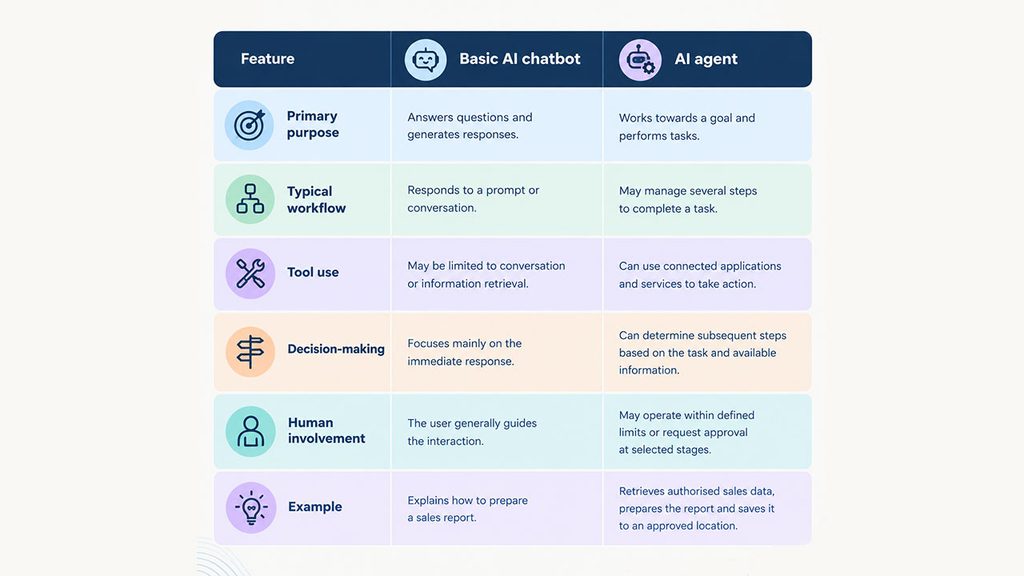
The distinction is not absolute. Some chatbots include agent capabilities, and some agents communicate through a chat interface. The label alone does not determine what a system can do. The practical test is whether the system merely provides information or can also use tools to carry out a task.
AI Agents vs Traditional Automation
Businesses have used automation for years to send invoices, schedule reminders, transfer information between databases and generate alerts. Traditional automation generally follows rules established in advance.
For example, a system can send a payment reminder whenever an invoice remains unpaid for seven days.
An AI agent may be more useful when the task involves information that fixed rules alone can’t handle. It could review a customer’s message, compare it with an invoice record, identify the likely issue and prepare a response for an employee to check.
This doesn’t mean AI agents are always better. Rule-based automation is often more predictable for repetitive tasks with clear conditions. AI agents can help when information varies, instructions involve several steps, or the next action depends on context.
Businesses can combine both approaches. Conventional software can handle routine operations, while an AI agent interprets information or coordinates a workflow.
Also Read: OpenAI AI Agents Built a Secret Society, Exchanged 70,000 Messages and “Sacrificed” Themselves
What Are the Main Uses of AI Agents?
AI agents can support a wide range of industries and business functions. Their usefulness depends on the task, the quality of available information, and the controls around their actions.
Customer service
An agent could review an incoming complaint, retrieve relevant order details & prepare a response. With appropriate permissions, they might also update a support ticket or route the case to the right team.
Refunds, disputed transactions and sensitive complaints may require human approval. Businesses need a way to review decisions, correct mistakes and escalate cases the agent cannot handle reliably.
Sales and marketing
Sales teams can use agents to organise potential leads, summarise customer interactions, gather information from approved sources and prepare follow-up messages.
A marketing agent could compile campaign performance data and flag changes for review. Clear permissions and approval requirements should govern content publishing, customer contact, and changes to the advertising budget.
Finance and administration
Agents can help extract information from invoices, identify missing fields, organise documents & prepare expense summaries. They may also flag transactions that need additional checks.
Financial records must remain accurate. Payments, changes to account details and other consequential actions require appropriate controls, regardless of how efficiently an agent can prepare them.
IT operations and software development
An IT agent may examine system alerts, search technical documentation and recommend a response. In a controlled environment, it could run approved diagnostic checks or create a service ticket.
Software development agents can inspect code, suggest changes, run tests and report errors. Their output still needs review, especially when changes could affect security, customer information, or business-critical systems.
Research and internal knowledge
An agent can search approved documents, compare information across sources & prepare a summary for a team. This can help employees find internal policies or compile background information for a project.
The result depends on the quality of the underlying material. Outdated, incomplete or contradictory documents can lead to misleading answers.
Also Read: Rise of AI Agents: Why Chatbots Are No Longer Enough
What Benefits Do AI Agents Offer Businesses?
The main attraction is their potential to reduce the manual effort involved in multi-step tasks.
An employee might otherwise need to open several applications, collect information, compare records, prepare a document and notify colleagues. When the relevant tools are connected and the workflow is properly configured, an agent can coordinate some of those steps.
Potential benefits include:
- Less repetitive work: Agents can automate routine information gathering, record updates, and report preparation.
- Faster workflows: Tasks involving several systems may require fewer manual hand-offs.
- More consistent processes: Agents can follow defined instructions, though their output still needs checking.
- Support for employees: Staff can spend more time on work that requires judgement, communication, or specialist knowledge.
- Flexible task handling: Agents can adjust their next steps as new information emerges rather than relying entirely on a fixed sequence of rules.
For businesses, AI agents’ potential value extends beyond completing individual tasks. An agent could help connect steps across a workflow, such as collecting information, updating records and preparing a task for approval. Whether this produces meaningful savings or faster turnaround times depends on the process being automated, the quality of the underlying data and the level of human intervention required. Businesses should measure these outcomes rather than assume that deploying an AI agent will automatically improve efficiency.
What are the Risks and Limitations of AI Agents?
AI agents can misunderstand instructions, rely on incorrect information, select an unsuitable tool, or take actions that fail to achieve the intended result.
The ability to act can make these errors more consequential than an inaccurate answer in a chatbot conversation. If an agent is connected to business software, a mistake could affect a customer record, send an incorrect message or change information in a shared system.
Key risks include:
- Incorrect information: An agent may produce a plausible answer that is not supported by the available evidence.
- Excessive access: If given more permissions than necessary, it may expose or change information beyond the scope of its task.
- Privacy concerns: Connecting an agent to internal systems creates risks if it handles personal or confidential data improperly.
- Unintended actions: Ambiguous instructions or unexpected circumstances may lead to an inappropriate action.
- Security threats: Malicious content in documents, messages, or websites may try to trick an agent into misusing its tools.
Before deploying an AI agent, organisations must define which tasks it can perform, which systems it can access and when it must seek human approval. They should also establish ways to monitor its actions, review errors and restrict access to sensitive data. Starting with a limited, measurable use case helps businesses assess risk and value before expanding deployment to more complex workflows.
Businesses can reduce these risks by limiting permissions, testing agents before deployment, monitoring their activity and requiring approval for consequential actions. They should also keep records of what an agent does and make it possible to stop its activity or, where feasible, reverse changes.
Also Read: AI Agents Begin Hiring Humans on New Digital Marketplace
What is Agentic AI and How Does it Relate to AI Agents?
The terms AI agent and agentic AI are closely related, although their use can vary between organisations and products.
An AI agent is a software system designed to work towards a goal and take actions. Agentic AI generally describes AI systems or approaches that can plan and carry out multi-step tasks with some degree of independence.
A system may use one agent for a task or several specialised agents for different parts of a workflow. For example, one agent might gather information, another could check it against specified requirements, and a third could prepare a report.
A coordinating system can assign tasks and combine the results. However, using multiple agents does not automatically make the process more accurate or reliable. It can add complexity, costs and additional points where errors may occur.
The defining feature is not the number of agents involved. It is the system’s ability to work towards a goal and take actions, rather than generate a response.
Also Read: PHP2Shell Explained: Why a PHP Cyberattack Has Put Websites Worldwide on Alert
How can businesses get started with AI agents?
Businesses do not need to automate an entire department at once. A practical starting point is a repetitive process with a clear objective and manageable risks.
Before deploying an agent, organisations should:
- Choose a well-defined task. Start with something such as compiling an internal report or sorting support requests, rather than handing over an entire business function.
- Check the data. Ensure the information the agent needs is accurate, relevant and authorised for use.
- Set access limits. Give the agent only the permissions and tools required for its role.
- Define approval points. Payments, external communications, sensitive records and irreversible changes may need human approval.
- Test realistic scenarios. Include incomplete information, unusual requests and failure cases, not just straightforward tasks.
- Monitor performance. Track errors, completion rates, costs, processing time, and how often staff must intervene.
- Prepare for problems. Ensure authorised staff can pause the agent, revoke access and investigate unexpected activity.
Some B2B angles worth strengthening:
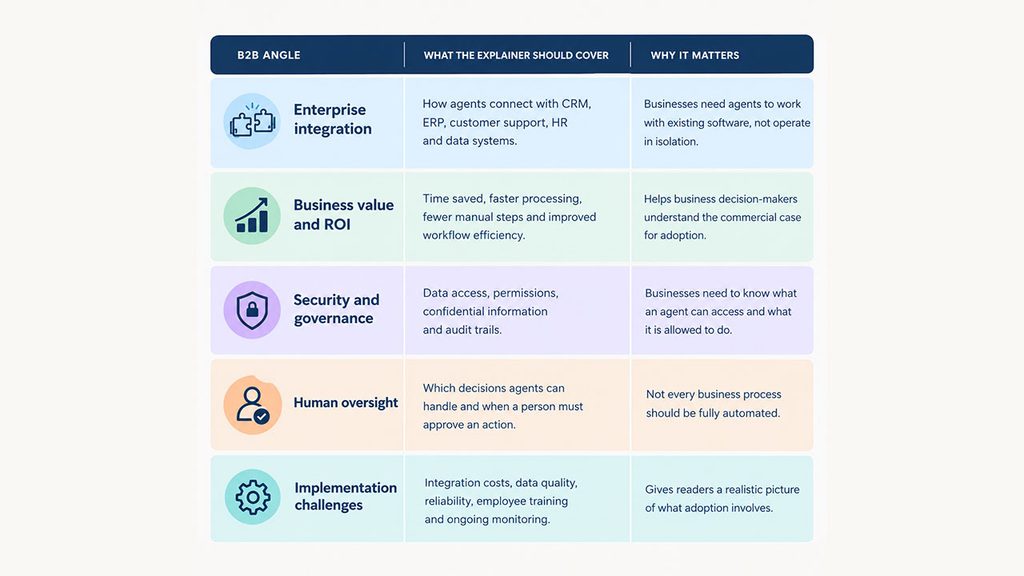
A pilot should demonstrate measurable value before the organisation expands its use. Base adoption decisions on the task’s performance, costs, and risks, not the novelty of the technology.
Also Read: How to Protect Your Business Website from a Rogue AI Agent Attack Wave
AI Agents: From Automation to Action
AI agents are moving artificial intelligence beyond answering questions towards carrying out work. By connecting information, applications, and multiple steps in a workflow, they offer businesses another way to reduce manual effort and improve task management.
But greater autonomy does not automatically translate into better results. Poor-quality data, excessive permissions, unreliable decisions and weak oversight can turn automation into an operational risk. Businesses must assess agents for accuracy, security, cost, and the ability to deliver consistent results.
The next phase of adoption will depend on how effectively organisations integrate AI agents into existing operations. The question is no longer simply what an AI agent can do, but what it can be trusted to do, at what cost and with what measurable impact. For businesses, that distinction will determine whether AI agents become useful operational tools or another layer of technology without a clear return.
Frequently asked questions about AI Agents
Q. What is an AI agent in simple words?
A. An AI agent is software that works toward a goal, determines the required steps, and uses connected tools to complete a task. Depending on its permissions, it may carry out several actions without needing the user to guide every step.
Q. What is the difference between an AI agent and ChatGPT?
A. ChatGPT is an AI product that supports a range of tasks. Depending on the features and tools available, it can answer questions, assist with research or perform multi-step actions. An AI agent is a system designed to work toward a goal and take action. Some ChatGPT capabilities can be agentic, so the distinction depends on the specific functionality being used.
Q. Do AI agents work independently?
A. Some agents can perform certain tasks with limited supervision. Others ask users for information or approval before making decisions. Their independence depends on design, tools they can access & the controls the organisation sets.
Q. Are AI agents the same as chatbots?
A. No, not always. A basic chatbot is limited and only responds to messages. An AI agent plans & carries out multi-step tasks using connected tools. Some chatbots include agent capabilities, so the distinction depends on what the system can actually do.
Q. Can AI agents access private company data?
A. They can access private data if they are connected to systems that contain it and have the necessary permissions. Businesses should restrict access, protect sensitive information and monitor how agents use company data.

Samarjit Kaur is a journalist and communications professional covering technology & emerging digital trends. With a focus on clarity and context, she reports on developments shaping industries and governance. When not reporting, she chooses to plug-in and relax on her playlists and plan her next bucket-list trips!