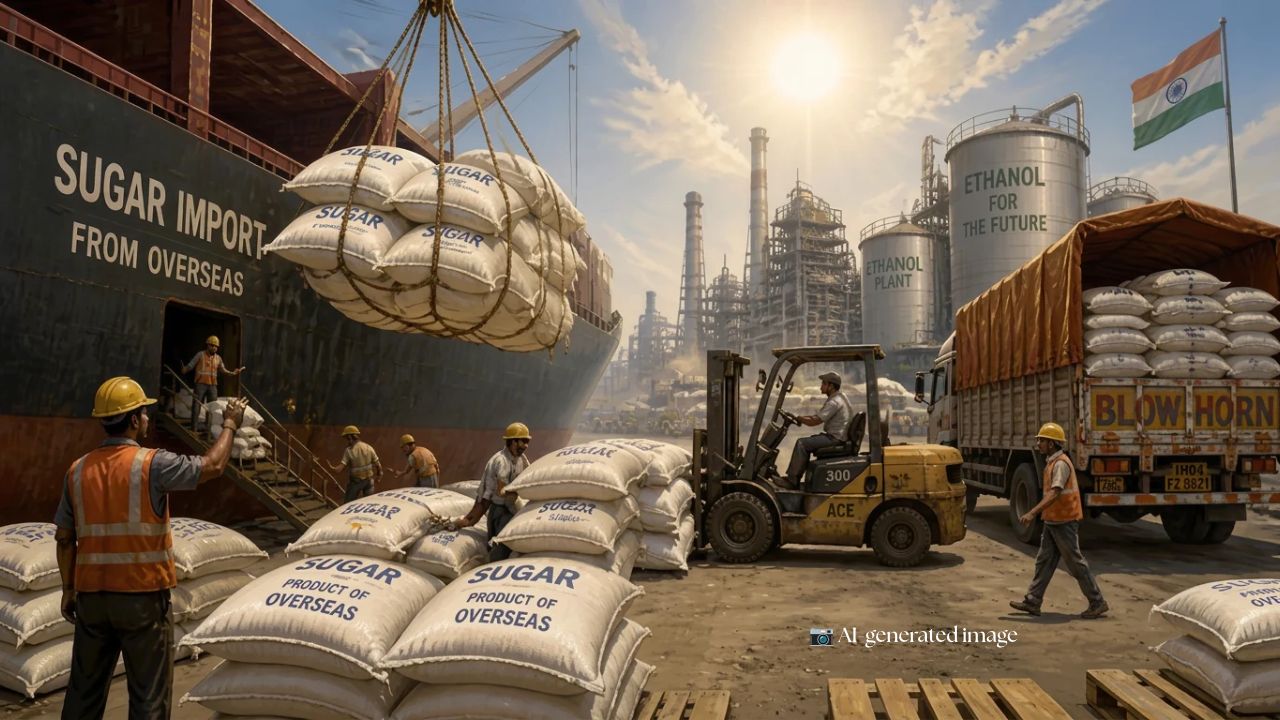
India is importing sugar. That may not sound unusual at first. But for a country that is the world’s second-largest sugar producer, it is a striking development. The government has allowed one million tonnes of raw sugar to be imported duty-free until October 31, just ahead of the festive season. This is the first such sugar import in nearly a decade. The move comes as domestic sugar prices have climbed to record levels and concerns grow over supplies during the months when demand usually rises sharply.
Read More | From Surplus to Export: India’s Next Big Move in Ethanol
Why is India importing sugar when it produces so much of it?
India is expected to produce around 32.4 million tonnes of sugar in the 2025-26 sugar season. But that is the gross production figure. Around 3.1 million tonnes of sugar equivalent is estimated to be diverted towards ethanol production, leaving net sugar production at about 29.3 million tonnes. Domestic consumption is estimated at around 28.3 million tonnes.
On paper, that still looks manageable. But sugar supply is not just about annual production. India needs enough stocks to carry the country through periods of high demand. The festive season, from Ganesh Chaturthi to Dussehra and Diwali, is one such period. Demand for sweets and other sugar-based products rises sharply during these months.
And this year, the buffer is looking much thinner. Sugar prices have already risen sharply. Wholesale prices in key markets have touched record levels as supplies tighten and traders prepare for stronger festive demand. That is why the government has now turned to imports.
But where does ethanol come into this?
Over the past decade, India has made a major push to blend ethanol with petrol. The aim was clear: reduce dependence on imported crude oil, save foreign exchange, create another market for farmers and sugar mills, and reduce emissions. The results have been significant.
India’s ethanol blending rate has risen from less than 1.5% in 2013-14 to around 20% in 2025-26. The country achieved the 20% target five years ahead of the original 2030 deadline. That is a major policy achievement. But there is another side to it. To make more ethanol, sugarcane and sugar-based feedstock are diverted away from sugar production.
Read More | India Now World’s Third-Largest Automobile Industry, Says Nitin Gadkari
Government data shows that sugar diversion for ethanol has been substantial in recent years. About 43 lakh tonnes of sugar was diverted towards ethanol in the 2022-23 sugar season, 24 lakh tonnes in 2023-24 and 34 lakh tonnes in 2024-25. This helped solve one problem. But has it created another?
Did the ethanol policy solve India’s sugar surplus problem too quickly?
There was a good reason for pushing ethanol. India’s sugar industry has historically struggled with excess production. When sugar prices fall, mills struggle to pay farmers on time. Diverting surplus sugarcane towards ethanol gives mills another source of revenue and helps them clear cane payments.
The government also says ethanol has helped reduce India’s oil import dependence and save foreign exchange. According to the government, the ethanol programme has substituted significant volumes of crude oil and generated additional earnings for farmers.
Was India too quick in pushing ethanol?
This is the uncomfortable question. India did not suddenly wake up and decide to use ethanol. The policy has been built over years. But the pace of implementation has certainly been fast. The government moved the 20% ethanol blending target forward from 2030 to 2025-26. India then reached that target ahead of schedule.
Read More | Nitin Gadkari: “No Future for Petrol & Diesel Vehicles in India”
At the same time, the country is facing the effects of weaker sugarcane yields in some major producing states, weather-related pressures and falling inventories. So it would be too simple to say “ethanol caused India’s sugar shortage.” It did not. The current pressure is the result of several factors, including production, weather, inventories, consumption and past trade decisions.
But ethanol is an important part of the equation because millions of tonnes of sugar equivalent are being redirected towards fuel. And that raises a bigger policy question:
Should India have moved so aggressively towards ethanol before ensuring that food and fuel demands could comfortably coexist?
Is importing sugar the irony of India’s ethanol story?
India is using more domestically produced ethanol to reduce its dependence on imported petrol and crude oil. Now, at the same time, it is preparing to import sugar. The government has allowed up to one million tonnes of raw sugar to enter the country without import duty until October 31. The move is aimed at improving domestic availability before the peak festive season.
Imported sugar is not necessarily cheap. The final cost depends on international sugar prices, freight, insurance, refining costs and the rupee-dollar exchange rate. So, India is effectively trying to balance two import bills. One is the oil bill that ethanol is meant to reduce. The other could now be a sugar import bill.
Did India get the balance right?
India wanted to solve one strategic problem: its dependence on imported fuel. It has made impressive progress. But the sugar market is now showing that energy policy does not exist in isolation. The same crop can be used for food or fuel. The same sugarcane that helps produce ethanol can also help keep sugar prices under control.
Read More | Can India Afford Ethanol Blending Amid Rising Water Crisis?
And when that balance shifts too far in one direction, the consequences can show up somewhere else. For India, the question now is whether the country pushed the ethanol transition too quickly, without leaving enough room to respond when sugar supplies tightened.
If India has to import sugar after aggressively diverting sugarcane towards ethanol, did the hurried push for ethanol really do more good than harm?

Indrani Priyadarshini is a journalist and editorial professional specialising in technology, artificial intelligence, smart cities, green energy, and digital transformation. With over four years of experience in tech journalism and digital media, she is known for turning complex industry developments into clear, engaging, and insightful stories. Her expertise spans reporting, editorial strategy, digital publishing workflows, and in-depth coverage of emerging technologies shaping the future.