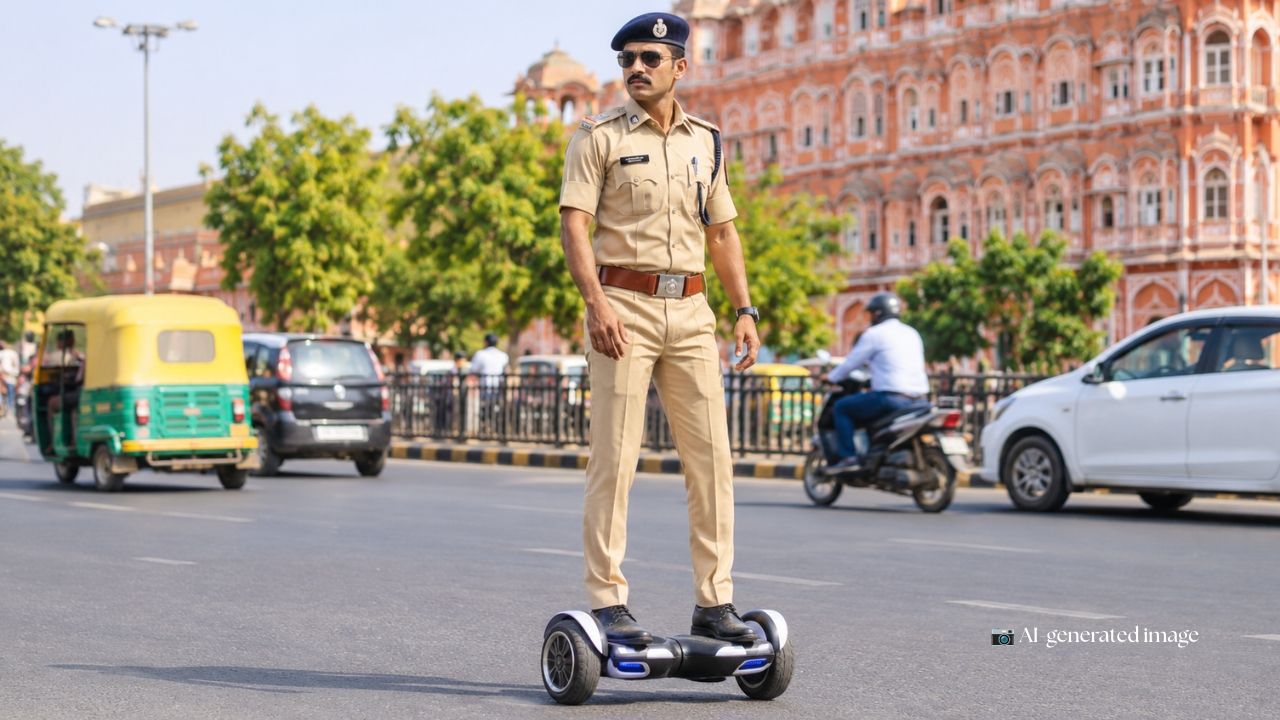
A recent video of a Jaipur Traffic Police officer patrolling on a self-balancing electric vehicle has caught attention. The unusual sight of a police officer moving through the city while standing on a two-wheeled electric device has sparked interest in how the technology works and how it could make traffic policing easier.
The vehicle, commonly known as a hoverboard or self-balancing electric scooter, is designed to help riders move around without having to sit or pedal. It has a standing platform positioned between two wheels and uses sensors to respond to the rider’s body movements. Jaipur Traffic Police has introduced five such electric self-balancing vehicles to help personnel patrol crowded public spaces, including shopping malls and busy roads.
Read More | Flying Wedge Defence Unveils India’s First AI-Piloted Fighter Jet Prototype
Why Has Jaipur Traffic Police Introduced Electric Hoverboards?
The electric hoverboards are aimed at making patrolling more convenient in locations where conventional vehicles may not be practical. In crowded areas, traffic police personnel often need to move through narrow spaces, monitor vehicle movement and manage pedestrian activity. Motorcycles and larger patrol vehicles may not always be convenient in such situations.
The compact design of self-balancing electric scooters allows officers to move around while standing, making it easier to navigate crowded locations and cover short distances. These vehicles can move forwards and backwards and turn in different directions depending on how the rider shifts their body weight.
How Do Self-Balancing Electric Scooters Work?
Self-balancing electric scooters use a combination of gyroscopic sensors, electronic control systems and motor technology to maintain balance and respond to the rider’s movements. The technology works by continuously detecting changes in the rider’s position and adjusting the speed of the wheels accordingly.
For instance, when a rider leans slightly forwards, the sensors detect the movement and signal the motors to move the vehicle forwards. Leaning backwards slows the vehicle or makes it move in reverse. Shifting weight towards either side helps the rider turn.
Read More | India’s Hydrogen Train Logs 6,000 Km as Railways Pushes Zero-Emission Mobility
The system continuously makes small adjustments to keep the platform balanced while the vehicle is moving. Unlike conventional scooters, these vehicles do not require handlebars or a steering wheel. Riders control their movement primarily through changes in body position.
How Can Hoverboards Help Traffic Police?
Electric self-balancing scooters could offer traffic police an additional option for patrolling busy public spaces. Their relatively compact size makes them suitable for locations where officers need to move around frequently, stop at short intervals or navigate through crowds.
What Other Equipment Has Jaipur Traffic Police Received?
Along with the five electric self-balancing vehicles, Jaipur Traffic Police has received additional equipment to support traffic management and enforcement. The equipment includes 4 motorcycles fitted with handheld laser speed guns, 50 iron barricades, 1,000 pairs of sunglasses and 100 reflective jackets.
Read More | India Now World’s Third-Largest Automobile Industry, Says Nitin Gadkari
The motorcycles equipped with laser speed guns can help personnel monitor vehicle speeds and identify traffic violations. Barricades and reflective jackets are also important for managing traffic and improving the visibility of officers on duty.
Which Indian Companies Make Self-Balancing Electric Scooters?
Self-balancing electric mobility products are available in the Indian market, with companies such as HoverRobotix, Uboard India and Freego Bikes manufacturing or selling products in this category.
These products are generally designed for personal mobility and recreational use, although similar technology can also have applications in security, patrolling and other public-facing services.

Indrani Priyadarshini is a journalist and editorial professional specialising in technology, artificial intelligence, smart cities, green energy, and digital transformation. With over four years of experience in tech journalism and digital media, she is known for turning complex industry developments into clear, engaging, and insightful stories. Her expertise spans reporting, editorial strategy, digital publishing workflows, and in-depth coverage of emerging technologies shaping the future.