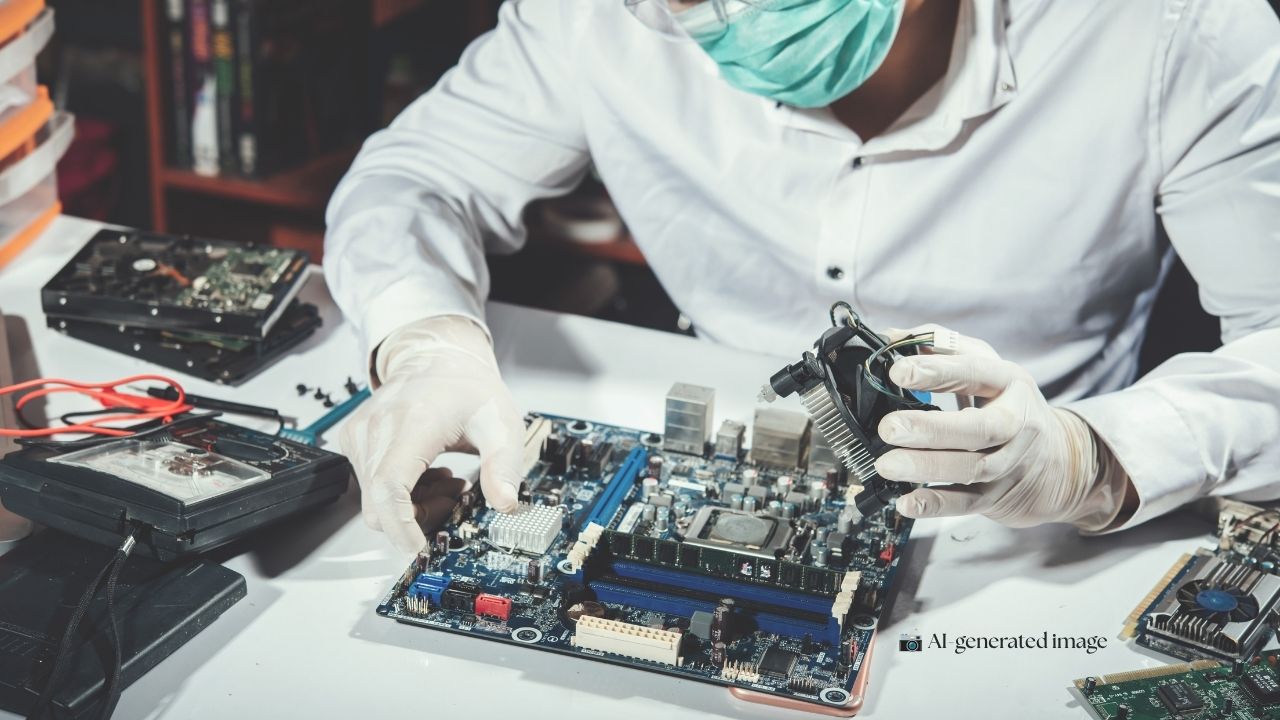
India’s semiconductor industry is entering a new stage. The focus is now shifting from policy announcements and government plans to the actual work of designing, manufacturing, and producing chips. Across government offices, startup companies, and large manufacturing plants, several developments are helping India move closer to becoming a major player in the global semiconductor industry.
India-US Partnership Strengthens Semiconductor Goals
A major boost has come from the growing technology partnership between India and the United States. During US Secretary of State Marco Rubio’s four-day visit to India, both countries highlighted semiconductors and artificial intelligence (AI) as top priorities for future cooperation.
Read More | India Moves Deeper into Chip Manufacturing with Fresh ₹3,900 Cr Investment
This collaboration is being guided through the TRUST Initiative, which was signed during Prime Minister Narendra Modi’s visit to Washington in February 2025. The initiative provides a framework for technology cooperation between India and the US across multiple sectors. One of the most important parts of the initiative is the US-India Roadmap on Accelerating AI Infrastructure. The roadmap aims to remove challenges related to financing, connectivity, and infrastructure that have slowed the development of large AI data centres in India.
The United States sees India as a key market for AI growth and as an important partner in building AI infrastructure outside China’s influence. Another important development is the American AI Exports Program’s National Champions Program. Introduced during the IndiaAI Impact Summit in February, the program allows leading AI companies from partner nations to become part of American AI export ecosystems. Applications are open until June 30, and the Indian government is encouraging domestic companies to participate.
If selected, Indian AI firms could gain easier access to American AI hardware, software, and supply-chain networks, provided they meet US approval standards.
Read More | Iran Crisis Signals Urgency for India’s Semiconductor Push
India has also joined the Pax Silica alliance. The Pax Silica fund is a $250 million seed facility backed by the US State Department. It aims to attract more than $1 trillion in trusted investments for critical infrastructure projects worldwide.
India is actively seeking support from the fund for semiconductor and related technology projects. The US administration views Pax Silica as a way to reduce dependence on Chinese supply chains, making India an attractive partner due to its growing semiconductor ambitions and strategic position.
Indian Chip Startups Are Moving Into Production
While the government are building partnerships, Indian semiconductor startups are making significant progress. Companies such as Netrasemi, Mindgrove Technologies and Agnit Semiconductors have moved beyond the prototype stage and are now supplying chips to customers, conducting pilot projects and preparing for larger scale production.
Netrasemi has already put its main chip into production. Samples are being tested by three customers and commercial-scale production is expected by mid-2027.
Mindgrove Technologies, backed by PeakXV Partners, is targeting sectors such as biometrics, motor controllers and industrial electronics. The company plans to begin commercial rollout by the end of this year and aims to ship hundreds of thousands of chips in 2025.
Read More | India’s Third Semiconductor Plant to Begin Operations in July, Fourth Unit by Year-End
Agnit Semiconductors focuses on gallium nitride chips, which are important for defence applications. The company currently has three pilot projects running with defence public sector units and private defence companies. It expects production volumes to reach between 5000 and 10,000 chips within the next nine months. This progress is notable because semiconductor startups usually take three to four years to move from prototype to production. Indian firms are achieving this much faster.
Two government schemes have played an important role:
- The Design-Linked Incentive (DLI) scheme, which supports chip design activities.
- The Production Linked Incentive (PLI) scheme, which provides financial support for manufacturing.
The India Semiconductor Mission (ISM), launched in December 2021, helped start this wave of semiconductor development.
Government Policies Are Creating Market Opportunities
Government policy has already influenced related industries. Restrictions on uncertified internet-connected CCTV cameras pushed Chinese brands such as Hikvision and Dahua out of the Indian market. This created new opportunities for domestic manufacturers.
Indian chip companies now want similar policy support. They are looking for measures that encourage Indian companies to buy locally produced chips instead of relying on cheaper imports from Taiwan and China.
Supply Chain Challenges Are Increasing
Despite the positive momentum, supply chain challenges remain a major concern. The ongoing Gulf conflict has disrupted global component markets and created difficulties for Indian semiconductor companies.
Read More | India Semiconductor Mission 2.0 May Get 12-Year Run as Centre Expands Chip Ecosystem Push
Shipments from China have fallen by 21%, reducing the availability of critical components that Indian manufacturers still depend on heavily. Delivery times for printed circuit boards (PCBs) have increased from about seven days to 25 days.
The situation is similar for semiconductor manufacturing chemicals, most of which are imported. Even before the Gulf conflict, manufacturers were already facing shortages that forced them to use alternative materials instead of ideal specifications. Since the conflict began, supply chains have become far more unpredictable.
This is especially dangerous in the semiconductor industry because mistakes are extremely expensive. The process of sending a chip design to a fabrication facility can cost more than $3 million. Production-quality versions can cost several times more. Any delay or mistake at this stage can seriously threaten a startup’s survival.
Tata’s Assam Plant Marks a New Industrial Phase
India’s semiconductor ambitions are not limited to startups. Ashwini Vaishnaw, Minister of Electronics and IT, Government of India, has confirmed that the Tata Semiconductor Assembly and Test facility in Jagiroad, Assam, is expected to begin production during the current financial year.
The project involves an investment of Rs 27,000 crore. The plant is designed to manufacture up to 48 million semiconductor chips per day using advanced packaging technologies such as flip-chip and Integrated System in Package (ISiP). It will serve industries including automotive, Electric vehicles, telecommunications and consumer electronics.
The Jagiroad facility, along with Micron’s plant in Gujarat and other approved projects under ISM 1.0, represents the large-scale manufacturing side of India’s semiconductor strategy. The first phase of the India Semiconductor Mission has now concluded after approvals were granted to the final two projects by Crystal Matrix and Suchi Semicon.
ISM 1.0 had a total budget of around Rs 76,000 crore and provided up to 50% fiscal support for semiconductor fabs, compound semiconductor facilities, assembly and testing units, and chip design operations.
Important Gaps Still Remain
Despite all the progress, India’s semiconductor ecosystem is still incomplete. The country lacks strong foundries and specialised Outsourced Semiconductor Assembly and Test (OSAT) facilities that can support strategic sectors. Existing facilities mainly focus on consumer products and general-purpose applications instead of specialised industries where India has long-term strategic interests.
NITI Aayog’s Vision for the Future
According to NITI Aayog, India’s semiconductor market could reach around $200 billion by 2035, while the global semiconductor market could exceed $1.5 trillion. Currently, 90% to 95% of India’s semiconductor demand is met through imports. This dependence creates major risks, including large foreign exchange outflows and supply chain vulnerabilities, which have become more visible during recent global disruptions.
NITI Aayog estimates that building a globally competitive semiconductor ecosystem will require investments between $135 billion and $180 billion over the next decade. The government may need to contribute at least one-third of that amount to reduce risk and encourage private investment.
Read More | India Semiconductor Mission Launches Investor Portal to Accelerate Chip Ecosystem Push
Priority investment areas include- semiconductor fabrication plants (fabs), advanced packaging facilities, compound semiconductors and critical chip design infrastructure.
Rather than directly competing with established semiconductor giants such as Taiwan, South Korea, and China, NITI Aayog recommends that India follow its own path. The objective is to create a semiconductor value chain worth between $120 billion and $150 billion while achieving greater self-reliance and global importance.
A Defining Moment for India’s Chip Industry
International partnerships are strengthening. Domestic startups have moved beyond the prototype stage. Large manufacturing projects are nearing production. Government policies have already shown they can influence market behaviour.
Read More | Delhi Bets on Chip Design Over Fab Plants in New Semiconductor Push
At the same time, the strategic goal of reducing dependence on Chinese supply chains and building trusted alternatives with the US and allied nations has become increasingly important. Supply chain risks continue to grow. The gap between startup funding and large institutional investment needs to be addressed. India still requires more foundries and specialised OSAT facilities. Most importantly, the industry requires sustained investments running into hundreds of billions of dollars over many years.
The real questions now are how quickly India can scale and how resilient its ecosystem can become. Whether it can establish a meaningful position in a global semiconductor market that is becoming increasingly concentrated among a few dominant players.

Indrani Priyadarshini is a journalist and editorial professional specialising in technology, artificial intelligence, smart cities, green energy, and digital transformation. With over four years of experience in tech journalism and digital media, she is known for turning complex industry developments into clear, engaging, and insightful stories. Her expertise spans reporting, editorial strategy, digital publishing workflows, and in-depth coverage of emerging technologies shaping the future. She has also conducted high-profile interviews and podcasts with industry leaders, bringing sharp analysis and accessible storytelling to a wide audience.