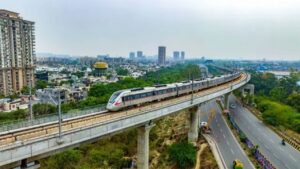
BRICS countries have reaffirmed their commitment to building more sustainable and resilient transport infrastructure, while stepping up cooperation on low-carbon aviation. At a meeting chaired by India, the BRICS nations agreed to deepen cooperation in transport policy, investment, technology and capacity building. The focus is on developing transport infrastructure that supports economic growth while reducing its environmental impact.
Read More | BRICS Backs Secure Telecom Networks and Common ICT Security Standards
The countries also stressed the need to increase the use of Sustainable Aviation Fuels (SAF) and other low-carbon aviation fuels to cut carbon emissions from international aviation.
BRICS backs sustainable transport infrastructure
According to the New Delhi Declaration: Building for Resilience, Innovation, Cooperation and Sustainability, BRICS members recognised transport as an important part of economic growth, connectivity and environmental sustainability.
The declaration said the countries would strengthen cooperation in transport policy, investment, technological development and capacity building to support sustainable and resilient infrastructure. The bloc also highlighted the importance of bringing circular economy principles into the development and maintenance of transport infrastructure. This approach could help make transport systems more resource-efficient and sustainable over their full lifecycle.
Sustainable Aviation Fuel gets greater focus
A key part of the BRICS commitment is the promotion of Sustainable Aviation Fuels and low-carbon aviation fuels. The countries recognised SAF as an important tool for reducing carbon emissions from international aviation. They also welcomed the BRICS Forum on Sustainable Aviation Fuels, which is intended to support knowledge sharing and cooperation among member countries.
Read More | Pune, Germany Cities Explore Partnership on Mobility, Waste Management and Technology
For an aviation industry under growing pressure to reduce its carbon footprint, greater cooperation on alternative fuels could become increasingly important.
BRICS promotes transport decarbonisation
The BRICS countries also welcomed the BRICS Framework of Cooperation for Exchange of Knowledge on Transport Decarbonisation, with a focus on using renewable energy potential. The framework is aimed at encouraging countries to share knowledge and approaches that can help reduce emissions across the transport sector.
The declaration also announced the establishment of the BRICS Urban Mobility Hub. The platform will support knowledge exchange and cooperation on accessible, affordable, inclusive and smart urban transport solutions.
New cooperation on logistics and railways
Transport cooperation will also extend to logistics and railways. The BRICS nations welcomed the establishment of the BRICS Logistics Supply-Chain Cooperation Framework and encouraged further discussions on a proposed BRICS Railway Research Network.
Read More | Bengaluru Startup Unveils AI-Piloted Fighter Concept
The countries also agreed to continue dialogue on transport, including civil aviation, with the aim of improving transport potential across member countries. The declaration stressed that such cooperation would continue while respecting the sovereignty and territorial integrity of all BRICS members.
What does the BRICS transport agreement mean?
The latest commitments show that BRICS is looking beyond conventional transport infrastructure. The focus is increasingly on cleaner fuels, renewable energy, smart urban mobility, resilient infrastructure and more efficient supply chains.
Read More | India Now World’s Third-Largest Automobile Industry, Says Nitin Gadkari
For aviation in particular, the push for Sustainable Aviation Fuels could strengthen cooperation between member countries as the industry looks for ways to reduce emissions. The BRICS meeting also welcomed the expansion of the International Civil Aviation Organisation (ICAO) Council by four seats for underrepresented regions, including Africa and Asia-Pacific.
With transport becoming a major part of the wider sustainability agenda, BRICS is signalling that future connectivity will need to be not only faster and more efficient, but also cleaner and more resilient.

Indrani Priyadarshini is a journalist and editorial professional specialising in technology, artificial intelligence, smart cities, green energy, and digital transformation. With over four years of experience in tech journalism and digital media, she is known for turning complex industry developments into clear, engaging, and insightful stories. Her expertise spans reporting, editorial strategy, digital publishing workflows, and in-depth coverage of emerging technologies shaping the future.