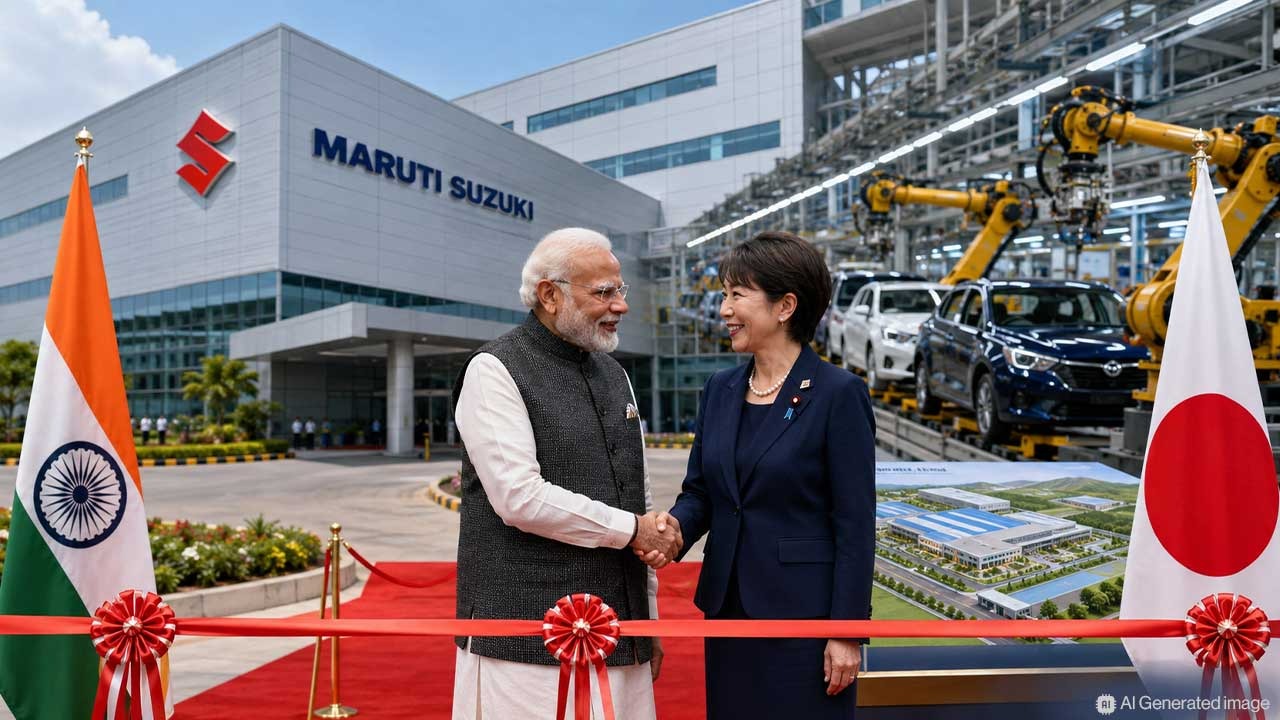
Prime Minister Narendra Modi, along with Japanese Prime Minister Sanae Takaichi, virtually inaugurated Maruti Suzuki India’s Rs 35,000 crore vehicle manufacturing facility at IMT Kharkhoda. The event reflects the deepening collaboration between the two countries in manufacturing, technology and investment.
Read More | India-Japan Sign AI, Defence and Energy Deals as Modi-Takaichi Summit Strengthens Tech Partnership
The Kharkhoda plant is among the largest investments in India’s automotive sector and is central to Maruti Suzuki’s long-term strategy to expand production capacity while adopting advanced manufacturing technologies and sustainable industrial practices.
One of India’s Largest Automobile Manufacturing Facilities
Spread across 800 acres, the Kharkhoda manufacturing complex includes an integrated supplier park and has been designed to become one of the world’s largest automobile production facilities. Once fully operational, the plant will have an annual production capacity of 10 lakh vehicles, significantly contributing to Maruti Suzuki’s goal of achieving a total manufacturing capacity of 40 lakh vehicles per year across its facilities.
The project represents a total investment of ₹35,000 crore, including the supplier ecosystem and is expected to create over 21,000 direct employment opportunities. It is also expected to strengthen India’s position as a global hub for automobile manufacturing and exports.
Built Around Industry 5.0 Technologies
The Kharkhoda facility has been developed under Maruti Suzuki’s ‘Suzuki Smart Factory’ concept, integrating advanced digital technologies with human-centric manufacturing.
Some of the key features include:
- Industry 5.0-enabled manufacturing systems
- AI-powered human-aware collaborative robots (cobots)
- Advanced digital manufacturing technologies
- Automated production processes designed to improve productivity while enhancing worker safety
The company says these technologies are aimed at creating a more efficient, flexible and safer manufacturing environment.
Sustainability Integrated into Plant Operations
Environmental sustainability has been a key focus in the design of the Kharkhoda facility, with several initiatives planned to reduce its environmental footprint. The plant will operate entirely on renewable electricity and follows a Zero Liquid Discharge manufacturing process, ensuring that wastewater is treated and reused within the facility. It also incorporates 100% water recycling systems.
Additional sustainability initiatives include an in-house solar power plant with a scalable capacity of up to 70 MW and a biogas plant scheduled for commissioning during FY2026-27. To reduce logistics-related emissions, the facility will also feature a dedicated in-plant railway siding for vehicle transportation and material movement.
Reinforcing the India-Japan Manufacturing Partnership
The inauguration coincides with the India-Japan Joint Economic Forum, highlighting the longstanding economic relationship between the two countries.
Read More | Japan PM Sanae Takaichi’s India Visit: AI, Semiconductors & Critical Minerals On Agenda
As a subsidiary of Japan’s Suzuki Motor Corporation, Maruti Suzuki has played a significant role in strengthening Japanese investment in India over the past decades. The Kharkhoda project further supports India’s ambition to emerge as a global manufacturing and export hub under the government’s ‘Make in India, Make for the World’ initiative.
With its combination of large-scale production capacity, advanced manufacturing technologies and sustainability-focused infrastructure, the Kharkhoda facility is expected to become one of the most significant automotive manufacturing investments in the country.

Indrani Priyadarshini is a journalist and editorial professional specialising in technology, artificial intelligence, smart cities, green energy, and digital transformation. With over four years of experience in tech journalism and digital media, she is known for turning complex industry developments into clear, engaging, and insightful stories. Her expertise spans reporting, editorial strategy, digital publishing workflows, and in-depth coverage of emerging technologies shaping the future.