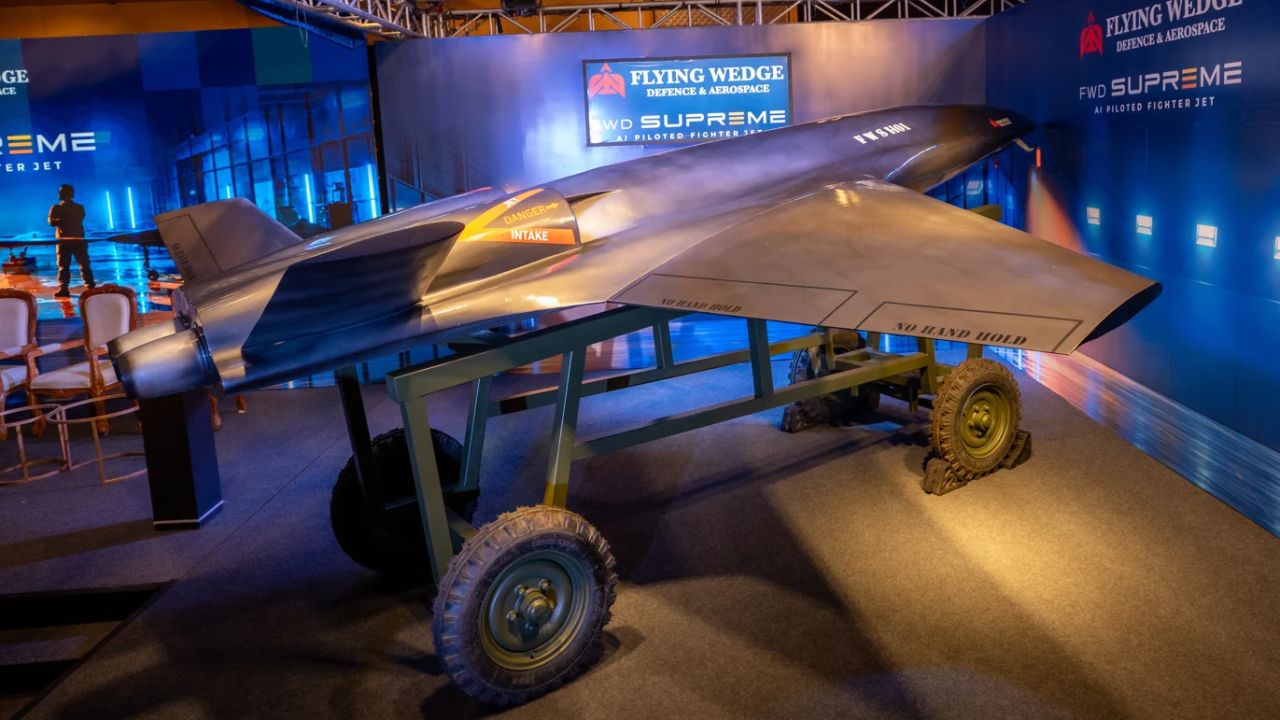
Indian defence technology company Flying Wedge Defence & Aerospace (FWDA) has unveiled the full-scale static prototype of FWD Supreme. It is an AI-powered autonomous fighter jet programme that is designed to bring AI and autonomous systems into combat aviation.
The Bengaluru-based company unveiled the prototype at an event in New Delhi, marking a major step in its plans to develop a family of AI-piloted fighter aircraft.
Read More | IG Defence tests JWALA micro-missile rocket motors in major counter-drone milestone
The event was attended by senior defence officials, including Shri A. Anbarasu (IAS), DG Acquisition; Air Marshal Prem Kumar, DG Weapon Systems; Lt. General Puneet Ahuja, Chief of Staff, Western Command; and Major General Tarun Aggarwal, ADG Acquisition Tech. Miguel Abreu, CEO of SketchPixel and Director of KEYDEF also attended the event.
What is FWD Supreme?
FWD Supreme Heavy is being developed as an AI-powered autonomous fighter aircraft in the 1,500 kg-plus class. According to FWDA, it will have a payload capacity of around 350 kg and use a 5 kN propulsion system.
The aircraft is designed to reach a maximum speed of Mach 0.8–0.85, while its cruising speed is expected to be around 500–600 km/h. FWDA says the aircraft is being designed for a range of more than 1,500 km and an endurance of over two hours.
The platform will also feature satellite communications (SATCOM) and a flying-wing configuration with an internal weapons bay. Its approximate dimensions are 10 metres by 10 metres.
FWDA plans indigenous engine integration
FWDA says it is looking to integrate a turbo-fan engine developed by the Defence Research and Development Organisation (DRDO) into the FWD Supreme programme. The company said this would help make the aircraft more indigenous while reducing dependence on foreign components and potential delays linked to overseas suppliers.
FWDA also highlighted its smaller FWD Supreme Lite aircraft. The 250 kg-class demonstrator is described as a platform for the Army and a testbed for the wider programme. According to the company, FWD Supreme Lite is 90% indigenous and uses an Indian-made engine manufactured by UMS in Coimbatore. The aircraft has already completed taxi trials and is being prepared for its first flight in the next two months, FWDA said.
AI at the centre of the fighter jet programme
The FWD Supreme programme is built around the use of AI-enabled autonomous aircraft rather than relying solely on conventional piloted fighter platforms. FWDA says its approach is based on what it calls the Mobbing Doctrine. The concept involves multiple AI-piloted aircraft operating as a coordinated force, sharing information and making decisions in real time.
Read More | AI and GIS Transform Defence Operations as India Moves Towards Predictive Battlefield Intelligence
The company believes this approach could change the economics of air combat by allowing several networked aircraft to operate together. The idea is to use numbers, autonomy and coordination to support missions rather than depending only on a small number of expensive high-value aircraft.
FWD Supreme aims for an India-led aerospace ecosystem
Suhas Tejaskanda of FWDA said the FWD Supreme programme is aimed at developing advanced defence capabilities through Indian design, engineering and manufacturing. The company also plans to work with international aerospace and manufacturing partners through Operation 777, with the stated objective of building an India-led ecosystem for advanced combat aviation.
The programme is being developed in phases, with the next stage expected to focus on technology development, testing and integration, alongside work on the wider Supreme family of aircraft.
Who is behind FWD Supreme?
FWDA said the programme is being led by Sr Girish Dixit, Secretary ADA and a control systems expert and former DRDO scientist.
Read More | India Expands Cyber Defence Push as Government Orders Sector-Wide Drills Against AI-Powered Cyber Threats
The team also includes aerospace scientists associated with the development of platforms such as the LCA Tejas and AMCA. They include V. Subba Rao, G. Radhakrishnan, Mahesh Prabhakar Padwale and R.S. Rao, who bring experience across fighter aircraft development, airframe and structural systems, propulsion, engine integration, avionics and weapons integration.

Indrani Priyadarshini is a journalist and editorial professional specialising in technology, artificial intelligence, smart cities, green energy, and digital transformation. With over four years of experience in tech journalism and digital media, she is known for turning complex industry developments into clear, engaging, and insightful stories. Her expertise spans reporting, editorial strategy, digital publishing workflows, and in-depth coverage of emerging technologies shaping the future.