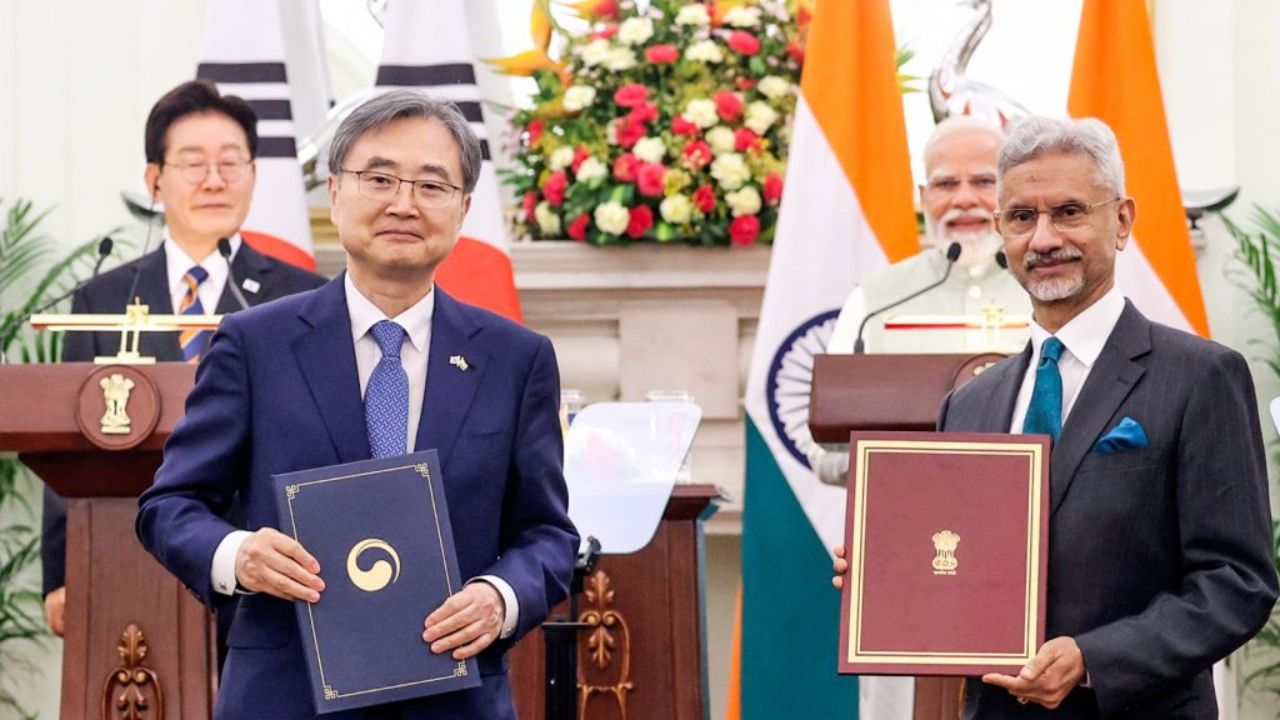
India and South Korea have taken a significant step toward deepening their bilateral ties, with Prime Minister Narendra Modi and President Lee Jae Myung outlining an expansive roadmap for what they described as a “futuristic partnership.” The announcement came after delegation-level talks held at Hyderabad House during President Lee’s State Visit to India, culminating in key outcomes spanning multiple sectors.
A Broader Strategic Vision
At the heart of the discussions was a renewed Joint Strategic Vision for the India–Republic of Korea Special Strategic Partnership. The framework signals a shift toward long-term collaboration in areas such as tech, shipbuilding, maritime logistics, sustainability, and energy security—sectors that are increasingly central to both economies.
The emphasis was not just on expanding cooperation but on making it more structured and future-ready, aligning with global shifts in technology, trade, and climate priorities.
Expanding Cooperation Across Sectors
A series of agreements and memorandums reflected the breadth of engagement between the two countries. These covered ports and shipping, steel supply chains, small and medium enterprises, science and technology, and climate action. Among the more notable developments was the proposed India–Korea Digital Bridge, which aims to bring closer collaboration in emerging technologies like artificial intelligence, semiconductors, and IT infrastructure. Negotiations to upgrade the existing Comprehensive Economic Partnership Agreement are also set to resume, signalling intent to remove bottlenecks in trade and investment. Other agreements focused on financial cooperation, digital payments, maritime heritage, and a Cultural Exchange Programme for 2026–2030, alongside initiatives in sports and creative industries.
New Dialogues and Institutional Mechanisms
Both sides announced new platforms to strengthen coordination. These include an Economic Security Dialogue to address supply chain resilience and critical technologies, as well as a Distinguished Visitors Programme to promote stronger people-to-people connections.
Read More | Convergence Awards 2026 Winners Revealed: Jio, Tata Communications & More Shine
In addition, foreign ministries from both countries will initiate structured dialogues on global challenges, including climate change, Arctic cooperation, and maritime affairs—areas where shared interests are increasingly evident. South Korea’s decision to join India-led initiatives such as the International Solar Alliance and the Indo-Pacific Oceans Initiative marks a further alignment of priorities. India, in turn, will become a member of the Global Green Growth Institute.
A Shared Message on Global Stability
Beyond economic cooperation, the discussions carried a broader geopolitical message. Both leaders emphasised their commitment to peace and stability, particularly in the Indo-Pacific region. With shared democratic values, India and South Korea reiterated their support for a free, open, and inclusive regional order. They also highlighted the need for reform in global institutions and agreed to work together more closely in multilateral forums to address emerging global challenges.
Strengthening Cultural Ties
The partnership is not limited to strategic and economic interests. Both countries acknowledged their long-standing cultural connections and the growing exchange of ideas and creativity. The rising popularity of Korean culture in India, alongside increasing interest in Indian cinema in South Korea, reflects a shift toward deeper societal engagement. Future cooperation is expected to expand in areas such as tourism, education, research, and creative industries, strengthening the human dimension of the relationship.