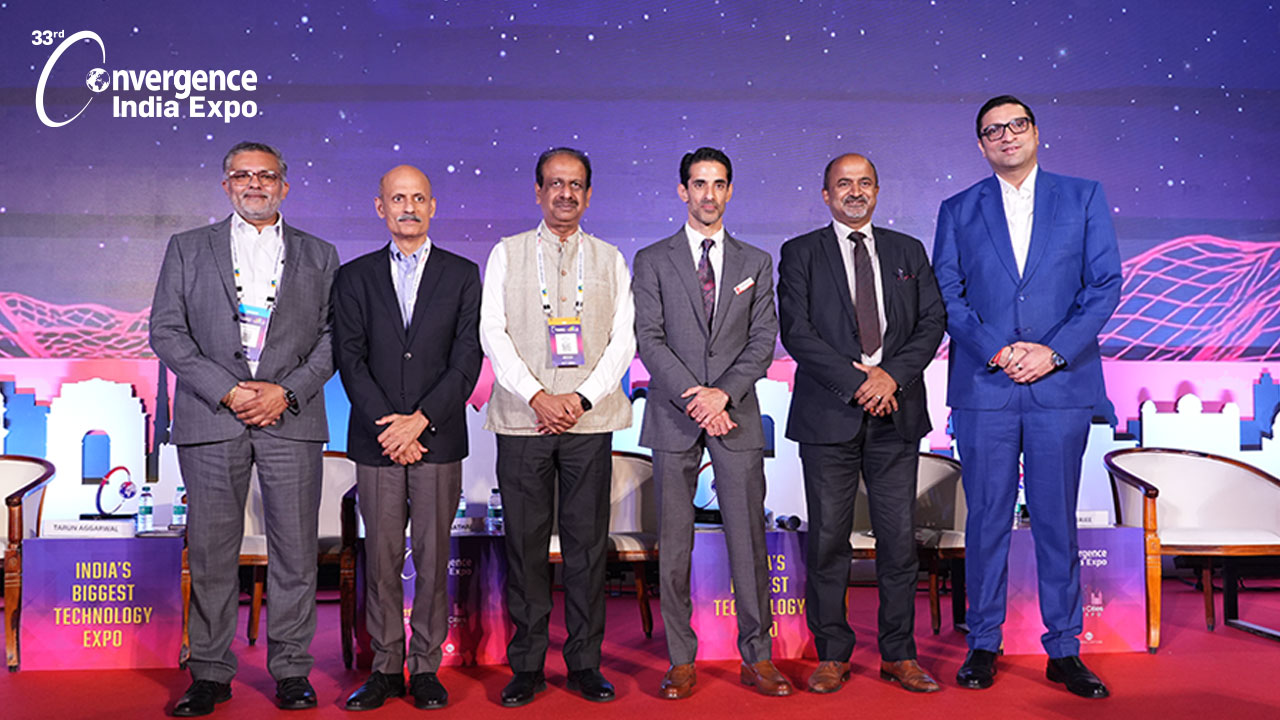
At the 33rd Convergence India Expo 2026, a thought-provoking panel discussion on “Creating Interconnected, Interoperable & Intelligent Transport Networks” brought together key stakeholders from across the automotive and mobility ecosystem. The session examined how emerging technologies, ranging from vehicle-to-vehicle (V2V) communication and advanced driver assistance systems (ADAS) to software-defined vehicles (SDVs) and connected infrastructure, are collectively redefining the future of mobility in India.
Read More | Convergence Awards 2026 Winners Revealed: Jio, Tata Communications & More Shine
Moderated by Dhruv Behl, Editor-in-Chief of autoX and Director at Exhibitions India Group, the panel featured distinguished industry leaders, including:
Dr. Reji Mathai, Director, ARAI and ARAI AMTIF
Anuraag Bharadwaj, VP and Head Automotive Industry Platform, Capgemini
Puneet Aggarwal, Head Smart Mobility & Sustainable IoT, Jio Platforms Limited
PK Banerjee, Chief Executive Director, Society of Indian Automobile Manufacturers (SIAM)
Anuraag Bharadwaj, VP & Head Automotive Industry Platform, Capgemini
Tarun Aggarwal, Sr. Executive Officer, Engineering, Maruti Suzuki India Limited
Software-Driven Vehicles: A New Automotive Reality
Setting the tone for the discussion, Dhruv Behl highlighted the growing complexity of modern vehicles, emphasising the industry’s shift from mechanical engineering to software-centric systems. He noted, “Today, it is very difficult to be an automaker because vehicles have become highly complex, with millions of lines of code and multiple ECUs, making it a completely different ball game.” This transformation is redefining not just how vehicles are built, but also the expertise required across the automotive value chain.
However, this rapid evolution comes with its own challenges. Behl pointed out that while there is immense opportunity, “automakers globally have invested heavily in new technologies like EVs without seeing the expected demand,” underlining the risks associated with large-scale technological transitions.
He also stressed the importance of cross-sector collaboration, stating that building a comprehensive mobility ecosystem, such as an “India Mobility Stack”, requires alignment across ministries and industries, from telecom to transport and heavy industries. “It requires all of us—government, regulators, and industry—to work together… even though it is much easier said than done.”
Read More | Women Leaders Take Lead at Convergence India Expo, Call for Equity within Startup Ecosystem
Connectivity as the Foundation of Future Mobility
Puneet Aggarwal of Jio Platforms underscored connectivity as the backbone of next-generation mobility systems. According to him, connected vehicles will soon become the norm rather than a premium feature. “By default, all vehicles are going to be connected… driven by safety, security, and the need to build a broader ecosystem,” he said. Drawing parallels with smartphone connectivity, he added, “Just like today, we cannot function without internet on our phones, it will become a basic necessity for automotive systems as well.”
Aggarwal also highlighted the urgent need for standardised data-sharing frameworks. Currently, vehicle data remains siloed within OEM ecosystems, limiting its broader utility. “There is a need for norms and regulation around data sharing… cross-sharing can unlock significant value for the entire ecosystem.”
He emphasised that India’s diversity requires tailored solutions rather than imported global models. “We cannot replicate global models directly; we need systems that are interoperable and adapted to our diverse conditions,” he said, pointing to the lack of alignment among stakeholders as a key bottleneck.
Read More | India Pushes Quantum Tech Agenda with National Mission at Convergence India Expo
Connectivity, Sustainability, and Lifecycle Optimisation
From the perspective of industry bodies, P K Banerjee of SIAM stressed that connectivity will be central to addressing key mobility challenges. “Mobility growth in the near future needs to be connected,” he said, linking it to broader goals such as sustainability, congestion reduction, and enhanced customer experience. He explained that intelligent connectivity enables optimisation across the entire vehicle lifecycle, from design and manufacturing to in-service performance.
Banerjee also highlighted the importance of interoperable charging infrastructure and V2X communication for electric vehicles. Technologies like C-V2X, he noted, can significantly improve road safety through collision avoidance while also enhancing traffic flow and reducing fuel consumption. “There is a huge opportunity to address decarbonisation and efficiency through connectivity,” he added, reinforcing the role of digital technologies in achieving sustainability goals.
Read More | Smart Mobility Takes Centre Stage at Convergence India Expo 2026
Bridging Infrastructure and Regulation Gaps
Dr. Reji Mathai of ARAI offered a regulatory and testing perspective, describing the current phase as a transitional one. “We are in a transition phase where new technologies like EVs and connected vehicles are being compared to systems that have evolved over decades,” he said, noting the challenge of demonstrating incremental value in such an environment.
He emphasised that the benefits of connected mobility are closely tied to infrastructure readiness. Countries with robust infrastructure and aligned processes are able to realise these benefits faster, while others may take longer.
Importantly, Mathai highlighted India’s collaborative regulatory ecosystem. “Any new regulation is deliberated through industry-led committees,” ensuring that technologies are adapted to Indian conditions before implementation. He also pointed out that extensive road data and testing have already been conducted to validate systems like ADAS and collision warning in India’s complex driving environments.
Read More | Fintech India Innovation Awards 2026: A Look at this Year’s Standout Performers
From Connectivity to Meaningful Implementation
Tarun Aggarwal of Maruti Suzuki brought attention to the gap between connectivity potential and real-world implementation. “Connectivity today is omnipresent and powerful, but it alone cannot solve problems,” he said, emphasising the need for coordinated execution across policy, infrastructure, and industry.
He advocated for a pragmatic, use-case-driven approach: “We must identify clear use cases, focus on prototyping and experimentation, and then scale solutions.” This approach, he argued, is critical for addressing India’s unique challenges, such as congestion and pollution.
Aggarwal also stressed that the EV transition is not just about selling vehicles but about building a complete ecosystem. “We are not just trying to sell EVs; we are trying to build an ecosystem around them,” he said, highlighting the role of OEMs in defining standards and collaborating with partners.
Read More | AI vs Authenticity: Creators Outline New Rules of Influence at Convergence India 2026
Toward a Unified Mobility Stack for India
Anuraag Bharadwaj of Capgemini focused on integration as the defining challenge for the future. “Integration is the key challenge today, and what we need is a UPI-like India stack for mobility,” he said, envisioning a seamless ecosystem where platforms and applications work together without fragmentation.
He emphasised that electrification is not optional for India. “It is a necessity, because we cannot remain dependent on external sources for energy,” he said, linking mobility transformation to energy independence.
Looking ahead, Bharadwaj pointed to the long-term opportunity presented by infrastructure development. “Over the next 30 years, new infrastructure will come up… we have the opportunity to design the kind of systems we want,” he noted, urging stakeholders to focus on building future-ready, integrated systems.
Read More | Convergence India Expo: Smart Cities India Awards 2026 Celebrate India’s Leading Urban Innovations
Collaboration as the Driving Force
A common thread across the discussion was the need for deep collaboration between government, industry, and technology providers. Whether it is building digital highways, enabling V2V communication, integrating renewable energy with charging infrastructure, or designing software-defined vehicles, no single stakeholder can drive the transformation alone.
The panel made it clear that while technologies like ADAS, telematics, and SDVs are advancing rapidly, their true impact will depend on interoperability, standardisation, and coordinated implementation.
Read More | Day 2 at Convergence India Expo 2026: AI Momentum, Policy Push & Cross-Sector Innovation Take Centre Stage
About Convergence India Expo
The Convergence India Expo is one of India’s leading technology events, bringing together government leaders, industry experts, startups, and innovators to showcase cutting-edge developments across telecom, digital infrastructure, artificial intelligence, IoT, and increasingly, smart mobility.
With a strong focus on the future of transportation and connected ecosystems, the expo serves as a vital platform for collaboration, knowledge exchange, and business opportunities in the mobility sector. It plays a key role in accelerating India’s transition toward intelligent transport systems, sustainable mobility solutions, and integrated digital infrastructure.
The next edition of the Convergence India Expo will take place from March 23–25, 2027, at Bharat Mandapam, New Delhi, promising an even larger showcase of innovations shaping the future of smart mobility and connected transport networks.

Indrani Priyadarshini is a journalist and editorial professional specialising in technology, artificial intelligence, smart cities, green energy, and digital transformation. With over four years of experience in tech journalism and digital media, she is known for turning complex industry developments into clear, engaging, and insightful stories. Her expertise spans reporting, editorial strategy, digital publishing workflows, and in-depth coverage of emerging technologies shaping the future.