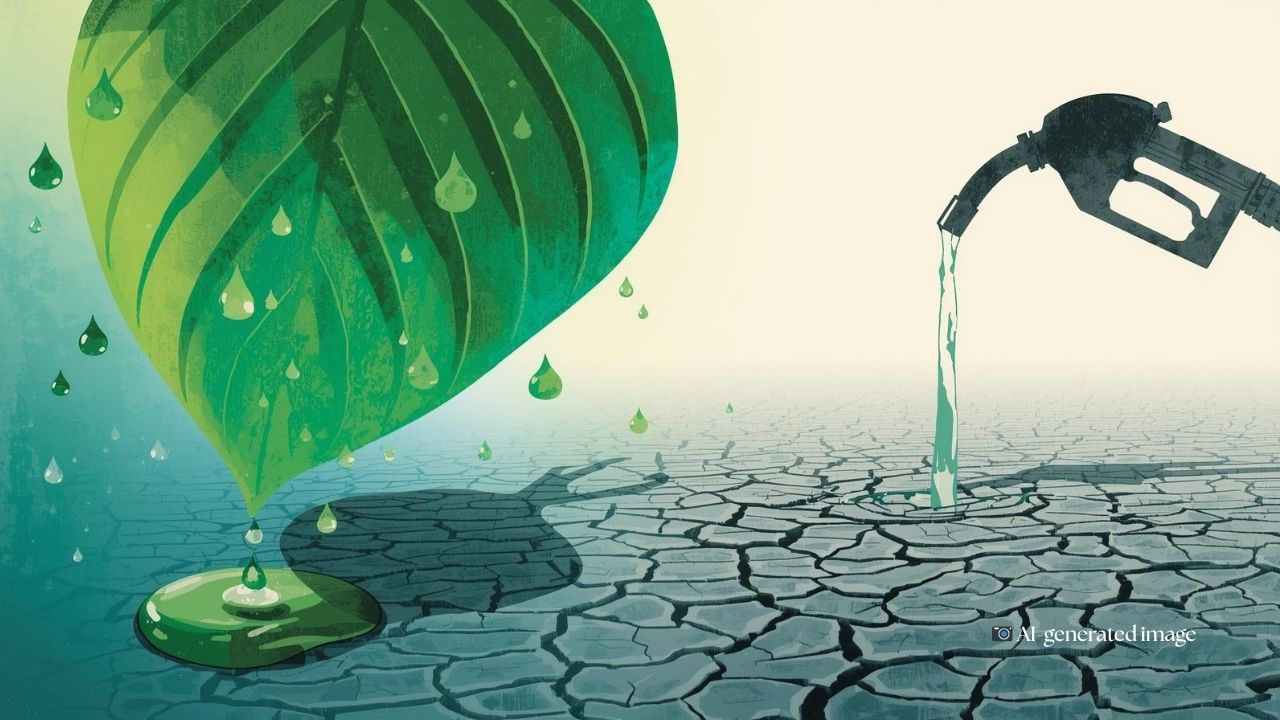
India’s aggressive push toward ethanol-blended fuel, often framed as a cleaner alternative to fossil fuels, is raising a different kind of environmental concern: water stress.
The debate has gained urgency after Union Minister Nitin Gadkari reiterated that petrol and diesel vehicles have no long-term future in India, signalling a strong policy tilt toward alternative fuels, including ethanol-blended petrol. But as the country accelerates toward this transition, questions are emerging about its unintended consequences.
Read More | Nitin Gadkari: “No Future for Petrol & Diesel Vehicles in India”
Ethanol Blending: A Clean Solution with Hidden Costs?
Ethanol blending involves mixing ethanol—a plant-based alcohol—into petrol to reduce dependence on imported crude oil. India has been rapidly scaling this programme, positioning it as a step toward cleaner mobility and energy security.
However, the environmental trade-offs are becoming harder to ignore.
“Ethanol blending can worsen India’s water crisis mainly because most of the raw material, sugarcane and increasingly maize, is extremely water-intensive to grow and process,” said Anjal Prakash, a contributor to the Intergovernmental Panel on Climate Change.
Read More | India’s EV Charging Infrastructure: What Needs to Change?
The Water Problem: Rice, Sugarcane, and Maize
At the centre of the issue are crops that already demand enormous amounts of water, rice, sugarcane, and maize. India is increasingly turning to rice as a feedstock for ethanol. The government allocated 52 lakh tonnes of rice for ethanol production in 2024–25 and is targeting 90 lakh tonnes for 2025–26. To support this, it plans to reduce the share of broken rice distributed through the public distribution system, redirecting supplies to distilleries.
But rice is among the most water-intensive crops in the country.
According to environmental experts, producing one litre of ethanol from rice requires around 10,790 litres of water. Most of this is consumed during cultivation, not processing. Growing just one kilogram of rice can take between 3,000 and 5,000 litres of water. The conversion math makes it worse: roughly 2.5–3 kg of rice is needed to produce one litre of ethanol, meaning the water footprint quickly exceeds 10,000 litres per litre of fuel.
Even alternatives are far from water-efficient. Maize requires about 4,670 litres of water per litre of ethanol, while sugarcane needs around 3,630 litres.
Read More | India’s Rare Earth Magnet Push: A Turning Point for EVs and Electronics?
Groundwater Under Pressure
This surge in ethanol production is unfolding against an already alarming water backdrop.
The NITI Aayog has warned that by 2030, groundwater levels in 21 major Indian cities, including Delhi, Bengaluru, and Chennai, could be critically depleted. At the same time, India’s ethanol production capacity has reached 1,822 crore litres, with a significant share concentrated in water-stressed states.
Maharashtra alone hosts facilities with a combined capacity of 396 crore litres, even as regions like Vidarbha and Marathwada continue to face acute water shortages. Similarly, plants in Uttar Pradesh and Karnataka rely on groundwater reserves that are already under strain.
“Several of the ethanol plants are located in sugarcane cultivating regions due to easy access to feedstock,” said Swathi Seshadri of the Institute for Energy Economics and Financial Analysis. “Years of sugarcane cultivation have already stressed the water tables in these regions, with ethanol production exacerbating the situation.”
Pollution Risks Add to Concerns
Beyond water consumption, ethanol production also generates wastewater, known as vinasse, which can contaminate surface and groundwater if not treated properly. This adds another layer of environmental risk to a programme that is otherwise marketed as sustainable.
Read More | Sustainability in Tech Infrastructure: A Mere Buzzword?
A Policy Contradiction?
For years, farmers in states like Punjab and Haryana have faced restrictions for over-extracting groundwater. Now, similar crops are being diverted at scale for fuel production under a green energy label. The contradiction is stark: crops once flagged for depleting water tables are now central to India’s clean fuel ambitions.
Read More | India’s Largest Tech Expo 2026 Ends on a High Note!
The Bigger Question
India’s ethanol blending programme is undoubtedly aligned with goals of energy independence and reduced emissions. But as it expands, the strain on water resources could become a defining challenge. With cities already on the brink of water scarcity, the question is not just about cleaner fuel, but whether the country can afford the environmental cost of producing it.