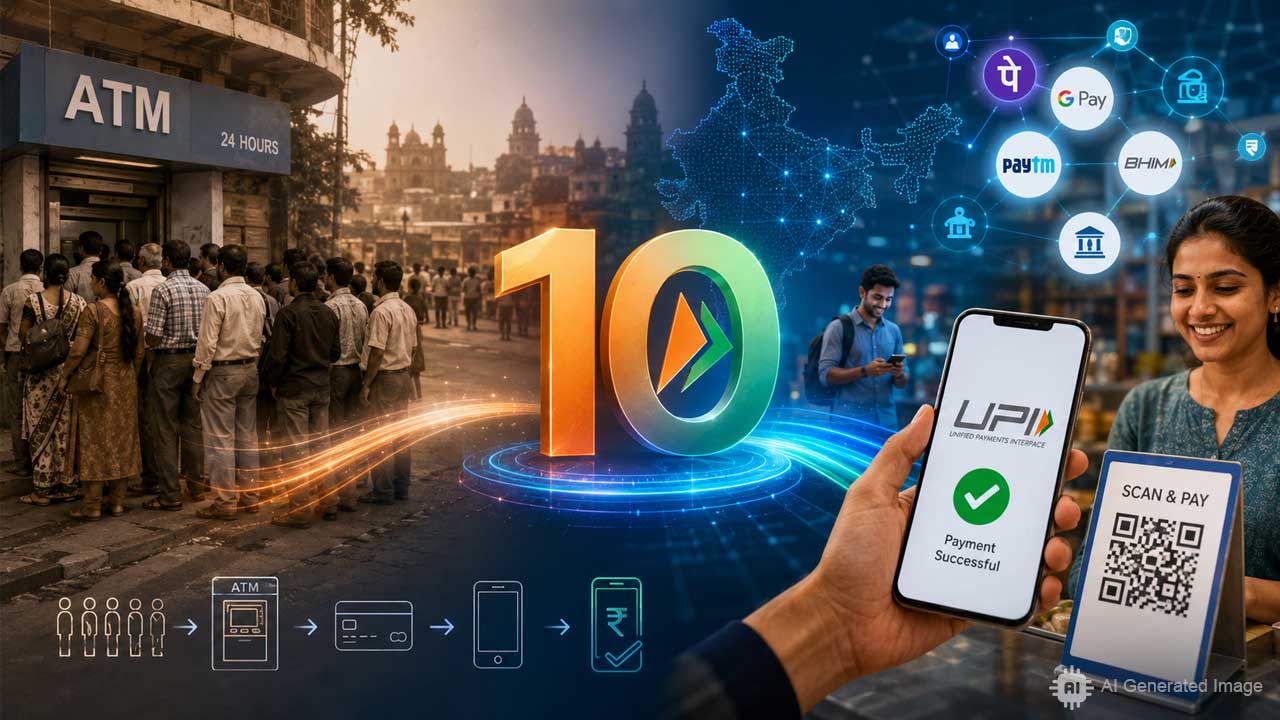
In 2016, I had just joined college. At the time, I could never have imagined that a payment system being developed in India would eventually become part of almost every ordinary transaction I made.
I remember paying my college fees, hostel mess bills and other expenses either in cash or by card. I remember going to ATMs for things that today take a few seconds on my phone. If I wanted to send money to someone, I usually had to think about bank details, cash or cards. That was the India I knew when the Unified Payments Interface, or UPI, arrived.
Ten years later, I find it difficult to imagine everyday life without it.
Read More | India’s SIM Card Limit Explained: Why the Limit Is 6 in J&K and Northeast
What started as a payment system developed by the National Payments Corporation of India (NPCI), under the regulatory framework of the Reserve Bank of India (RBI), has become a piece of digital infrastructure used at extraordinary scale. UPI completed a decade on August 25, 2026, and its numbers tell a remarkable story. Annual UPI transaction volume rose from 1.78 crore transactions in FY2016-17 to 24,162 crore in FY2025-26. Transaction value went from about ₹0.07 lakh crore to around ₹314 lakh crore.
But numbers alone do not explain what UPI changed. For me, the more interesting story is how India went from cash, cards and ATM queues to a system where a roadside vendor, a student, a large retailer and a multinational company can all use the same underlying payment network.
This is the story of how that happened.
2016: When UPI entered the picture
UPI did not appear out of nowhere. Before UPI, India already had systems such as NEFT, RTGS and IMPS. But the experience was not always simple for an ordinary consumer. Sending money could mean knowing an account number, IFSC code or other banking details. NPCI wanted to build something different: an interoperable system that could connect banks and allow people to move money through a mobile phone.
The UPI pilot was launched on April 11, 2016, with 21 member banks. It then went live for customers in August 2016. The first version introduced an important idea: the Virtual Payment Address, or VPA. Instead of sharing my bank account number and IFSC every time I wanted someone to pay me, I could use a UPI ID.
That sounds normal today. In 2016, it was a big change. UPI also brought together fund transfers, payment requests and merchant payments through a mobile interface. It was designed to work around the clock, rather than making digital payments feel like something tied to banking hours.
When I scan a QR code or enter a UPI ID, my payment app is only one part of the process. The request moves through the participating payment service providers and banks, while NPCI provides the interoperable network that helps route the transaction between the payer and beneficiary banks. That is the part most of us never see. We see a notification saying ‘Payment successful’.
Behind it, several institutions and systems have already done their jobs. Banks had to connect their systems. NPCI had to build and operate the common infrastructure. Payment apps had to make the experience simple enough for ordinary users. Regulators had to create the rules. Merchants had to accept it. And consumers had to trust it. The first month saw only about 90,000 UPI transactions.
2017: Demonetisation gives UPI a push
If 2016 was the beginning, 2017 was when UPI started getting noticed by a much larger part of the country. The demonetisation exercise in late 2016 had suddenly pushed digital payments into everyday conversations. People and businesses were looking for alternatives to cash, and UPI happened to be arriving at exactly the right moment.
For consumers, the attraction was obvious. I could send money directly from my bank account using my phone without carrying cash or remembering another person’s bank details. For merchants, it offered another way to accept payments without depending entirely on cash.
Read More | What Happens When You Get Rich and Let Technology Run Your Life?
Banks began joining the network in larger numbers. Consumer-facing payment apps started gaining traction. Registrations increased. Merchant acceptance began expanding. The government also backed the ecosystem through initiatives such as BHIM, which was launched in December 2016 as a simple UPI-based payments app.
By the end of FY2016-17, UPI had processed around 1.78 crore transactions. It was still tiny compared with today’s numbers, but the foundation had been laid. I think this was one of the most important stages of the journey because UPI was no longer just a technology experiment. People were beginning to use it.
2018: The QR code changes the street
There is one image I associate most strongly with India’s UPI revolution: the QR code. By 2018, UPI was moving beyond person-to-person payments and becoming a merchant payment system. A small printed QR code could turn almost any shop counter into a digital payment point.
The change was particularly important for small merchants. A QR code did not require a large card machine sitting on a counter. A shopkeeper could display a code and receive money directly into a bank account.
NPCI had already worked with international card schemes to develop common QR specifications, while banks were being asked to standardise their merchant UPI solutions. That helped solve one of the biggest problems in digital payments: acceptance.
I could have a payment app from one bank and pay a merchant using another bank. The merchant did not need to use the same app as me. That interoperability became one of UPI’s biggest strengths.
The launch of UPI 2.0 in August 2018 added more capabilities, including mandates, invoice-related features and overdraft account linking. UPI was beginning to look less like a new payment option and more like a common layer connecting India’s banking system.
2019: Building trust at scale
As UPI transaction volumes increased, banks and fintech companies had to work on reliability, authentication, fraud controls and customer support. This part of the story is less visible to me as a consumer, but it may be just as important as the QR code. A payment system cannot become part of daily life if people are constantly worried that their money will disappear, a transaction will fail, or a complaint will never be resolved.
UPI’s two-factor authentication model, bank-level controls and the wider security architecture helped build that trust. NPCI also introduced mechanisms for complaints and dispute handling through UPI-enabled applications.
Read More | What’s Really Inside Your Smartphone? The Technology Behind Today’s Most Powerful Device
Then came another important milestone. In October 2019, UPI crossed one billion transactions in a single month. That was a clear sign that the experiment had moved into the mainstream.
2020: The pandemic makes digital payments essential
For me, this is the chapter that best explains UPI’s social impact.
The COVID-19 pandemic changed the meaning of contactless payments almost overnight. When people were staying indoors, travelling less and trying to avoid unnecessary physical contact, money still had to move. Groceries had to be bought. Medicines had to be paid for. Rent had to be transferred. Bills had to be settled. Families had to support relatives who were living elsewhere.
At a time when people were sanitising groceries, parcels, door handles and even currency notes, handling cash could feel like another thing to worry about. UPI gave people a way to move money while staying apart.
For migrant workers and families separated by lockdowns, digital transfers also became an important way of sending and receiving money without travelling to a bank or ATM. I remember that period as the moment when digital payments stopped feeling like a convenience and started feeling like infrastructure.
The pandemic accelerated adoption among consumers who may not otherwise have tried digital payments. Merchants who had previously relied heavily on cash had another reason to accept them. Remote commerce grew, and UPI became part of the machinery that kept everyday transactions moving. Money had to remain fluid even when people could not.
Read More | Will India’s Data Centre Boom Create a New Noise Pollution Problem?
2021: UPI becomes part of everyday life
By 2021, UPI was no longer something I associated only with technology enthusiasts or online shopping. It had become part of ordinary life. I could use it to pay for groceries, transport, food, utility bills and countless small purchases. I could split a restaurant bill with friends without worrying about who had cash. This is where I think UPI’s real strength became clear. Its success was not built only on large transactions.
It was built on thousands of small ones. A cup of tea. A vegetable purchase. A cab ride. A monthly bill. A contribution to a family member. A payment to a local shop. The small-value transaction became the backbone of the ecosystem.
2022: UPI becomes digital public infrastructure
In 2022, UPI became part of India’s wider Digital Public Infrastructure. It worked alongside other digital building blocks such as Jan Dhan bank accounts, Aadhaar-based identity and verification systems, mobile connectivity, e-KYC, DigiLocker and the Account Aggregator framework.
The important idea was that these systems did not necessarily have to be owned by one company. They could work as interoperable layers. A private company can build a successful payment application. But an open and interoperable public infrastructure can allow multiple banks, fintech companies, merchants and consumers to participate. That helped create the network effect that eventually made UPI so difficult to ignore.
2023: From payments to financial inclusion
Once millions of transactions were taking place digitally, another possibility emerged. What if a digital payment could do more than simply move money? For small businesses, digital transactions could create a record of cash flow. A shopkeeper who previously operated largely in cash could start building a digital financial footprint.
That could potentially help with formalisation and access to financial services. This is where I think UPI’s impact becomes more interesting. A QR code on a small shop counter may look like nothing more than a way to accept ₹50 or ₹500.
But repeated digital transactions can create a record of business activity. That can support better visibility into cash flows and, where combined with appropriate consent-based financial systems, potentially improve access to credit.
So the UPI story was gradually moving from “How do I pay?” to “What can digital payments enable next?”
Read More | If a Humanoid Can Become a Monk, What Is Left That Only Humans Can Do?
2024–2025: UPI becomes an ecosystem
By 2024 and 2025, UPI was no longer developing around one single use case. It was becoming an ecosystem:
- UPI Circle introduced delegated payments, allowing a primary user to authorise another person to make payments within defined limits.
- RuPay credit cards were integrated with UPI, expanding the ways consumers could use the network.
- UPI Lite helped support smaller-value transactions, while UPI AutoPay made recurring payments easier.
- UPI 123PAY extended digital payments to feature-phone users, widening access beyond smartphones.
The system also began moving into areas such as credit lines, international payments and other financial services. Biometric authentication was another major area of development, with on-device biometrics and Aadhaar-based face authentication expanding the ways users could authenticate payments.
2026: Ten years later, the scale is difficult to comprehend
In FY2025-26, UPI processed 24,162 crore transactions worth around ₹314 lakh crore. UPI accounted for about 84% of India’s digital payment volume in that financial year and around 49% of global real-time payment transaction volume in 2025, according to government data.
The monthly numbers are even more striking. In July 2026 alone, UPI processed 2,366 crore transactions, its highest monthly volume in the decade so far. The value of those transactions reached about ₹29.88 lakh crore.
UPI has also moved beyond India’s borders. As of August 2026, the government said the system was operational across 11 countries, including Bhutan, Nepal, Singapore, the UAE, France, Sri Lanka, Mauritius, Qatar, Cambodia, Greece and the Maldives. The journey that began with 21 Indian banks has therefore become a global payments story.
But what actually happens when I make a UPI payment?
This is the part most of us never think about. When I scan a QR code, select a contact or enter a UPI ID, I am interacting with the front end of a much larger network.
My payment application connects me to the relevant payment service provider and bank. The transaction is routed through the UPI infrastructure. My bank authenticates and debits the payment, the beneficiary’s bank receives the funds, and the transaction status is returned almost instantly.
All of this happens in seconds. The clever part is that I do not need to know where every piece of the transaction sits. I do not need to know the merchant’s bank. I do not need to remember an account number. I do not need to know the IFSC code. I simply scan, check the name, enter the amount and authenticate.
That simplicity is the result of years of work by NPCI, RBI, banks, payment apps, technology companies, merchants and millions of users. The screen looks simple because the system behind it is not.
Read More | Top LLM Models for B2B Use in 2026: GPT-5, Claude, Gemini, Llama & More Compared
What comes next for UPI?
When I think back to myself in college in 2016, the biggest change is not simply that I now use my phone to pay. It is that I no longer think about paying as a separate activity. It has become almost invisible. I scan a QR code, enter an amount and move on, rarely stopping to think about the vast network working behind those few seconds. And perhaps that is the clearest sign of UPI’s success.
And the next decade could take UPI well beyond everyday payments. For me, the real test of UPI will be whether it can remain simple, free and reliable as it grows even bigger.
Ten years ago, UPI changed the way India pays. So, as the next ten years begin, how far can it change the way India lives, earns and participates in the digital economy?

Indrani Priyadarshini is a journalist and editorial professional specialising in technology, artificial intelligence, smart cities, green energy, and digital transformation. With over four years of experience in tech journalism and digital media, she is known for turning complex industry developments into clear, engaging, and insightful stories. Her expertise spans reporting, editorial strategy, digital publishing workflows, and in-depth coverage of emerging technologies shaping the future.