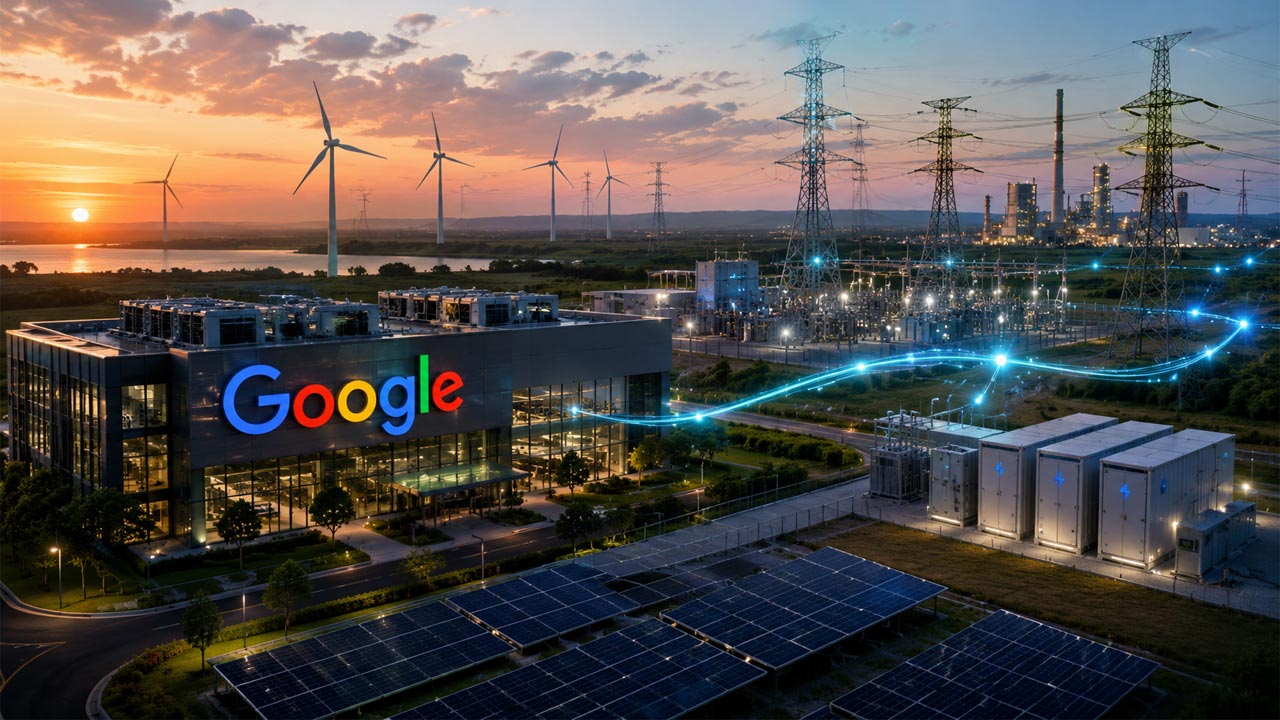
Google’s move to explore a direct electricity sourcing arrangement in Andhra Pradesh could mark the beginning of a broader shift in how global cloud and AI companies secure power in India, according to industry executives and analysts.
The proposal, centred on obtaining electricity directly from a state distribution company for large-scale data centre operations, has sparked discussion across the digital infrastructure and energy sectors.
Analysts say the model could encourage other hyperscalers, including Amazon Web Services (AWS), Microsoft Azure and Meta, to seek similar long-term, dedicated power arrangements as India’s AI infrastructure and data centre demand accelerates.
Also Read: Indian Solar Market Becomes World’s Second-Largest in 2025, Surpasses the US
Google’s Andhra Bid Puts Power Access in Focus
At the centre of this development is Google’s reported interest in a direct supply arrangement.
Andhra Pradesh’s power distribution ecosystem is ready to support the upcoming high-capacity digital infrastructure. While details remain under discussion, the move highlights a growing concern among large technology firms: securing uninterrupted, affordable and scalable electricity for AI workloads, cloud computing and data centre expansion.
Industry experts say hyperscale data centres consume vast amounts of electricity, often on par with small industrial clusters. As AI adoption rises, power demand from these facilities is expected to increase sharply over the next decade.
Also Read: Solar Storage Push Gains Momentum as Centre Urged to Extend Battery Subsidy for Rooftop Systems
Private Power Networks May Become the Next Big Trend
Experts in the energy and infrastructure sectors believe the ‘Andhra Pradesh case’ could become a template for future agreements between technology firms and state utilities or private generators.
Instead of relying entirely on conventional grid supply, hyperscalers may increasingly pursue captive power, green energy corridors, open-access electricity and dedicated transmission arrangements.
The trend aligns deeply with India’s push towards renewable energy and the growth of digital infrastructure. Several states are competing to attract large data centre investments by offering land, connectivity and power incentives.
Analysts note that reliable electricity has become as important to data centres as fibre connectivity. A prolonged outage can disrupt cloud services, AI processing and enterprise operations across regions.
Also Read: India Enforces Domestic Solar Cell Rule for Government Projects, Industry Debates Cost Impact
What does it mean for India’s digital infrastructure push?
India is emerging as a major destination for AI infrastructure, cloud computing and hyperscale data centres. The trend is driven by rising internet usage, enterprise digitisation and government-backed digital initiatives. If large technology firms begin securing bespoke power networks, it could reshape both the power sector and the data centre market.
For utilities, such deals may bring stable long-term demand from creditworthy global clients. Hyperscalers offer greater control over costs, reliability and sustainability targets.
The development in Andhra Pradesh is being closely watched by both the energy sector and the digital infrastructure industry. If the model gains traction, India could see a new wave of integrated power-plus-data-centre partnerships, particularly in states positioning themselves as AI and cloud hubs.

Samarjit Kaur is a journalist and communications professional covering technology & emerging digital trends. With a focus on clarity and context, she reports on developments shaping industries and governance. When not reporting, she chooses to plug-in and relax on her playlists and plan her next bucket-list trips!