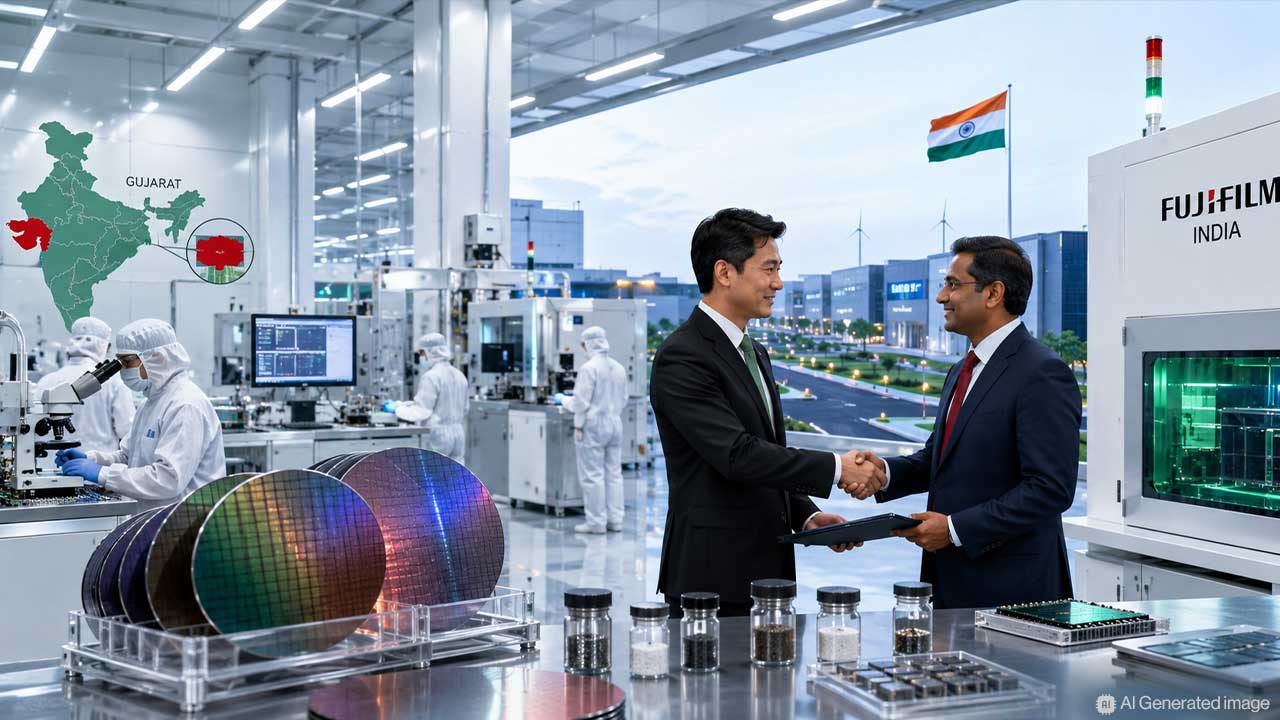
Japan’s Fujifilm India has signed a Memorandum of Understanding (MoU) with the Government of Gujarat to examine the possibility of manufacturing semiconductor materials within the state. This marks a step forward in India’s efforts to build a stronger domestic chip supply chain.
The agreement comes at a time when India and Japan are deepening cooperation across semiconductors, critical minerals and advanced manufacturing. Rather than announcing a manufacturing plant, the MoU focuses on assessing the commercial and technical feasibility of producing semiconductor materials locally. If the study moves ahead, it could reduce India’s dependence on imports for a key part of semiconductor production.
Also Read: India Semiconductor Mission 2.0 Moves Closer as ₹1.25 Lakh Crore Plan Gets Finance Panel Approval
Study to assess local manufacturing potential
The feasibility study will evaluate the demand, infrastructure, investment requirements and supply chain needed to manufacture semiconductor materials in Gujarat. Fujifilm is recognised globally for supplying advanced materials used in semiconductor fabrication, including photoresists, chemical-mechanical planarisation (CMP) slurries and other speciality chemicals essential to chip production.
India has been pushing to develop a comprehensive semiconductor ecosystem rather than focusing solely on chip fabrication. Industry experts say the availability of materials, chemicals and equipment will be equally important if the country wants to establish a reliable manufacturing base.
The Gujarat government has emerged as a major destination for semiconductor investments, with several projects already announced under India’s semiconductor programme.
Also Read: Japan PM Sanae Takaichi’s India Visit: AI, Semiconductors & Critical Minerals On Agenda
Move aligns with wider India-Japan technology partnership
The development coincides with Japanese Prime Minister Sanae Takaichi’s visit to India, where semiconductor cooperation, critical minerals, AI and economic security feature prominently in bilateral meetings.
Both countries are working to strengthen resilient technology supply chains amid growing global demand for chips. Critical minerals required for semiconductor manufacturing are also expected to be a major area of collaboration.
India has been accelerating investments in semiconductor manufacturing through government incentives to attract global companies across the chip value chain. The strategy extends beyond fabrication facilities to include packaging, testing, materials and component manufacturing.
For Fujifilm, the Gujarat study could help determine whether India offers the right conditions for long-term production of semiconductor materials as the country’s electronics manufacturing sector continues to expand.
Also Read: India May Need $80 Billion in Incentives by 2035 to Build a Global Semiconductor Ecosystem
What it means for India’s semiconductor ambitions?
While the MoU does not promise a manufacturing facility, it highlights the increasing confidence of global players in India’s semiconductor ecosystem.
Local production of semiconductor materials would strengthen supply chains, support future chip plants and reduce reliance on overseas suppliers.
As India stands out as a global electronics manufacturing hub, partnerships with established Japanese technology companies are expected to play an important role in building a more comprehensive and resilient semiconductor industry.

Samarjit Kaur is a journalist and communications professional covering technology & emerging digital trends. With a focus on clarity and context, she reports on developments shaping industries and governance. When not reporting, she chooses to plug-in and relax on her playlists and plan her next bucket-list trips!