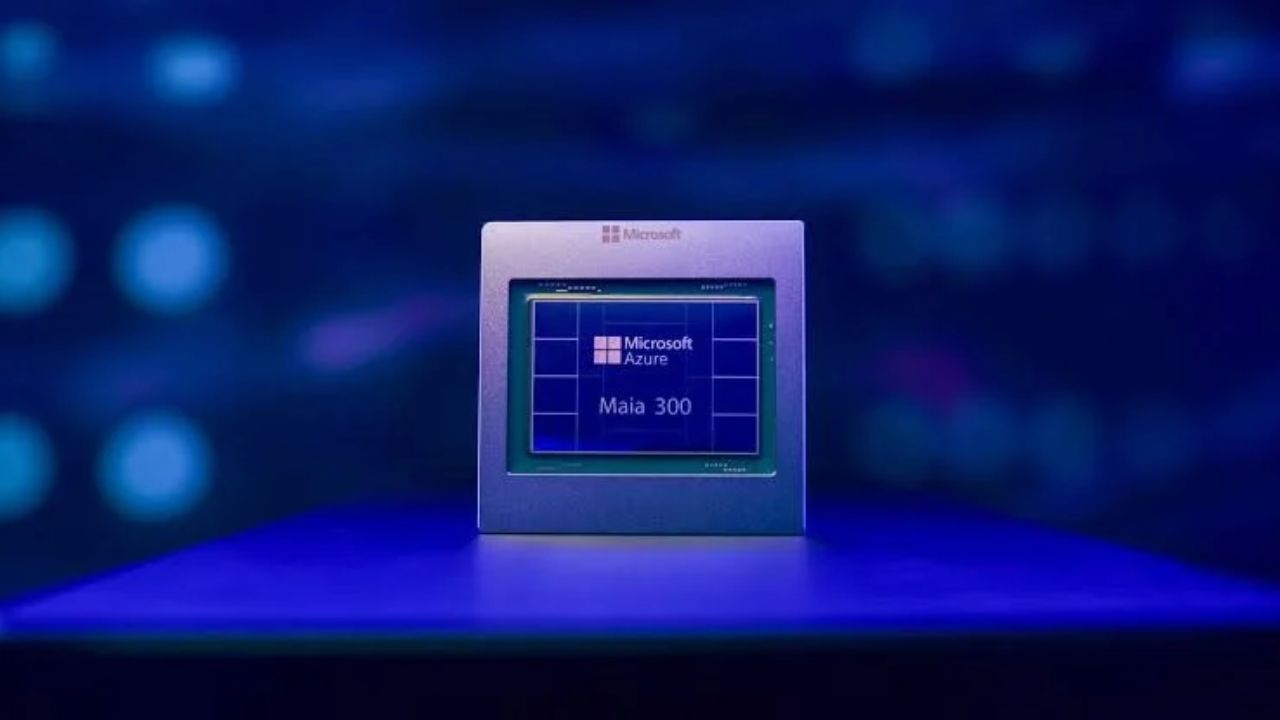
Microsoft is expanding its in-house AI chip programme, with plans to scale its Azure Maia family to multi-gigawatt deployments from 2027. The company aims to make Maia its primary inference system for Microsoft products and services, reducing the cost and power needed to run AI workloads at scale.
The announcement also introduces Azure Maia 300, Microsoft’s next-generation AI accelerator, which is expected to deliver 40% more tokens per watt than leading GPU-based systems. The chip is designed to handle demanding AI tasks, including long-context reasoning, conversational AI and multi-step tasks carried out by AI agents.
Microsoft’s move reflects the growing importance of specialised chips as AI services expand. Running large AI models requires significant computing power, memory and electricity. Developing its own silicon gives Microsoft greater control over how its hardware, software and AI models work together.
Microsoft Maia 200 is already powering AI services
Microsoft has begun deploying Azure Maia 200 across the United States, Europe and Australia. The chip is already handling production workloads, including Microsoft Copilot, and supporting the company’s MAI team in developing its next-generation AI models.
According to Microsoft, Maia 200 delivers up to 1.7 times more tokens per watt for built-in AI features across Microsoft Teams, Copilot and Cowork experiences compared with leading GPU infrastructure.
Read More | Microsoft Doubles Down on India With Massive $17.5 Billion AI & Cloud Plan
Tokens are the units of text or other data that AI models process and generate. Measuring tokens per watt helps assess how efficiently a system runs AI workloads. Higher efficiency can help reduce electricity use and operating costs while allowing cloud providers to serve more users.
Microsoft plans to extend Maia’s use to more services. GitHub Copilot and Microsoft Foundry are expected to follow by the end of 2026, while the company’s Dragon Copilot platform is among the services that could benefit from more efficient AI infrastructure.
The Maia programme supports a range of models, including OpenAI models, Microsoft’s own MAI models and leading open-source models. This allows Microsoft to use its chips across different AI services rather than relying on a single model family.
Azure Maia 300: What makes Microsoft’s new AI chip different?
Azure Maia 300 is designed for the demands of modern AI inference. Inference is the process through which a trained AI model generates responses, produces content or completes a task when a user or application sends it a request.
As AI applications move beyond simple question and answer interactions towards longer conversations and autonomous, multi-step tasks, inference systems need to manage larger amounts of information efficiently.
Microsoft says Maia 300 is designed to improve performance by balancing computing power, memory bandwidth, networking and energy consumption. In a rack containing 96 accelerators, the company expects the system to deliver up to seven times the rack-scale token throughput of Maia 200.
The chip’s design focuses on several areas:
Improved data movement: Maia 300 uses a software-defined dataflow architecture and AI-assisted kernel optimisation to reduce unnecessary data movement and make better use of computing and memory resources. This matters because moving data between components can become a major bottleneck in large AI systems.
High memory bandwidth: The chip uses eight stacks of HBM4, a type of high-bandwidth memory designed for demanding computing workloads. Microsoft lists peak memory bandwidth of 18 terabytes per second within a 950-watt thermal design power (TDP). This is intended to help the chip handle large AI models and long-context requests more efficiently.
Chiplet-based design: Maia 300 separates computing, memory-controller and input/output functions across multiple chiplets. Its compute chiplets use TSMC’s N2P manufacturing process, with the aim of improving performance per watt and supporting efficient scaling.
Read More | Microsoft Flags Copilot AI as ‘Entertainment Only’, Warns Users to Verify Outputs
Support for larger AI contexts: The chip supports advanced low-precision formats, including enhanced MXFP4. These formats can reduce the memory and bandwidth needed to run models and store the information required to maintain a conversation. This can help systems process longer contexts and serve more requests within the same power limits.
Networking designed for AI workloads: Maia 300 uses high-bandwidth connections between accelerators and a custom AI transport system built on Ethernet-based networking infrastructure. This approach is designed to help accelerators exchange information efficiently, from a single rack to larger data centre deployments.
Maia 300 rack systems target higher AI performance
Microsoft’s Maia 300 rack configuration combines 96 accelerators within a 167-kilowatt power envelope. The system provides 27.6 terabytes of HBM capacity and aggregate memory bandwidth of 1.7 petabytes per second.
Read More | Microsoft Hyderabad Data Centre Goes Live, Expanding Cloud & AI Capacity
This configuration is designed to handle more simultaneous AI requests and larger workloads within each rack. For Microsoft, that could help increase the capacity of its data centres without relying solely on adding more computing infrastructure.
The focus on performance per watt is also important as AI demand grows. More efficient hardware can help cloud providers manage electricity consumption, make better use of available data centre capacity and control the cost of expanding AI services. Microsoft expects Maia 300 to begin production deployments in 2027.
Why Microsoft is investing in its own AI chips
Microsoft’s investment in Maia is part of a broader effort to develop AI infrastructure that combines custom silicon, software, networking and cloud services. Building specialised chips allows the company to design hardware around the workloads its services actually run. It can also optimise how its models use memory, computing resources and power, rather than relying entirely on general-purpose GPU systems.
However, Microsoft’s strategy does not mean that one chip will power every AI workload. The company says its infrastructure approach will continue to support different models, hardware platforms and technologies from across the wider ecosystem.
Read More | Microsoft Develops Wearable AI Device Designed for Workplace Productivity
With Maia 200 already running production workloads and Maia 300 planned for 2027, Microsoft is building towards a larger role for its own silicon in AI inference. The longer-term goal is to make AI services more efficient and scalable as businesses adopt systems that can reason, interact with applications and complete multi-step tasks. For Microsoft, the success of Maia will depend not only on chip performance but also on how effectively the hardware works with its AI models, cloud infrastructure and software products.

Indrani Priyadarshini is a journalist and editorial professional specialising in technology, artificial intelligence, smart cities, green energy, and digital transformation. With over four years of experience in tech journalism and digital media, she is known for turning complex industry developments into clear, engaging, and insightful stories. Her expertise spans reporting, editorial strategy, digital publishing workflows, and in-depth coverage of emerging technologies shaping the future.