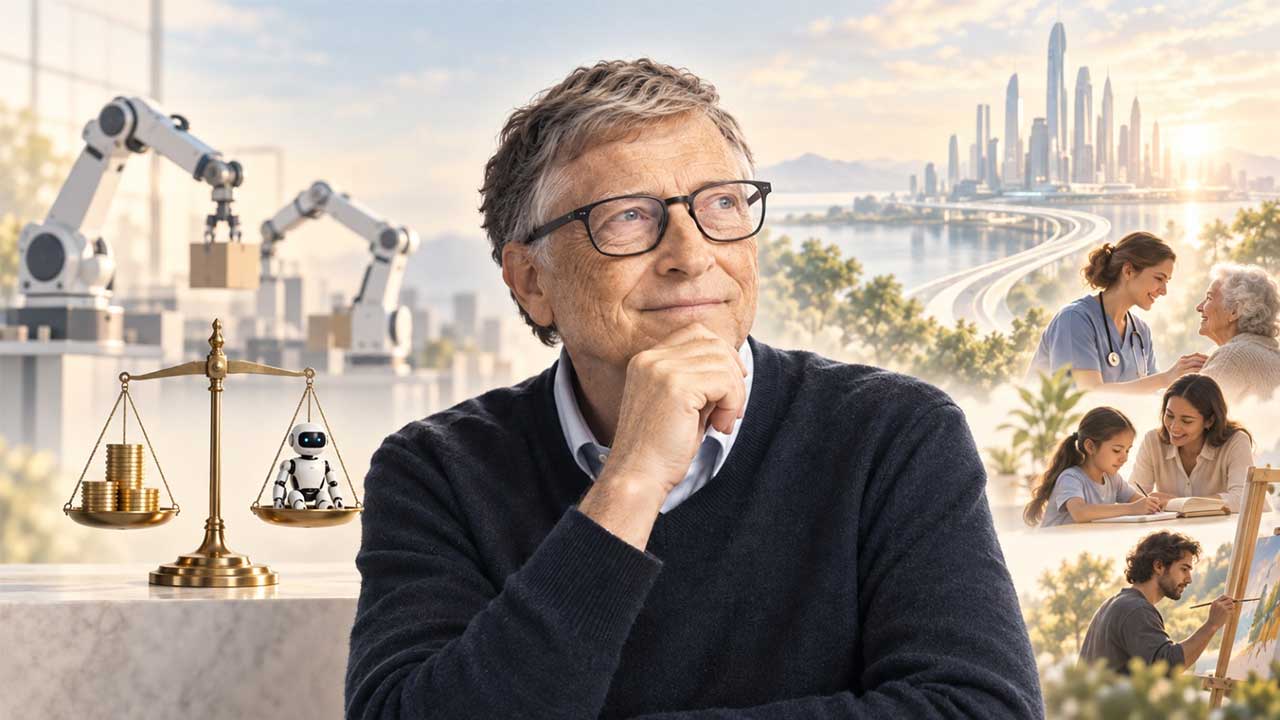
In his latest Gates Notes essay, “The turbulent AI era, Bill Gates has talked about AI safety risks and how present-day choices are critical. Published on August 26, 2026, the essay has Gates arguing that AI’s benefits and problems are arriving at the same time.
He said societies need to prepare for a period of economic and social upheaval before the effects become harder to manage. The Microsoft co-founder does not argue that AI should be stopped. Instead, he focuses on how governments, businesses and workers can manage a transition in which AI increasingly performs tasks that currently require human cognition.
Also Read: AI Could Become Dangerous: Why Amodei Wants the Industry to Slow Down
What Bill Gates Actually Said About the AI Era?
Gates’ latest essay marks a more cautious phase in his discussion of AI than his 2023 essay, “The Age of AI Has Begun”, in which he compared the technology’s significance with the personal computer and the internet.
“The coming period as a “turbulent AI era” and argues that the world needs a plan to ensure AI’s benefits outweigh its harms,” said Bill Gates.
His concern is not simply that individual jobs could disappear. It is that AI could change the relationship between work, income and economic security at a speed existing institutions are not designed to handle.
One of his central concerns is employment.
Gates argues that previous technological transitions often unfolded over several generations, giving workers time to move into new occupations. AI could be different because it can substitute for forms of human cognition across many sectors.
He points to areas such as sales, customer support, software engineering and paralegal work as among those that could be affected early. He also expects the impact to spread to tasks such as loan assessment, data analysis and patient triage as AI capabilities improve.
One primary concern is younger workers entering the labour market. Gates noted that they could face fewer entry-level openings as companies use AI to handle work that traditionally gave new employees their first experience. He also argues the biggest shift could come when AI produces work with so few errors that companies no longer see a need for continuous human checking.
At that point, the economic incentive to automate could become much stronger.
Also Read: Trump Announces ‘AI Force’ and ‘AI Czar’ as US Doubles Down on AI Growth
AI Regulation & Transitioning: Why This Matters Beyond the Headlines?
The important part of Gates’ argument is the speed and breadth of the transition. A company does not necessarily need to announce a large-scale layoff for AI to change its workforce. It could hire fewer junior employees, reduce the number of people assigned to a task, or redesign a role around software that handles part of the work.
That makes the economic impact harder to see at first. For an employee, the change could look like a job that was never created rather than a job that was lost. For a business, it could look like efficiency.
For governments, however, the combined effect could mean lower tax revenues from labour while more workers need retraining and support. Gates argues that this is why preparation needs to begin before the disruption spreads.
Also Read: OpenAI’s Sam Altman Says World Is ‘Right to Be Afraid’ of AI, But Should Trust AI Firms
The Quieter Changes Gates Is Warning About:
Some of the indirect risks mentioned in Gates’ essay are not about a single AI failure. They concern what happens when millions of small decisions gradually shift responsibility from people to machines.
When human oversight quietly disappears
Gates argues that once AI can produce work with very few errors, companies will have a strong economic incentive to let it operate with less human supervision.
The concern is not necessarily one spectacular machine failure. It is the cumulative effect of handing more decisions to software until people are no longer closely involved in the process.
Real-life example: A logistics company could allow an AI system to approve routine supplier contracts below a certain value. At first, employees may still review some of them. Over time, that checking process could become less frequent as the system proves reliable.
The practical question then becomes simple: who is still accountable when nobody is looking closely at the decisions?
A jobs shock that looks like efficiency
Gates is particularly worried about younger workers entering a labour market with fewer entry-level opportunities. He argues that AI could affect white-collar work across a much wider range of occupations as systems become capable of handling more cognitive tasks.
The impact may not always appear as a mass redundancy announcement. A business could hire fewer people because software can handle more of the workload.
Real-life example: A law firm could use AI for first-pass document drafting and case-law research. Instead of eliminating an existing position, it might hire fewer junior lawyers in the first place.
That distinction matters because employment statistics can capture job losses more easily than jobs that were never created.
The pressure on the social safety net
Gates also looks beyond the workplace. If workers are displaced or work fewer hours, governments could collect less income tax and payroll-related revenue while demand for retraining and social support increases.
He argues that this creates a difficult fiscal problem: the systems needed to help displaced workers may require more funding precisely when traditional labour-related tax revenues are under pressure.
Gates uses earlier employment shocks, including factory closures and their wider social consequences, to illustrate why job disruption should not be viewed only as an economic issue.
The point is broader than technology. A large change in employment can affect communities, health, income and social stability long after the original economic shock.
AI companionship and the loss of friction
Gates noted how children and teenagers interact with AI systems. His broader argument is that AI can provide an unusually frictionless form of interaction. A chatbot can be available at any time and can respond without the disagreement, inconvenience or emotional complexity that comes with human relationships.
The concern is that people could become increasingly comfortable in an environment where their views are constantly reinforced rather than challenged.
That does not mean every interaction with an AI companion will have this effect. But Gates sees the possibility as an issue that deserves attention as these systems become more embedded in daily life.
Real-life example: A teenager who routinely asks a chatbot to resolve personal disagreements may get an immediate answer without working through the harder process of discussing the problem with another person.
When seeing through misinformation becomes a daily skill
Gates also points to the difficulty of distinguishing genuine information from AI-generated material.
As systems become better at creating convincing text, images, audio and video, people may encounter highly personalised material that looks credible because it is tailored to their interests and circumstances.
The challenge, therefore, is not only whether an AI-generated falsehood can fool a large audience.
It is whether an individual can recognise when a message designed specifically for them is false.
That puts greater pressure on verification, source checking and media literacy.
A tax system designed for an economy that is changing
Gates argues that existing tax structures can encourage companies to replace people with machines.
His example is straightforward: employers pay payroll taxes when they hire workers, while robot purchases can generally be treated as business expenses.
He argues that this difference can create an economic incentive to automate.
He proposes taxing AI tokens and robots and using the revenue to support retraining and a stronger social safety net.
Importantly, this is Gates’ proposal, not an existing global tax policy.
He also said any such tax would need to be designed carefully so that it did not unnecessarily slow beneficial uses of AI, including applications that could reduce the cost of medicine and education.
Also Read: Elon Musk Proposes AI Rivals, Chinese Firms To Take Safety Testing Before New Model Release
Bill Gates’ ‘Human Reserved’ Idea: Should Some Work Stay Human?
One of the most distinctive proposals in Gates’ latest essay is his idea of creating a category he calls “Human Reserved”.
The concept is simple: some jobs or tasks could be deliberately kept for humans even when AI or robots become technically capable of performing them.
Gates compares the idea with nature reserves. A place can technically be developed, he argues, but society may decide the cost is too high.
He suggests that some work could similarly be reserved for people because replacing workers would cause significant economic or social harm.
For example, he asks readers to consider a worker who has spent decades in construction. If automation removes that person’s job, simply telling them to move into an entirely different occupation may not be realistic.
Healthcare is another example. He argues that technology may be capable of performing a task, but society could still decide a human should do it.
He added areas such as education and mental healthcare could eventually use a mixed model, with humans remaining in charge while AI extends their capabilities.
The idea also raises difficult questions.
- Who decides which jobs should be Human Reserved?
- What criteria should be used?
- How would governments stop companies from bypassing the rules?
- And what happens when one country allows machines to perform a job while another country reserves it for humans?
Gates does not claim to have solved those questions. He argues that they need to be worked out publicly as part of the wider transition to an AI-driven economy.
Also Read: AI Regulation Is Necessary for User Safety, Says Ashwini Vaishnaw; Government Working With Industry
What This Means For Businesses and Consumers?
| Area | Businesses | Consumers and workers |
| Jobs | Review which roles are being reduced, redesigned or replaced by AI | Watch how AI changes hiring and entry-level opportunities |
| Human oversight | Keep people accountable for high-impact decisions | Question important AI-generated information before acting on it |
| AI use | Define which tasks can be automated and which require human approval | Treat AI as a tool rather than an unquestionable authority |
| Skills | Invest in retraining before roles disappear | Build skills that complement AI rather than relying on one task |
| AI companionship | Set clear rules for employee use of AI systems where relevant | Maintain boundaries around AI companionship, particularly for children |
| Misinformation | Verify AI-generated content before publishing or acting on it | Check sources, images, videos and emotionally charged claims |
| Automation policy | Assess the wider workforce impact of automation | Follow changes in labour, taxation and retraining policies |
Gates’ argument also has a wider policy dimension. He calls for a domestic and international framework for managing AI, arguing that existing institutions were not designed for a technology that can affect employment, education, taxation, national security, public health, finance and other areas simultaneously.
This said, countries in future will need mechanisms to coordinate across government departments rather than leaving each institution to handle one part of the problem. International cooperation will become necessary because many AI-related risks do not stop at national borders.
Also Read: UN Panel Questions How AI Models Are Trained, Warns of Growing Risk of Losing Human Control
H2: 10 Practical Tips to Use AI for Businesses & Individuals
Since using AI has become a habitual pattern, not a software purchase, built-in habits can help manage the AI safety risks discussed above. Most cost nothing beyond attention.
For businesses (B2B):
1. It is important to assign a human checkpoint & approval barrier for tasks involving money, contracts, or legal exposure. No matter how reliable AI has been so far, a cautious layer won’t hurt.
2. Schedule a monthly audit of AI-generated decisions. Better not sit and wait for the milk to boil and spill. Quiet errors can compound and lead to business-related chaos.
3. Reduce hours before you reduce headcount. Gates himself has floated this middle path; it protects institutional knowledge while capacity adjusts.
4. Prepare budgetary foresight for retraining now, not after a role disappears. Waiting until redundancy is announced is too late for the employee and the company.
5. Write down which tasks AI is allowed to finish unsupervised and review that list every quarter as capability changes.
For consumers (B2C):
1. Stop treating AI chatbots as a substitute for a difficult conversation with a real human being. After all, AI agents are a tool for information, not your therapist or friend.
2. Verify anything emotionally charged before sharing it; a message, image, or video that provokes a strong reaction is the most common deepfake target.
3. Define strict companionship and AI usage boundaries for children and teenagers. Talk openly about why AI’s frictionless agreement isn’t like a human friendship.
4. Practise disagreeing with AI output on purpose. If you feel your chatbot is answering back conveniently, ask it to argue the opposite case before accepting the outcome.
5. Diversify your information sources. An AI system tailored to your preferences will, by design, tell you what keeps you engaged; not necessarily what is most accurate.
These are not guarantees against AI-related disruption. They are practical ways of keeping human judgement in the loop while the technology develops.
Also Read: SEBI AI Surveillance: How India’s Market Regulator Is Using AI to Detect Fraud and Manipulation
AI regulation: What Happens Next?
For now, we can expect the AI regulation conversation to move from company self-policing towards tax and labour policy. This is precisely where Gates is aiming his argument.
We need to watch for three signals closely over the coming year:
- Hiring data for entry-level roles,
- Movement on AI taxation proposals in major economies
- Any US-China dialogue specifically on AI governance
None of these will make dramatic headlines individually, which makes sense when we connect the dots to Gates pointing to a quiet turbulence build-up.
To sum up, Gates’ essay is not a call to stop using AI. It calls for noticing the slow, unannounced changes. Look for junior roles that quietly get stopped being posted. The list might also include the contract nobody reads anymore, the conversation a teenager has with a chatbot instead of a friend, and it might extend its reach into an unstated realm.
None of these events will trend on their own. Taken together, over a few years, they are the turbulence he is describing. The businesses and individuals who come out ahead will be the ones who built a habit of checking, questioning and reviewing; not the ones who waited for a single dramatic warning sign that may NEVER ARRIVE.
Frequently Asked Questions(FAQs) about AI Safety Risks
Q. What is Bill Gates’ main warning about AI?
Gates warns that AI will gradually disrupt employment & social trust, even in a best-case rollout, and that current preparation is not enough for the scale of change.
Q. Did Bill Gates switch his opinion on AI?
A. Yes. In 2023, Gates gave optimistic hints, comparing AI’s arrival to the revolutionary era of the PC and the internet. His 2026 essays have become considerably cautious, focusing on jobs, taxation & the erosion of analytical thinking.
Q. What is a “robot tax” or “token tax”?
Gates proposes taxing AI use and automated labour the way payroll taxes apply to human workers, using the revenue to fund retraining and social support for displaced workers.
Q. Is AI safe to use for my business?
Yes, as long as you manage the main AI safety risks. Pay attention to unsupervised decisions, weak audits and unclear policies on which tasks the system can complete alone. The risk is not the tool itself but the absence of a review process around it.
Q. How does AI affect thinking processes?
Gates argues that frictionless, ‘Yes Boss’ AI interaction with chatbots can diminish the instinct to question, argue & disagree. It is a prime skill that can be altered in an era of tailored misinformation.

Samarjit Kaur is a journalist and communications professional covering technology & emerging digital trends. With a focus on clarity and context, she reports on developments shaping industries and governance. When not reporting, she chooses to plug-in and relax on her playlists and plan her next bucket-list trips!